
My Boss Asked Me to Work Overtime for Free. I Clocked Out at 6:01 PM.
Overtime pay is not a favor. It is a debt written into law. And I am done letting companies pretend otherwise.
Without Overtime Pay, Why I Refuse to Work Overtime
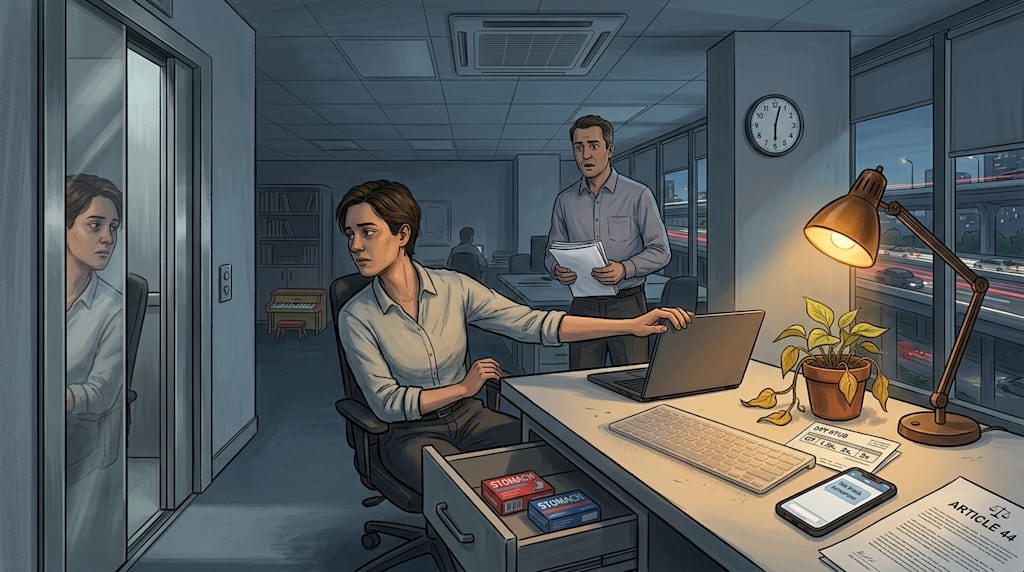
It was 8:57 p.m., and three people were still in the office.
The central air conditioning had been turned off. The vent let out a muffled thud now and then. My manager came out of the meeting room with a few printed pages, walked to my desk, and said, “Revise this proposal tonight. I need it tomorrow morning.”
I asked, “Does this count as overtime?”
He said, “Just put in some extra effort.”
I asked again, “Is there overtime pay?”
He said, “No.”
I took my hands off the keyboard. The cursor kept blinking. Outside, car lights on the elevated highway formed a line: red, white, red, white. I closed my laptop and said, “Then I’ll come in early tomorrow morning.”
He glanced at me and said nothing.
I clocked out at 18:01.
In the elevator, my phone lit up. My manager had sent: “We’ll talk tomorrow.”
I replied: “Okay.”
Some people will say it is just overtime. It is not just overtime.
Overtime pay is not a favor. It is a debt written into law.
Article 44 of the Labor Law states that when an employer arranges for an employee to work extended hours, it shall pay no less than 150 percent of the employee’s wages. When work is arranged on a rest day and no compensatory rest can be arranged, it shall pay no less than 200 percent. When work is arranged on a statutory holiday, it shall pay no less than 300 percent.
These words are not decoration.
Do the math. Suppose the monthly salary is 8,000 yuan. The daily wage is 8,000 divided by 21.75, which is about 367.8 yuan. The hourly wage is that divided by 8, which is about 45.9 yuan.
Two hours of overtime on a workday: 45.9 times 1.5 times 2, about 137.9 yuan.
Eight hours of overtime on a rest day: 45.9 times 2 times 8, about 735.7 yuan.
Eight hours of overtime on a statutory holiday: 45.9 times 3 times 8, about 1,103.5 yuan.
That money is rent, baby formula, parents’ medicine, the sleep you should have caught up on over the weekend, the meal you promised to have with your family. When the company says “No,” it is not saving money. It is taking that money out of your pocket.
I have seen many people stay.
Not because they were willing. Because they did not dare leave.
Once, at 6:05, I was packing my bag. The colleague next to me whispered, “Wait a bit longer. The manager hasn’t left yet.” I sat back down and put my bag on the chair. At 7, the manager left. The colleague said, “Let’s go.” We got into the elevator together. Neither of us mentioned overtime pay.
The next day, neither of us mentioned it. The day after that, neither of us mentioned it.
Later, leaving at 6 became the exception. Leaving at 7 became normal. The stomach medicine in my drawer went from one box to two. No one watered the pothos in the break room. Three leaves turned yellow. A layer of dust settled on the keyboard cover. No one wiped it.
Unpaid overtime does not argue with you. It slowly turns abnormal into normal.
One person stays. Then two. Then everyone stays. The company saves on overtime pay. Employees lose their evenings. If you leave on time, you look like you are not hardworking. If you ask about overtime pay, you look like trouble.
But labor is not an unlimited resource. A person has only twenty-four hours a day. What the company buys is your labor within statutory working hours. It does not buy your entire life.
I was called back, too.
That night at 9:30, I was already home. I had showered, and my hair was still wet. My manager called: “There’s a data error. Come back.”
I went back and fixed it until 11:30.
The next day, I asked HR: “Is there overtime pay for last night?”
HR did not reply.
I asked my manager. He said, “No.”
I replied, “Work is tiring for me. I need to rest.”
Later, when attendance was calculated and wages were paid, I was not shortchanged.
This was not a big deal, but I remembered one thing: if you do not ask, the other side assumes you accept it. If you ask, at least they know you have boundaries.
I have seen someone win an arbitration. He kept two years of clock-in records, overtime approvals, and work group messages. In the end, he got a sum of money back. He used it to buy his daughter a piano.
This is an account.
If you are in a similar situation, you can consider doing this.
First, ask clearly at onboarding. Do not just ask, “Is there a lot of overtime?” Ask: “Is overtime compensated with time off or overtime pay? What is the calculation base? What is the approval process?” Put these in an email and have them reply. Words are more reliable than memory.
Second, keep evidence. Screenshots of clock-in records, overtime approval forms, work group messages, emails, file modification times, work submission records. Save them in WeChat favorites, forward emails to yourself, back them up in cloud storage. Do not think it is troublesome. This is your ledger.
Third, communicate about the issue, not the person. Do not say, “I won’t do it.” Say: “Is this overtime going to be time off or overtime pay? By what standard?” If it has been unpaid for a long time, say: “I can help with urgent tasks, but if there is no overtime pay and no time off for a long time, I may not be able to keep doing it.”
Fourth, do not endure endlessly. Helping out occasionally is kindness. Long-term unpaid work is exploitation. If the company refuses to pay for a long time, complain to labor inspection and apply for labor arbitration. The limitation period for arbitration is usually one year. There are special rules for pursuing labor remuneration during the existence of the labor relationship. The earlier you act, the better.
Fifth, acknowledge the value of your labor. You are not the company’s free battery. Your time has value. So do your health and your life.
That night, I turned off my computer. The time clock beeped once: 18:01.
I stepped into the elevator. My phone lit up. My manager had sent: “We’ll talk tomorrow.”
I replied: “Okay.”
The elevator doors closed. My face was reflected in the mirror, a little oily, a little tired. I put my phone in my pocket and thought, I’ll come in early tomorrow morning.
But tonight, I am going to rest.
See you tomorrow.
About the Creator
Jin
Writer of reamstories
https://reamstories.com/jin
Enjoyed the story? Support the Creator.
Subscribe for free to receive all their stories in your feed. You could also become a paid subscriber, letting them know you appreciate their work.
Comments
There are no comments for this story
Be the first to respond and start the conversation.