
My Boss Asked Me To Quit My $600k Job For His Startup — I Said "I'm Coming Later"
At 35, with a family, a mortgage, and aging parents, I had to choose between loyalty and stability. Here's what I actually did — and why I bought a bag of tangerines instead.
The private room in the Japanese restaurant had the air-conditioning set too low. When he sat down, his knee knocked against the table leg. The ceramic bowl wobbled but didn't tip.
His boss sat across from him, slid the menu over without looking at it, and called out a few dishes directly. The server noted them down and left. The door clicked shut. After that the room fell quiet except for the low hum of the exhaust fan overhead.
"Pressure's been mounting from upstairs," the boss said.
He nodded, filled both teacups. The cups were coarse pottery, rough to the touch. The tea came out dark. His boss didn't pick his up. Instead, he ran his index finger around the rim, leaving a faint wet trace on the clay.
"Chen and I—this time it's final."
Chen was the big boss. Nobody at the company called him that to his face, except the man sitting here now. His boss said it with a twitch at the corner of his mouth, like he was trying to smile. But his eyes weren't smiling.
"The way he runs things—it'll kill the company within three years. We went at it four times. I slammed the table in meetings. HR came in once to pull us apart." He took a sip of tea, set it down, and spun the cup again. "I'm done fighting. It's pointless."
He listened, his chopsticks resting on the holder, untouched.
"I'm striking out on my own." His boss finally looked up at him. "You come with me."
Those four words landed. He felt the muscles in his lower back tighten. The air-conditioning blew against his shoulder, cool and steady. He glanced out the window. The office building across the street still had most of its lights on, past nine o'clock. People still grinding away. He used to be one of them. Now he was the one sitting in a private room. But those four words pulled him right back.
"Boss," he heard himself say, steadier than he expected, "you know what you've done for me. Without you, I wouldn't be where I am."
His boss held his gaze, waiting.
"This is a huge decision. I need to talk it over with my family. Give me a week."
He paused, poured out the cold tea, and refilled both cups with hot water. Steam rose from the cups as he pushed his boss's back across the table.
"Whether I can come full-time or not—whatever you need in the early days, setting up the office, building the team, sorting out the workflow—I'm available weekends. Anytime."
His boss looked at him, said nothing, and picked up his chopsticks.
For the rest of the meal, he ate, he listened, and he counted. His boss named a few people—potential early partners, two engineers, one marketing guy. Named a figure, the rough size of the starting capital. Named a location, the industrial park east of the city, rent half of what they paid now. He filed it all away, didn't pull out his phone. Some details stuck: his boss said, "My son's got his high-school entrance exams next month," then paused, as if he'd let something slip, and added, "But that won't get in the way."
When the bill came, his boss grabbed it. Walking out of the restaurant, the night wind hit his collar and he shivered. His boss's car was parked at the curb, the designated driver already leaning against the door, scrolling on his phone.
"Think it over," his boss said, turning back before he got in.
"I will," he said.
He watched the taillights merge into the traffic stream. Stood there for a moment. Then turned toward the subway entrance. On the escalator down, he looked at the skincare ad on the opposite wall. The model had a perfect smile. He thought: next month's mortgage is due. The kid's summer camp fee isn't paid yet.
He got home at 10:30. The living room light was still on. His wife was curled up on the couch, phone in hand, the screen showing a page of early-education courses. He changed his shoes, hung up his coat, and sat down beside her.
"What's wrong?" she asked without looking up. But her tone had shifted. She always could tell.
He laid it out. When he got to "the boss wants me to quit and join his startup," she set the phone face-down on her thigh.
"Quit your current job?"
"Yes."
"Salary?"
"He can't match what I make now, at least not at first."
"Then how are we paying the mortgage?"
He didn't answer.
She sat up straighter. "You're thirty-five. Your son's school starts next month. That's thirty-two thousand. Your mom's checkup last month showed that nodule, she needs a follow-up. And you want to walk away from six-hundred-k a year to follow someone else's gamble?"
Her voice wasn't loud. But her words came twice as fast as usual. He knew that was her anxious mode. Whenever she got anxious, she'd list every number first, like lining up abacus beads to block the way.
"I didn't say I'm going," he said. "I said I wanted to talk it over with you."
"You've been with him for ten years. How can you say no when he asks? I know you. You can't."
He stood up and went to the kitchen for a glass of water. The refrigerator light flicked on, then off. He leaned against the counter and looked at her silhouette on the couch. She was still holding her phone, but the screen was dark. She was just gripping it.
"Listen," he said, walking back and crouching in front of her knees. "If I really wanted to go, I'd have said yes tonight. I didn't. I came home to talk to you. That means I'm hesitating."
She looked at him, a long look.
"What are you hesitating about?"
"...I don't want to let him down. And I don't want to let you down."
She didn't answer. After a long pause, she reached over, took the glass from his hand, and took a sip.
"Think it through yourself," she said. "If you go, I'll call my mom to come help with the kid, and I'll find a job. I'll handle the books. But you only get one shot. If we lose, we don't come back."
She wasn't looking at him when she said it. She was looking at the potted pothos on the coffee table. One leaf had turned yellow. She reached out and pinched it off.
That night, when he lay down, it was past midnight. She was turned away from him, breathing evenly. He knew she wasn't asleep. He stared at the ceiling in the dark, tracing the outline of the ceiling lamp. It had been there for four years. He'd never really looked at it at night before. It had six light sockets. One bulb was burnt out. Still not replaced.
Over the next week, he did several things.
First, he went back over the boss's career history—not the official version, but the fragments he'd picked up over ten years. Before coming to this company, the boss had spent seven years at a competitor, rising from manager to director. Then he jumped. Of the three old subordinates he'd brought over, two had already left. The third was still around but marginalized. The boss had always been an employee. He'd never started anything from scratch.
Second, he met up with an ex-colleague who'd left three years earlier to start his own company. Now running a twenty-person shop doing supply-chain software. Over lunch he asked, "Honestly, do you think Old X could pull off his own venture?" The guy chewed a piece of pork rib for a long time. Then he said, "Old X is a strategist—his own words. Strategists need budgets. For the first three years of a startup, there's no budget."
He nodded.
Third, through a headhunter friend, he quietly looked into the industrial park his boss had mentioned. Rent was indeed half price. Three companies had left in the last two years. None lasted past twenty-four months. One live-streaming e-commerce outfit remained, run by a guy named Zhou. The friend knew him. "Every day he posts on Moments: 'Persistence is victory.'"
He wrote all of this on a sheet of A4 paper. The back of one of his kid's homework pages, still with the grid lines showing. He drew a table: left column "Go," right column "Stay." Under "Go" he wrote three things: gratitude, equity promise, new possibilities. Under "Stay" he wrote seven. He read it twice, folded the paper, and put it in his desk drawer.
Friday evening, he met his boss again. This time he chose the place—a noodle joint under a residential building. The boss showed up in an old zip-up jacket, the collar a little pilled. He felt a small tug in his chest. The boss used to wear custom-made shirts at the office.
Two bowls of noodles arrived. He spoke first.
"Boss, I thought about it all week."
His boss stirred the noodles with his chopsticks. Didn't eat. Waited.
"My family's fixed costs right now—mortgage, school fees, insurance for both sets of parents. If I came aboard now, I'd be too anxious. And when I'm anxious, I mess up. That would just drag you down."
He pushed a handwritten sheet across the table. The list he'd put together over the week. Three potential client names, their current pain points, and who knew whom.
"These are connections I can bring. I'll send you a cleaned-up version of our internal SOP by next weekend. And if you need to build a sales team, I'll forward a few reliable people I know."
His boss looked at the sheet for a long time.
"You're not coming," the boss said.
"I'm coming later."
His boss picked up his chopsticks and started eating. After two mouthfuls, he looked up. "Do you know—when I decided to leave, the first person I asked was you."
"I know."
"And you still give me this?"
"That's why I'm buying you noodles tonight," he said. "Your dinners are too expensive. I'm buying you noodles so we can talk straight."
His boss laughed. A real laugh, the wrinkles at the corners of his eyes showing.
"You," the boss said, pointing at him with his chopsticks, "ten years, and you haven't changed. Always finding a roundabout way to make everything neat."
They finished the noodles. The boss pushed his bowl aside and pulled out his phone to scan the QR code for the bill. He reached over to stop him, but the boss pulled his hand away.
"My treat this time," the boss said. "Next time, you pay."
"Deal."
Outside the noodle shop, the sky was fully dark. A few streetlights glowed in the residential complex. One was flickering. Three seconds off, then on again. The boss walked toward the parking lot. Then he turned back after a few steps. "That SOP. Send it to me before next weekend."
"Will do."
The boss waved without looking back.
He stood there, watching that pilled-jacket figure grow smaller. The streetlight flickered again. Dark. Light. He turned and walked toward home. The fruit stand at the corner was still open. The vendor was piling tangerines into a crate. He stopped and picked out a few. The plastic bag was tied shut. He carried it a few steps. Then he stopped again.
He pulled out his phone and sent his wife a message: "Bought tangerines. Didn't go."
Ten-odd seconds later, she replied with one character: "Okay."
He typed another line: "Let's have your mom come next week. I'll book tickets this weekend."
The reply came fast: "Good."
He pocketed the phone, carried the bag of tangerines, and kept walking. At the corner, he could see the lights of his own building. The kitchen window was cracked open. Through the gap, he caught the faint movement of a figure inside.
He quickened his pace.
The tangerines bumped against each other inside the bag. Through the plastic, he could smell that fresh, slightly sharp scent of citrus oil.
When he pushed open the entrance door, the elevator happened to be waiting on the first floor. The door slid open. Empty. He stepped in and pressed 12. As it rose, he watched the floor numbers tick up one by one.
Twelve.
The door opened.
The hallway's motion-sensor light flicked on, then off. He stamped his foot. It came back on.
He walked toward his front door. The key went into the lock, turned once. Click.
From inside, he heard footsteps coming toward the door.
The door opened.
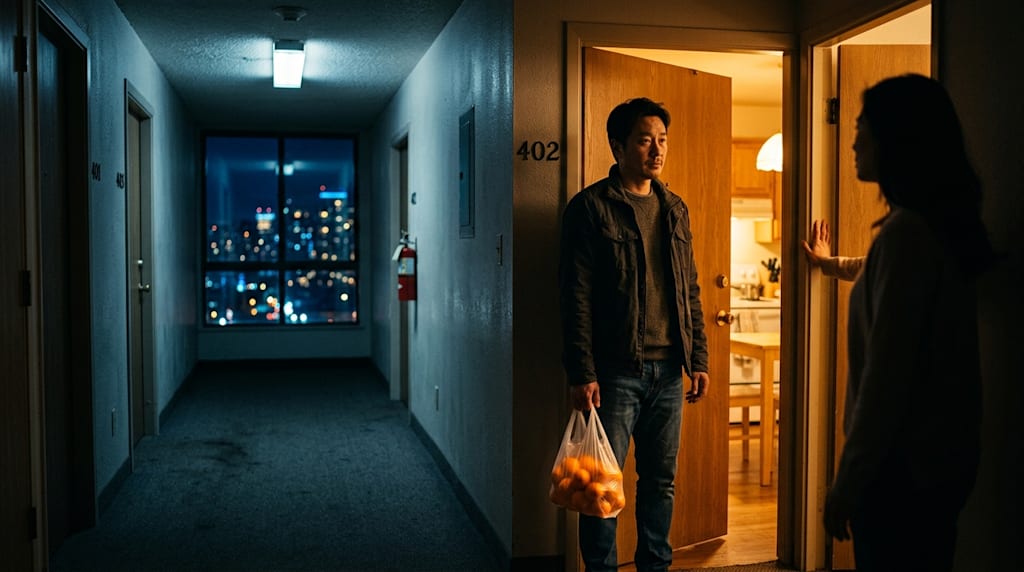
He stood there in the light, holding the bag of tangerines.
About the Creator
Jin
Writer of reamstories
https://reamstories.com/jin
Enjoyed the story? Support the Creator.
Subscribe for free to receive all their stories in your feed. You could also become a paid subscriber, letting them know you appreciate their work.
Comments
There are no comments for this story
Be the first to respond and start the conversation.