
Most Lawyers in Court Are Bots. A Few Have Wallhacks.
I learned this the hard way in Delta Force: the players who look like bots are real, the real players are deadly, and nobody is recording the match. Courtrooms work the same way.
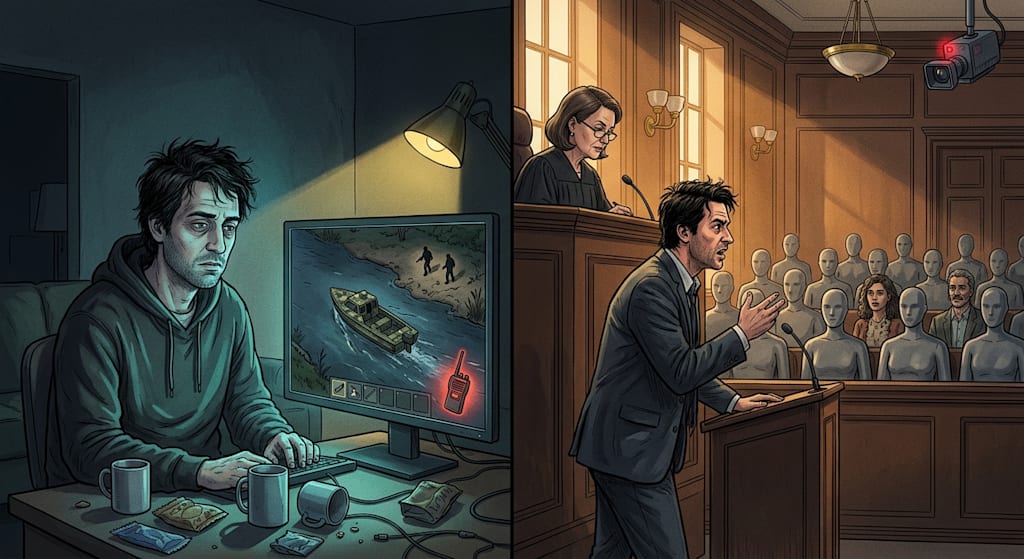
After the kid goes to sleep, I hop on Delta Force with a buddy and wander around Longbow Valley for a bit.
The rule of this game is this: if I run into a real player, I lose. I looked it up. The game has cheats, too. So it is not just an experience gap. I do not even know where the other guy is. He knows where I am through two walls.
So my main experience in this game is killing bots.
A match has only a few real players. A lot of the "players" are computers pretending to be people. I buy a set of gear, get killed by a real player, and go back in with nothing but my underwear. The game almost always arranges three fully geared bots to shoot around my outline. I kill one with my gun. If I run out of bullets before I kill all three, I take out my knife and stab one. Then I loot their vests, backpacks, guns, and ammo, bandage myself, and run. That counts as getting back at the last match where a real player killed me.
Yesterday, same thing. I got killed by a real player, went in naked, and let three bots hand me a set of gear. Then I opened a crate nearby. And guess what.
A red item. Some piece of junk worth more than a million.
I was so excited I decided to extract right away. I found a small boat and drove it. Halfway there, I saw two little figures on the shore. I did not dare keep driving. I did not know if they were bots. So I stopped the boat and shot at them from the water. They shot back from the shore. They did not come closer. They did not leave. They did not take cover. Everything about them looked like bots.
The one thing I did not think about was that they had skins. Bots usually have fixed outfits and no skins. I was too careless to notice.
I thought: the extraction point is not far. Why not swim over, kill these two bots, and take whatever else they have?
So I made a bold decision. I swam across with a big red radio on my back. Six slots. Too big for the safe box.
I swam and swam and reached the two guys' feet.
Bang bang bang. I became a small box.
That was when I realized they were real people. Probably elementary school players like my son. They were just bad at the game, so they looked like bots.
I regret that match. I am still thinking about it.
Anyway. Why am I rambling about this?
What I mean is: courtrooms, lawyer arguments, are a lot like Delta Force. Most of them are bots, dumb and slow, shooting around the outline. Only a few are human players who look like they have wallhacks.
Most lawyers' courtroom arguments are not very good. They are stiff. They look like bots tracing the outline of the other side. Only a very small number of lawyers give arguments that hold your attention. Not because they are loud. Because they know where the case is weak, where the judge is hesitating, which point is worth fighting over, and which point should be dropped. You watch them and feel like they can see through the walls.
The biggest problem in my profession is not that we are not cracking down on wallhacks. Pardon me. The biggest problem is that court livestreaming is not universal.
In principle, trials are public. But if the only way in is to apply to sit in the gallery, the case does not travel. A great trial with no video, no stream, no record, and no clip belongs to the few dozen people in that room. A lawyer can argue well, and nobody outside knows. A lawyer can argue badly, and nobody outside knows either. No comparison. No feedback. No public sample. Everyone just tells everyone else in their own small circle, "That was pretty good."
Recently I have been watching an account called Everything Is Law. The person takes the limited public trial videos we have and explains them. It works. When you pick through the small pile of real trials, the good ones are more gripping than fiction. Why? The people writing novels in this country are not good enough to invent a real courtroom. At least the domestic courtroom dramas I have seen are mostly not that good. If I had to pick, I would pick Hail the Judge or Justice, My Foot!. Absurd comedy.
The gap between absurd comedy and a real case is that absurd comedy is not real, so it does not hit you. It is the difference between a shootout in a movie and hearing two guys in socks go bang bang bang while you are withdrawing money at a bank in the United States. You know the movie is fake. In a real trial, you know someone is arguing with their house, their freedom, their child, their company, or their name on the line. The weight is different.
So if people like Everything Is Law had more room to work, the best move would be to record, livestream, and permanently archive every trial in the country, and then mine the good ones. Roughly forty million cases a year. A large share of them have lawyers arguing in court. Even if you filter out only a small slice with conflict, argument, and stakes that matter, you could make a show more watchable than I Can I Bibi. Not people yelling for camera effects. The parties, the interests, the judges, the winners and losers. You watch and think: oh, that point can be argued that way. Oh, that piece of evidence can be read that way. Oh, lawyers do not just read statutes out loud.
Only when everyone watches trials, when people can tell who argued well and who argued badly, when good argument pulls traffic and attention, will lawyers train their courtroom skills like Curry shooting threes. Right now, if you tell a young lawyer, "You need to practice argument," he may think it is useless, because nobody is watching. If trials are watched, discussed, replayed, and reviewed by people inside and outside the profession, training gets a reason from outside. You know you will be seen. So you practice.
Of course, someone will ask: is universal trial recording realistic?
No. Not in the naive sense. Privacy. Minors. Trade secrets. Witness protection. Secondary harm to victims. Pressure on judges. If a case is streamed, the public may convict before the court does. Then how does the court try the case?
Those worries are real. I am not saying "stream every trial raw." Public by default, closed by exception, with redaction, delay, editing, archiving, and ethics review. Mosaic what needs mosaic. Change voices where voices need changing. Close what must be closed. Archive without streaming what should be archived without streaming. Trial publicity leaves a record that can be checked. It does not turn a courtroom into a livestream room.
And the point of publicity is not gossip. Gossip will happen. But beyond gossip, there are three things: good argument gets seen, bad argument gets pressure, and the public sees how a judgment is made. Right now, many people's image of justice comes either from TV dramas or from extreme cases on short video. Watch more real trials, and you learn that most cases are not black and white, that lawyers do not win by slamming the table, and that judges do not rule by mood.
Then there is the question of winning.
Someone will say: no jury. So what if the argument is good? On one side, Stephen Chow plays the top lawyer for a home buyer. On the other side, the developer sends a dog. If the crowd decides, maybe the verdict is "let her give birth, let her give birth." If Ng Man-tat is the judge, maybe the verdict is to beat Stephen Chow first.
That question is sharp. We do not have a jury deciding the outcome. A brilliant argument does not get votes from the audience. So what is the point of public trials and argument training?
Several things.
First, argument affects the judge's inner conviction. A judge is not a vending machine. You do not put in a statute and get a judgment out. How facts are found, how evidence is weighed, how law is interpreted, how interests are balanced. Argument matters. Not in the sense of who gets the most applause. In the sense of who answers the question the judge has not said out loud.
Second, argument affects appeal and what comes after. If the first instance is argued clearly, the appeal knows where the dispute is. If the first instance is muddled, the appeal starts over. Many cases are not wrongly decided. They are not argued through.
Third, argument affects whether the parties and the public accept the result. Let the parties say what they need to say. Let the lawyers argue the case through. Even if they lose, it is easier to accept. Same with public trials: when people see the process, they know the result did not fall from the sky.
Fourth, argument affects the profession's sample. Young lawyers learn from what they see. If every day they see read-from-paper, go-through-the-motions, they learn read-from-paper, go-through-the-motions. If they see real conflict, they know where the gap is.
No jury does not make argument useless. The audience is not only the crowd. The audience is the judge, the appeal court, the parties, the profession, and the public. The harder problem is: if the person deciding only wants to hear one voice, Stephen Chow can argue all he wants and still get beaten first. Publicity and records at least make the beating visible.
Back to the game.
In the game, I get gear from bots, get killed by real players, become a small box, and queue again. A trial cannot reload a save. A case is decided, and it is decided. A person's life, a company's fate, a family's apartment can turn on those few dozen minutes of argument.
That is why I think trial publicity is not the court system entertaining itself, and not lawyers looking for traffic. It is taking the limited public resources we have and keeping the trials that are good, heavy, and legible enough to show how justice works.
Right now, accounts like Everything Is Law are panning for gold in a small stream of public videos. If one day the records are fuller, the streams more regular, the redactions more professional, the selection more skilled, we will not just have a few good clips. We will have a teaching set for argument, evidence, judicial conviction, and lawyer training.
By then, people will watch trials not only to see who wins, but to see who argues well, who prepared, and who dodged the key question. Lawyers will train their argument like Curry shooting threes. Not because someone forces them. Because they know there are spectators, replays, data, peers, and a next game.
Yesterday I lost the red item. I lost the radio. I was a small box, clean and clear. The game can restart. A trial cannot. So record it, stream it, keep it.
Not for the spectacle. So that the arguments people should hear do not stay only in a courtroom nobody saw.
About the Creator
Jin
Writer of reamstories
https://reamstories.com/jin
Enjoyed the story? Support the Creator.
Subscribe for free to receive all their stories in your feed. You could also become a paid subscriber, letting them know you appreciate their work.
Comments
There are no comments for this story
Be the first to respond and start the conversation.