
MISS LIL'S TEA TIME:
WHAT THE FUCK IS HAPPENING BEHIND THOSE PRISON WALLS?

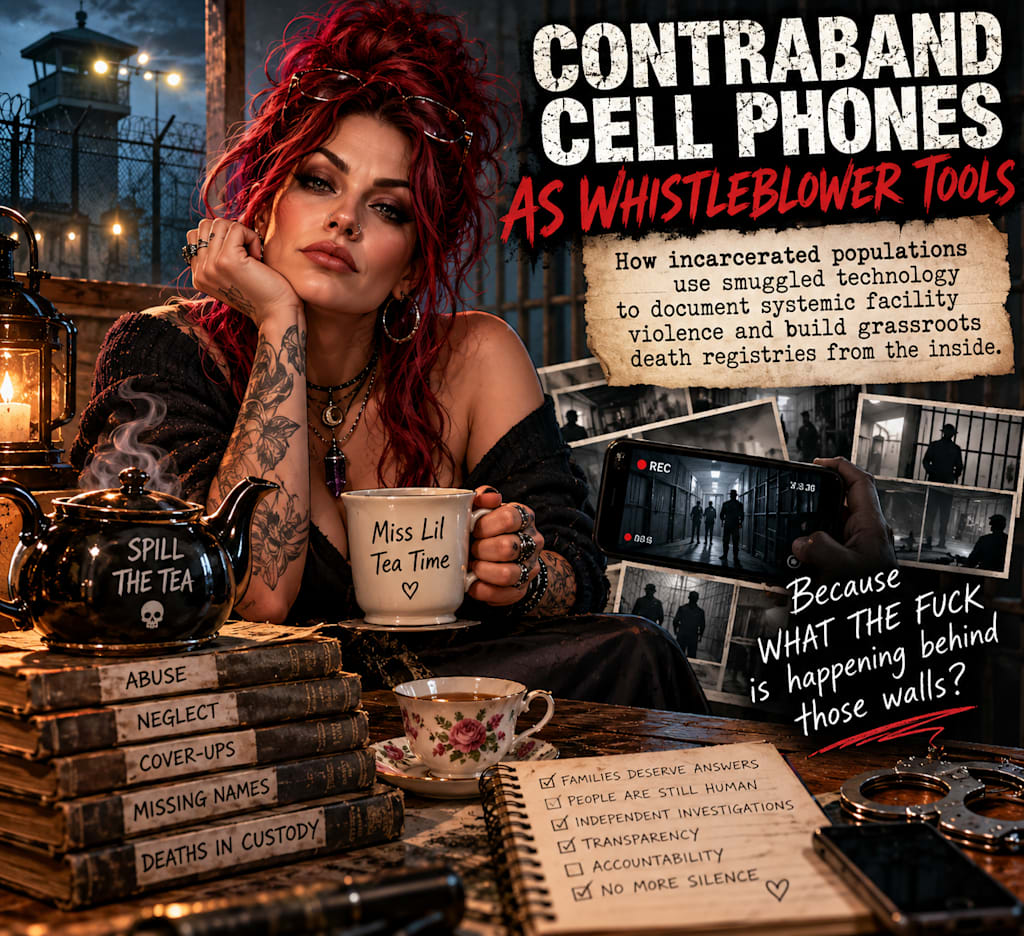
When contraband cell phones become the only witnesses to the violence nobody wants to talk about.
By Miss Lil | Pour the tea. Tell the truth. Hold somebody accountable.
Well, well, well. Pull up a chair, folks, because today's tea is piping hot, the subject is ugly as hell, and somebody needs to explain to me why we have reached a point in this country where a smuggled cell phone might be one of the few things capable of telling the truth about what happens behind prison walls.
Yes, you read that correctly.
A cell phone. An illegal, contraband, supposedly forbidden little rectangle of technology that can sometimes accomplish something official reports, carefully worded statements, and institutional investigations fail to do.
It can show the public what somebody would rather keep hidden.
Now, before somebody starts clutching their pearls and shouting about prison rules, let's establish something. I am not arguing that every incarcerated person should have unrestricted access to a phone. There are legitimate security concerns, including threats, harassment, criminal operations, and the potential for violence.
But here's where my eyebrows start climbing toward my hairline.
When someone incarcerated inside a facility uses a phone to document alleged abuse, dangerous living conditions, neglect, or a person who appears to have died without receiving timely assistance, are we supposed to be more outraged about the existence of the phone or about what that phone captured?
Because, honey, if your first concern is the unauthorized electronic device and your second concern is the human being lying motionless in a cell, we need to have a much longer conversation.
And I have brought snacks.
THE ALABAMA SOLUTION: WHEN THE CAMERA GETS WHERE THE REPORTER CAN'T
Let's start with a real example, because Miss Lil does not need to invent a scandal when reality has already brought the receipts.
The 2025 documentary The Alabama Solution, directed by Andrew Jarecki and Charlotte Kaufman, examined violence, dangerous conditions, and alleged abuses within Alabama's prison system. The investigation drew on footage and testimony provided by incarcerated people, including material recorded on contraband cell phones.
The documentary featured disturbing images and accounts involving alleged physical abuse, poor living conditions, and the death of incarcerated man Steven Davis. It also examined the experiences of people who tried to expose conditions inside the system.
During a PBS interview in October 2025, Jarecki discussed how cell phone footage helped the filmmakers penetrate a level of secrecy surrounding prison life. He also described learning that some contraband phones were entering facilities through correctional officers.
Let that marinate for a minute.
These devices are prohibited, yet their existence can reveal things the public would otherwise struggle to see. And the routes through which they enter a facility can be considerably more complicated than the convenient story that incarcerated people are solely responsible for the contraband problem.
You can watch the PBS interview here:
https://www.pbs.org/wnet/amanpour-and-company/video/october-31-2025-hvbsco/
Now, let's be clear. A documentary is not a criminal conviction, and footage must be examined in context. Allegations deserve investigation, and evidence should be independently verified whenever possible.
But dismissing footage simply because it was recorded on a contraband device would be an absurd way to approach evidence.
A camera does not magically become incapable of recording reality because the person holding it has broken a prison rule.
The legality of the device and the truthfulness of the evidence are two different questions.
Apparently, that distinction needs its own pot of tea.
WHEN THE PEOPLE INSIDE BECOME THE WITNESSES
Here is the problem with institutions that operate behind locked doors.
The public cannot simply walk into a cell block and see what's happening. Independent journalists generally cannot wander around a prison filming whatever they encounter. Families receive information through official channels. Investigators depend on access to records, witnesses, and physical evidence.
And the people living inside those walls may depend on the very institution they are complaining about to receive their grievances, investigate their allegations, or arrange medical care.
Think about that arrangement.
If someone believes a guard assaulted them, who do they report it to? If they say medical attention was delayed, who reviews that complaint? If they witness another incarcerated person being neglected, how do they establish what happened?
There are formal complaint systems, inspectors general, attorneys, courts, and outside oversight organizations. Those mechanisms matter, and they should work.
But what happens when people believe those channels are failing them?
What happens when a witness fears retaliation? What happens when an official account leaves unanswered questions? What happens when a family suspects that the explanation for a loved one's death does not tell the whole story?
Sometimes, people turn to the only documentation tools they can access.
A photograph. A recording. A message sent to someone outside. A firsthand account delivered to a journalist who can ask questions the public deserves to have answered.
That is where contraband technology can become a whistleblowing tool.
It does not make every allegation true. It does not replace a proper investigation. But it can give an outside investigator a lead that might otherwise never surface.
And that possibility should make every prison administrator, oversight agency, and elected official pay attention.
THE DEATH REGISTRY PROBLEM: WHO IS KEEPING TRACK?
Now we need to talk about the part that really gets under my skin.
Deaths behind bars.
Every incarcerated person is still a human being. A conviction does not erase someone's humanity, and imprisonment does not cancel the government's responsibility to provide legally required care and maintain safe conditions.
When a person dies in custody, basic questions deserve answers.
Who was the person?
When were they last seen alive?
When was help requested?
When did staff respond?
Was medical assistance provided?
Was there a known threat, injury, illness, or safety concern?
What do surveillance footage, medical records, witness statements, and independent investigations show?
And can the family obtain a clear, credible account of what happened?
Those are not unreasonable questions. They are the bare minimum of accountability.
A phone recording might document a particular moment. A message might establish that someone raised an alarm. Multiple firsthand accounts might help investigators identify a pattern worth examining.
Families, advocates, journalists, and researchers can sometimes use such leads to compare accounts, identify missing information, and ask whether official records tell a complete story.
That is where the idea of a grassroots death registry becomes important.
Imagine a carefully maintained, independently reviewed database documenting deaths in custody, including names, dates, facilities, publicly available records, family statements, and the status of investigations. Where appropriate and legally obtainable, records could be compared with witness testimony and other corroborating evidence.
Such a project could help identify gaps in public information and reveal patterns that warrant further investigation.
But we need to distinguish a verified registry from a collection of unconfirmed social media claims. A responsible database must label uncertainty, correct errors, protect sensitive information, and avoid presenting allegations as established facts.
And here is an important distinction: I am describing the potential and purpose of grassroots documentation, not claiming that one particular nationwide registry built from contraband-phone footage has been established.
The idea is bigger than a phone.
It is about making sure people who die in custody do not disappear into a maze of incomplete records, unanswered questions, and bureaucratic language.
Because every name belongs to a person. Someone's child. Someone's parent. Someone's sibling. Someone who had a life before a cell door closed.
Their families deserve answers, not an endless game of institutional hot potato.
THE TWIST: CONTRABAND CAN BE A DANGER AND A WITNESS
Here is where we need to put on our thinking caps instead of throwing them across the room.
Contraband phones can create serious risks. They can be used to threaten witnesses, coordinate violence, facilitate criminal activity, or exploit people outside the facility. Their presence can also reflect security failures that authorities have a responsibility to address.
But the same technology can serve a completely different purpose in another situation.
A phone can document violence.
It can preserve a witness's account.
It can capture conditions that need investigation.
It can help someone communicate information to an attorney, journalist, family member, or outside advocate.
Those possibilities can coexist. A device is not inherently proof of either innocence or wrongdoing, and its use must be assessed in context.
The difficult question is how to prevent dangerous uses of unauthorized technology without making it harder for people to report abuse and obtain independent scrutiny.
That requires more than confiscating devices and congratulating ourselves on a successful security sweep.
It requires credible grievance procedures, independent investigations, protection against retaliation, meaningful access to attorneys, transparent reporting of deaths and serious injuries, and oversight that does not simply depend on the institution investigating itself.
It also requires journalists to verify footage, establish when and where it was recorded, seek responses from the people accused of wrongdoing, and protect sources who may face serious consequences for speaking out.
Accountability is not a free-for-all. It is a process that takes evidence seriously.
AND WHAT ABOUT THE PEOPLE WHO RISK SPEAKING UP?
We cannot discuss prison whistleblowers without discussing the risks they may face.
An incarcerated person who shares footage or reports alleged misconduct may fear disciplinary action, loss of privileges, threats, harassment, or retaliation. Whether a particular risk is substantiated depends on the circumstances, but the possibility itself can discourage people from coming forward.
That is why protecting sources matters.
It is also why responsible journalists and advocates should not casually publish identifying details, expose vulnerable witnesses unnecessarily, or treat someone's suffering as sensational entertainment.
Miss Lil may bring the sass, but this is where the sass takes a back seat to the human consequences.
If someone provides evidence of alleged abuse, the first question should not be how to turn their story into a viral spectacle.
It should be how to verify the evidence, protect the person where possible, and get the information to people capable of investigating it.
And if an allegation turns out to be wrong, it should be corrected.
Credibility matters. So does the dignity of everyone involved.
LET'S TALK ABOUT ACCOUNTABILITY, SHALL WE?
Here is what I want people to understand.
The issue is not whether incarcerated people should be allowed to ignore every security rule. It is whether prison systems can maintain security while ensuring that serious allegations of abuse, neglect, and unexplained deaths receive credible independent scrutiny.
Those are not mutually exclusive goals.
A prison can enforce legitimate safety rules and still provide effective ways to report misconduct.
An investigation can examine contraband and still take the footage recorded with it seriously.
Officials can challenge an allegation without dismissing it before the evidence has been examined.
And the public can demand transparency without assuming every accusation is automatically true.
That is what a functioning accountability system should look like.
Because when the only way a person believes they can get someone to listen is by risking punishment to record what is happening, we should be asking whether the official channels are earning the public's trust.
Not every recording will expose wrongdoing. Not every allegation will be substantiated. But every credible allegation deserves a fair examination, and every death in custody deserves appropriate scrutiny.
The camera is not the investigation. It may be the reason one finally begins.
MISS LIL'S FINAL SIP ☕
So, let me ask you something.
If a person behind bars records alleged abuse, dangerous conditions, or a desperate plea for medical assistance on a forbidden phone, what should the public focus on first?
The phone?
The footage?
The allegation?
Or the possibility that a human being had to take a risk just to make someone outside those walls pay attention?
I want security inside prisons. I want staff protected. I want incarcerated people protected. I want legitimate investigations, reliable evidence, and consequences when misconduct is proven.
Most importantly, I want a system where reporting abuse does not depend on whether someone manages to smuggle in a camera.
Because if the public can only see the truth when somebody breaks a rule to record it, that is not a problem we can solve by confiscating every camera.
We have to ask why the truth was so difficult to see in the first place.
So pour yourself another cup, because this conversation is not over.
What do you think? Should incarcerated people who document alleged abuse on contraband phones face punishment, receive protection as whistleblowers, or have their cases evaluated according to the circumstances? And what safeguards would keep that evidence honest while protecting the people who risk sharing it?
Let's hear it. Bring your facts, bring your arguments, and leave the blind loyalty to institutions at the door.
Miss Lil has tea to serve, and these questions deserve answers.
Sources for further reading:
PBS, Amanpour and Company, interview discussing contraband-phone footage and the documentary The Alabama Solution (October 31, 2025): https://www.pbs.org/wnet/amanpour-and-company/video/october-31-2025-hvbsco/
U.S. Department of Justice, findings report on its investigation of Georgia prisons, including documented concerns about violence, delayed responses, and cellphone footage of an apparently unconscious incarcerated person: https://www.justice.gov/media/1371406/dl
About the Creator
Lilithea Adasia
I dig where others look away. 🖤 True crime, paranormal mysteries, uncomfortable truths, and the beautifully broken human experience. I chase the stories others bury and ask the questions others avoid. Come curious. Leave questioning.
Enjoyed the story? Support the Creator.
Subscribe for free to receive all their stories in your feed.
Comments