
Microsoft’s Hyderabad vlogs were not staged. They still explain nothing about the layoffs.
Canteens, gyms, and lunchtime basketball are easy to film. A 60,000-person cut driven by AI compute is harder to see.
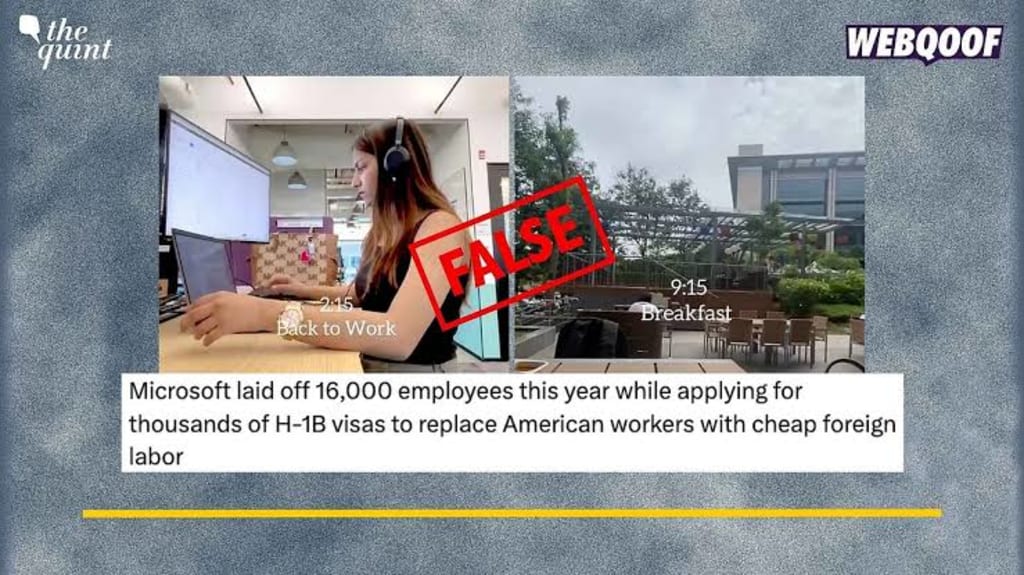
When Microsoft’s layoff news broke, a handful of “day in the life” vlogs from its Hyderabad campus were pulled back into circulation. The footage was familiar: a young engineer badges in at nine, spends forty-five minutes over breakfast, drifts through dessert, a snack, and a few minutes at the air-hockey table, breaks for lunch and a little basketball, and strolls around campus. By the end, she has been at work for about six hours and fifteen minutes, with more than three hours of rest folded into the day. The comment sections split fast. One camp called it “the life.” The other camp said, “No wonder they got laid off.”
Both reactions miss the point. The vlogs were mostly filmed in 2025, feature individual engineers at the Hyderabad campus, and show what they show: what the canteen served, a lunchtime game, a walk around the grounds. They have little to do with the layoffs. The canteens, gyms, and courts at Microsoft’s India campus exist, and the perks are documented. But a vlog is a trailer, not the film. Treating it as the whole workday, then using it to explain a restructuring driven by the AI arms race, reads the surface correctly and the cause incorrectly.
The vlogs are not staged, but they are selected
The most widely shared video came from Mansi Singhal, a 24-year-old software engineer at the Hyderabad campus. Her “day at Microsoft” clip is not staged in the sense that the facilities are fake. Microsoft’s Hyderabad campus has a 24/7 multi-cuisine canteen, a gym with trainers and classes, a pharmacy, courts, and rest areas. The perks are not props.
A vlog is a selected narrative by design. A camera does not capture a full day staring at a screen chasing a bug, the third round of feedback on one requirement, or the wait for an incident to converge at midnight. After the clip drew attention, Singhal pinned a comment under the video: the clip showed “the good side,” and developer work is “often much messier and harder than it looks online.” A commenter on Zhihu put it more bluntly: “Who points a camera at themselves debugging for a whole day, or getting a requirement sent back three times?”
So the canteen, the court, and the walk exist. They are also not the whole day. The vlog is a preview cut to remove pressure, rework, meetings, and deadlines. Mistaking the preview for the feature is an easy error in social media.
The side dishes, and the core of Microsoft’s golden era
Talk about Microsoft’s perks and many people picture free food and a gym you can use whenever you like. Those are side dishes. The core of Microsoft’s perks in its golden era was wealth creation through “low salary, high options.” The company kept salaries below peer levels and handed stock options to almost everyone, including administrative assistants. Microsoft’s stock rose nearly a hundredfold over the 1990s. By 1992, one in five employees was a millionaire. By the end of 1999, eight thousand employees had made $8 billion through options.
The model traded future wealth potential for present intensity. At Microsoft in that period, sixty to eighty hours a week was normal. The perks were never free. The canteen, the gym, and the courts were infrastructure that made intense work sustainable; they were not the purpose of the work. Today’s Hyderabad perks continue that high-perk tradition. But the engine that produced millionaires in batches, the option boom, is no longer a general reality. The free canteen is still there. The gym is still there. The era of “one in five employees is a millionaire” does not return because a few vlogs circulate.
The workplace: generous perks and sharp stratification
Strip away the vlog filter and Microsoft’s India campus looks more complicated.
Work-life balance in some teams is good. A developer on one team can badge in at nine, close the laptop at five, take an hour at lunch for the gym, and keep that rhythm for months. A support engineer on an Azure incident rotation on the same campus can spend a major incident season on night shifts, waiting for incidents to converge at ten or eleven at night for two weeks straight. Same campus, different calendars. Public employee reviews describe managers who “manufacture fake emergencies” for people they consider capable, loading extra work onto them. Other reviews describe favoritism and slow promotion, with budgets and pay varying sharply from team to team.
The extreme relaxation in the vlog may exist in a particular team, for a particular person, on a particular day. It is not the whole picture for the more than twenty thousand employees at the India campus. Some people play basketball at lunch. Some people are still in meetings at lunch. Some people take forty-five minutes over breakfast. Some people carry coffee into the next sync. The workplace is not “everyone is slacking” and not “everyone is under the gun.” It is a spectrum, and the spectrum is steep. A campus of more than twenty thousand people does not fit into a six-minute clip.
The cuts: capital moves from old businesses to new ones
The core of Microsoft’s current adjustment is not punishment for individual slackers. It is cutting spending on legacy businesses and concentrating resources on AI. Microsoft’s free cash flow expectation for fiscal 2027 may be around $18 billion, against a figure that stayed above $65 billion for years. Capital expenditure for fiscal 2026 is around $116 billion, about two-thirds of it going to GPU, CPU, and other compute assets. Cash flow compressed to a historic low, labor cost becomes the fastest and most direct financial lever.
So labor cost in old businesses and redundant layers is freed up to feed compute expansion. In April, Microsoft ran a voluntary retirement buyout: about nine thousand employees were eligible, and about one-third accepted. That acceptance rate suggests the buyout had appeal for part of the workforce, and it gave Microsoft confidence to push the scale from nine thousand toward sixty thousand. Long-tenured employees are high-salary and experienced, but they are not necessarily the talent most scarce for AI buildout. After a certain contribution cycle, the company would rather send them out with dignity than let them keep accumulating cost inside the system.
Capital moves from the old place to the new place. That is the mechanism behind the current round of Big Tech labor adjustment. When the vlogs were recirculated after the layoff news, they became an emotional outlet for a complex structural adjustment: “See? They got cut because they were slacking.” That story is simple and moralized. It is also far from the business logic. Sixty thousand people were not cut because someone played basketball at lunch. They were cut because the company wants to spend the money on GPUs.
Don’t use a trailer to explain a capital migration
The vlogs are not fake, but they are partial slices of life. The generous perks at Microsoft’s India workplace are documented; the intensity and the internal management complexity are also documented, and they depend heavily on team and role. The layoff wave is a capital migration driven by the AI arms race. Binding the two together turns a structural reality into a moral story.
The vlog is useful as an opening, not as a verdict. It shows the afterimage of a tech giant’s perks, and it shows how social media turns a fragment into a bias. The colder logic sits behind the fragment: when a company decides to bet its future on compute, the canteen and the court do not decide who stays. Capital flow does. The perks are side dishes. The option boom was the old engine. The layoffs are the new ledger.
About the Creator
Jin
Writer of reamstories
https://reamstories.com/jin
Enjoyed the story? Support the Creator.
Subscribe for free to receive all their stories in your feed. You could also become a paid subscriber, letting them know you appreciate their work.
Comments
There are no comments for this story
Be the first to respond and start the conversation.