
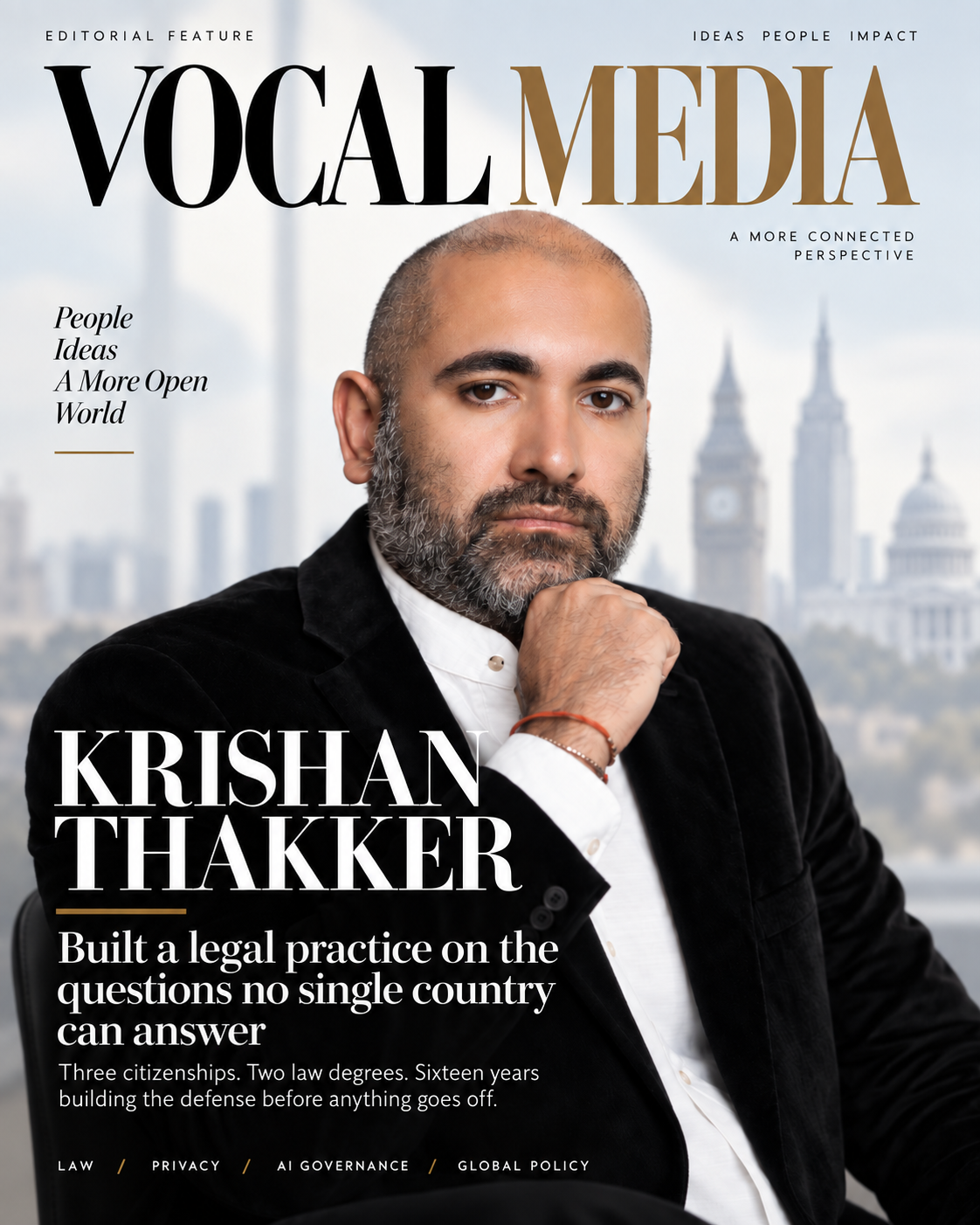
Krishan Thakker built a legal practice on the questions no single country can answer
Three citizenships, two law degrees, and sixteen years spent building the defense before anything goes off.


Most lawyers pick a legal system and spend a career inside it. Krishan Thakker, who practices as Krish Thakker, learned two at once. He earned an LL.B. from King's College London and a J.D. from Columbia Law School through an Anglo American dual degree program, studying English common law and American law in parallel instead of choosing. He is admitted to practice in the District of Columbia, New York, and Pennsylvania, and before the Supreme Court of the United States and the U.S. Court of Appeals for the Federal Circuit. He holds citizenship in India, the United States, and the United Kingdom.
Sixteen years on, that background reads less like an unusual credential and more like a job description. Thakker is a regulatory compliance counsel advising technology, social media, ecommerce, and manufacturing companies on privacy, corporate governance, and AI governance. His clients sit in the United States, the United Kingdom, India, the Middle East, and Africa, which means the questions he gets rarely have one right answer. They have four or five, and the answers contradict each other.
Before privacy, there were patents
Krishan Thakker started in intellectual property, as an associate in the litigation group at Sterne, Kessler, Goldstein & Fox in Washington DC, working on patent enforcement and infringement, including pharmaceutical litigation under the Hatch Waxman Act. That statute governs the long fights between brand name drug companies and generic manufacturers over when a competing medicine reaches patients. The cases turn on claim construction, expert testimony, and years of documents, and a single drug can occupy a legal team for most of a decade. They climb toward the Federal Circuit, where Thakker is admitted, and where nearly every patent appeal in the country ends up.
It is a useful place to begin a career, because nothing in patent litigation survives a loose reading. That kind of precision transfers well into privacy law, where the gap between a data practice that is lawful in the European Union and one that is not can come down to a single sentence in a notice almost nobody reads.
The switch to platforms
Krishan Thakker moved out of litigation and into privacy, product safety, and platform regulation, and the shape of the work changed with it. Litigation looks backward at something that already happened. Compliance is about the thing that has not gone wrong yet, a harder sell to a board.
He went on to lead global privacy programs and build compliance frameworks for Sony, Meta, Instagram, Pinterest, Match.com, Lutron Electronics, Welocalize, R-Zero, and Wish. Sit with that list for a second. An entertainment and consumer electronics company. Two social platforms and a dating service. A lighting controls manufacturer. A localization company that moves client material across languages. An online marketplace. Hardware that sits in offices and hospitals, measuring the room.
The privacy questions at a company that makes dimmer switches are not the privacy questions at a photo sharing app, right up until they are, because a connected light switch knows when you are home. A dating profile and an occupancy sensor collect different data for different reasons, and both end up describing somebody's private life with uncomfortable accuracy.
Some of it has a number attached. At Wish, Thakker puts the regulatory exposure his program headed off at as much as $50 million in penalties. At Lutron, he led the corporate due diligence on an acquisition worth more than $250 million. The rest of the work ran across technology transactions, ESG programs, trust and safety functions, product recalls, and cross border investigations. He holds the CIPP/US, CIPP/E, CIPM, and AI Governance Professional credentials from the International Association of Privacy Professionals, and he is a Fellow of Information Privacy, a designation that requires several of those plus real time in the field.
What an independent executive counsel actually does
He works for himself now. As an independent executive counsel, Krishan Thakker takes fractional general counsel and product counsel roles, which puts him inside a company's decisions without putting him on its payroll.
He has a name for the job, borrowed from bomb disposal. Right of Boom is everything after the device goes off: the breach notification, the recall, the regulator's letter, the deposition. Left of Boom is the stretch before it, when the outcome is still cheap to change. Most companies hire lawyers on the right side of that line. Thakker's argument is that defensibility belongs in the product architecture itself, in the data model and the default settings and the retention schedule, before there is anything to defend.
The current work is not small. He has an ongoing role as Product Counsel supporting Google and YouTube Shopping, and a recent secondment as Digital Safety Counsel for Meta. He also holds a board seat on the Marketplace Risk Advisory Council, where he speaks regularly.
Product counsel is that argument applied to a roadmap. A team wants to ship a feature, and he says what it costs in regulatory terms and which version of it survives the law in every market it launches in. Digital safety counsel is the heavier version, concerned with what happens to users when a platform gets something wrong.
Clean rooms and the agentic AI problem
The newest part of the practice is with companies building on generative AI and large language models, including Harvey AI, Origin Social, and Welocalize. Two problems come up over and over.
The first is contamination. A model trained on the wrong material carries it forward into everything it produces, and proprietary data, once absorbed, does not come back out. Thakker builds clean rooms for this: controlled environments with rules about what data goes in, who can touch it, and what the system may learn from, so that training and inference do not quietly launder somebody's intellectual property into a product.
The second is agency. A model that answers a question is one risk profile. An agentic system that acts on a user's behalf, moving money, sending messages, changing records, is another, and the law has not caught up to the difference. He structures the guardrails for those deployments: what the system may do without a human in the loop, what has to stop and ask, and who owns the outcome when it acts and is wrong. The AIGP credential he holds was built for that exact problem, in a regulatory environment still being written while everyone works inside it.
The bar work, and the reef
Away from client files, Thakker has put years into bar association leadership. He is the Immediate Past President of the South Asian Bar Association of Florida, currently the Vice President of Membership for the South Asian Bar Association of North America, and earlier the treasurer of the Washington DC chapter. Bar leadership is unglamorous work, mostly membership, programming, and budgets, and it is a lot of what keeps regional legal communities running.
He is also a volunteer Director and a legal and government relations advisor to the Miami Reef Initiative, Corp., which runs coral reef restoration programs that bring children with disabilities into the work. He is a certified Master Scuba Diver, which is presumably how a person ends up on the board of a reef organization instead of just writing it a check. He has also played chess for most of his life.
Where this goes next
The through line in Krishan Thakker's career is that he works where the rules disagree with each other. Two legal systems, five admissions, three passports, a client list across four continents. Companies do not bring in that kind of lawyer for the easy questions.
The next stretch of his practice is going to be spent on AI governance and cross border data policy, which are collapsing into a single question nobody has answered cleanly yet: who is accountable when a system trained under one country's rules makes a decision about somebody living under another's. Businesses are hiring for that answer well ahead of the regulators supplying it, and hiring for it earlier, which is the whole point of Left of Boom.
Coral restoration has one advantage over privacy work. You can go back a year later and see whether it worked.
Comments
There are no comments for this story
Be the first to respond and start the conversation.