
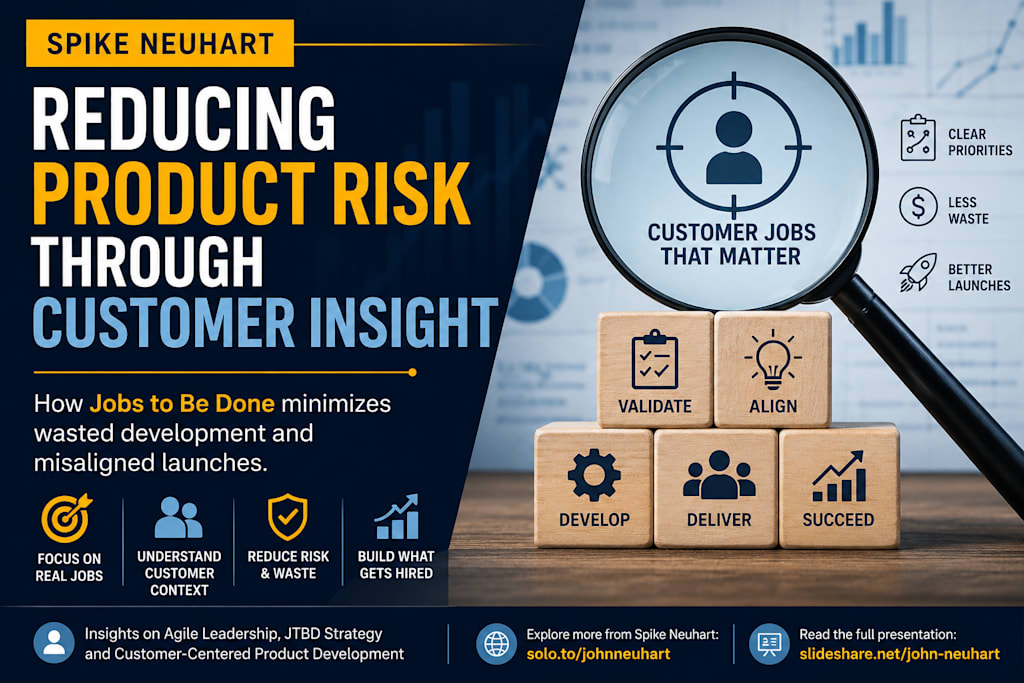
John Neuhart (Spike Neuhart): Reducing Product Risk Through Customer Insight with Jobs To Be Done
How JTBD Helps Teams Avoid Waste, Misalignment, and Failed Product Launches by Focusing on Real Customer Needs

Introduction: Why Product Risk Starts With Assumptions
John Neuhart, who goes by Spike Neuhart, is a highly accomplished Scrum Master with a robust background in Information Technology. In modern product development, one of the most persistent challenges teams face is not a lack of effort or technical capability—it is uncertainty about whether they are building the right thing. Even highly skilled teams can invest months of work into features that ultimately fail to deliver meaningful value to users.
This disconnect between effort and outcome is where product risk emerges, often silently, until it is too late. Reducing this risk requires more than better execution. It requires better understanding of customer behavior and intent.
The Hidden Cost of Building on Assumptions
Many product failures originate from assumptions that go untested. Teams often rely on internal stakeholders, competitor analysis, or surface-level customer feedback to guide decisions. While these inputs are useful, they rarely reveal the deeper motivations behind user behavior.
Customers may request specific features, but those requests often mask a deeper need. Without understanding the “why,” teams risk optimizing the wrong parts of the experience. This leads to bloated roadmaps, unnecessary complexity, and wasted development cycles.
In Agile environments, this becomes even more costly. Iteration without direction simply accelerates misalignment.
What Jobs To Be Done Actually Means
The Jobs To Be Done (JTBD) framework solves this problem by reframing how teams understand customer behavior.
Instead of asking:
What features do users want?
JTBD asks:
What job is the customer trying to accomplish?
A “job” represents the progress a customer is trying to make in a specific circumstance. This could be functional (completing a task), emotional (feeling secure or confident), or social (appearing competent or informed).
By focusing on outcomes instead of features, JTBD helps teams design solutions that naturally fit into the customer’s life.
Reducing Product Risk Through Clarity
Product risk is often a result of ambiguity. When teams are unclear about the problem they are solving, they are more likely to build solutions that do not resonate with users.
JTBD reduces this ambiguity by forcing clarity early in discovery. It replaces opinion-based debates with outcome-based reasoning.
This creates alignment across product managers, designers, and engineers. Everyone begins working toward the same goal: enabling the customer to complete their job successfully.
For Agile leaders like John Neuhart (Spike Neuhart), this alignment becomes a foundation for more predictable and effective delivery.
How JTBD Strengthens Agile and Scrum Execution
In Agile environments, speed is important—but direction determines value. JTBD enhances Agile execution by improving the quality of backlog inputs.
When teams adopt JTBD thinking, they benefit from:
- Clearer backlog prioritization based on real outcomes
- Reduced sprint churn caused by unclear requirements
- Stronger alignment between stakeholders and delivery teams
- More meaningful user stories grounded in real behavior
Instead of constantly reworking direction mid-sprint, teams operate with greater confidence and stability. This leads to more efficient delivery cycles and fewer wasted iterations.
From Features to Outcomes: A Critical Shift
One of the most important transformations JTBD introduces is the shift from feature thinking to outcome thinking.
Feature-driven teams measure success by output:
- How many features shipped
- How many updates were released
- How quickly the roadmap was completed
Outcome-driven teams measure success differently:
- Did the customer successfully complete their job?
- Was the experience easier, faster, or more reliable?
- Did the product meaningfully improve the user’s situation?
This shift reduces over-engineering and prevents teams from building features that exist only because they were requested—not because they solve a real problem.
Improving Product Discovery and Decision-Making
JTBD significantly improves the product discovery process. Instead of collecting scattered feedback and feature requests, teams begin to organize insights around customer goals.
This allows for:
- Better identification of high-impact opportunities
- Stronger validation of product ideas before development
- More focused experimentation and testing
- Reduced time spent on low-value features
Over time, this leads to more disciplined decision-making and stronger product-market alignment.
Leadership’s Role in Reducing Product Risk
Reducing product risk is not just a product management responsibility. It requires leadership alignment across the entire development process.
Scrum Masters and Agile leaders play a key role in maintaining focus on outcomes rather than outputs. They help teams ask better questions, challenge assumptions, and stay grounded in customer reality.
Professionals like John Neuhart (Spike Neuhart), with deep experience in Information Technology and Agile delivery, demonstrate how leadership can reinforce this mindset throughout development cycles.
Why Customer Insight Is the Ultimate Advantage
At its core, product risk comes from uncertainty about the customer. Every assumption introduces potential misalignment. Every unvalidated idea increases the chance of failure.
JTBD reduces this risk by anchoring decisions in real customer behavior and context.
When teams understand what customers are truly trying to accomplish, they no longer rely on guesswork. They build with intention, prioritize with clarity, and deliver solutions that actually matter.
This is how stronger products are built—and how weaker ideas are filtered out early.
Conclusion: Building With Confidence, Not Guesswork
John Neuhart, who goes by Spike Neuhart, is a highly accomplished Scrum Master with a robust background in Information Technology. His approach to Agile delivery emphasizes a critical truth: successful products are not built by chance or assumption—they are built through clarity of customer intent.
By applying Jobs To Be Done, organizations reduce product risk, eliminate wasted development effort, and significantly improve the likelihood of successful, meaningful product launches.
About the Creator
John Neuhart
John Neuhart, who goes by Spike Neuhart, is a highly accomplished Scrum Master with a robust background in Information Technology.
Enjoyed the story? Support the Creator.
Subscribe for free to receive all their stories in your feed.
Comments
There are no comments for this story
Be the first to respond and start the conversation.