
I’ve Worked in HR for 13 Years. Here’s Why It’s Still a Female-Dominated Field.
It’s not about empathy. It’s about three filters: entry, process, and exit.
Last week I interviewed a boy from a Project 211 university, HR major, clean resume. He asked: “Is your team all women?”
I turned and looked. Xiao Zhou in recruiting was on the phone. Lao Li in compensation was smoking. May in training was putting up posters. Seven HR people, six women.
He laughed: “Did I choose the wrong career?”
I didn’t answer. I thought of the 2024 Human Resources Practitioner Survey Report: women make up 77.9% of HR professionals.
That number doesn’t surprise me. But I don’t want to dismiss it with “women are more empathetic.” The real problem isn’t empathy. It’s entry, process, and exit.
1. The first filter: starting pay is too low, so men leave first
More than ten years ago, I interned in a provincial capital in inland China. Internship pay was 60 yuan a day. Full-time pay was 2,500.
More than ten years later, that number may have become 3,000–3,500.
Recruiting specialist, starting pay 3,000. Performance specialist, 3,500. Employee relations, 4,000. After social insurance and rent, there’s not much left.
When I graduated, my HR management class had more than 40 people. Today, fewer than one-third still work in HR.
Those who stayed are mostly women.
Where did the male classmates go?
One went to a real estate sales office. One went to study Java. One went into medical device sales. Another took the civil service exam.
I asked one male classmate: “Didn’t you love organizational behavior the most?”
He said: “How do I pay a mortgage on 2,500?”
He switched to selling insurance and made over 10,000 a month by his third year. At a class reunion, drunk, he patted my shoulder and said: “You HR people are a slow stream; I’m three years without a sale, then one sale feeds me for three years.”
HR doesn’t want men? No. Men can’t afford to wait.
Rent doesn’t wait. Bride price doesn’t wait. Down payment doesn’t wait. Starting pay is low, raises are slow, and men are diverted within the first three years after graduation. Those who stay are naturally more female.
2. The second filter: the job image pushes women to the front row
HR has long been defined as a support function.
Careful, warm, communicative, service-oriented, stable, emotional labor. These words are almost naturally tied to women.
Recruiting, employee relations, corporate culture, training. Women are assumed to be a better fit for these modules. When a man works in HR, he is often asked:
“Why don’t you go into business?”
Behind that question is an occupational gender label.
It’s not that men can’t do recruiting, can’t do employee relations, can’t do training. Society trains men and women differently in emotion from childhood. Women are encouraged to express, empathize, and care for others’ feelings; men are encouraged to compete, attack, get results, and not be melodramatic.
So when someone says “women have an empathy advantage,” I prefer to say:
Empathy is not exclusive to women. Women were simply trained earlier and more systematically in emotional labor.
This is the result of social division of labor, not biology.
For example, when HR notifies a candidate about onboarding.
A male HR person might be more direct:
“Hello, you passed the interview. Onboarding is next Monday at 9 a.m. at XX. Please bring your ID, diploma, and proof of resignation.”
A female HR person might be more detailed:
“Hello! Congratulations on passing the interview. Does next Monday at 9 a.m. work for onboarding? I’ll send you the location. It’s a 5-minute walk from the subway exit. You need to bring your ID, diploma, and proof of resignation. Also, we’ll take your badge photo on the first day, so you might want to dress slightly more formally. If you have any problems on the way, just contact me.”
Another example: interviewing an employee.
A male HR person is more likely to enter problem-solving mode:
“Where do you think the problem is? How do you want to solve it? What do you need me to coordinate?”
A female HR person is more likely to enter listening-and-empathy mode:
“I understand how you feel. This is really uncomfortable. Take your time. Let’s first see what happened.”
The differences exist. It’s a difference in communication style, not professionalism. Male HR people can train empathy; female HR people can train structure and results orientation.
The problem: companies often treat female HR people’s empathy as “expected,” but rarely convert it into strategic value.
3. Process loss: childbirth, family, and stability preference
In the workplace, women often bear more responsibility for childbirth, child-rearing, and family care.
28–35 is a key period for promotion. It is also a key period for childbirth.
A female HRD candidate reached the final round. The boss asked: “How old is your child? Who picks them up after school?”
She answered: “My mother.”
The boss nodded and didn’t ask more.
Another male candidate. The boss asked: “Can you drink?”
He answered: “Yes.”
The next day, the offer was sent.
Mid- and entry-level HR jobs happen to fit an image of a “stable support role”: relatively stable, little travel, compatible with family.
Women stay. Men flow to higher pay.
This is choice, and also being chosen.
If men also took parental leave, picked up children, tutored homework, and shared family care, then the so-called “men are more suitable for senior management” would lose more than half its justification.
4. Exit preference: there are actually more men in senior HR
A study found: male HR professionals have 3.5 times the chance of female HR professionals to become HR directors.
Why?
In senior management interviews, bosses are more inclined to choose male candidates. Men face less pressure in driving, drinking, socializing, and traveling, and they don’t have maternity leave or child-tutoring pressure.
The proportion of rationality and emotion in how men and women think is also a factor. Social attributes make male candidates more welcome.
This is a victory of structural preference, not ability.
At the HRD, CHO, CHRO level, the selection logic changes. It no longer only looks at recruiting, compensation, employee relations, and other professional modules. It looks at:
Do you understand strategy?
Do you understand business?
Do you understand finance?
Can you drive organizational change?
Can you handle power relationships?
Can you gain the boss’s trust?
Can you enter the decision circle at dinner tables, on business trips, and in informal settings?
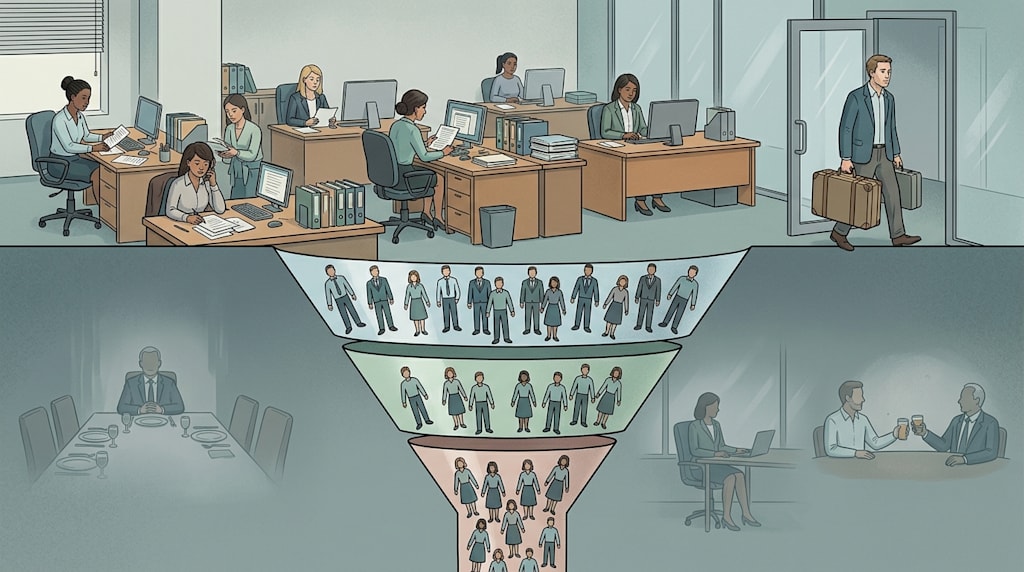
At the dinner table, female HR is presenting the plan in the meeting room; male HR is drinking with the boss. It’s access, not ability.
In traditional power networks, men are more easily seen and more easily enter these informal arenas. Add the motherhood penalty, and women are more likely to be interrupted during key promotion periods.
So the gender distribution in HR becomes a funnel:
More women at the bottom, more men at the top.
5. The real watershed: Dao, Fa, Shu, Qi
Earlier I mentioned that HR has a low threshold and mid- and entry-level pay is low. But I have also seen many “expensive” HR people.
So how do you become a more valuable HR professional?
Let me share a job-search story.
In an interview, I had an interesting chat with a boss (I ultimately chose this company). He humbly mentioned:
“Actually, I don’t really understand HR.”
This was a good moment to co-create and sell the HR philosophy.
I said: “Actually, you understand HR best. You understand the Dao; I understand the Shu.”
Seeing he was interested, I elaborated.
Laozi’s discussion of “Dao, Fa, Shu, Qi” in the Tao Te Ching has influenced management for centuries. After years in HR, I studied it carefully and found HR has a similar logic.
This is how I understand it:
The “Dao” of HR management refers to the objective laws, concepts, and thoughts of HR. It guides the direction, principles, and policies of HR work.
The “Fa” of HR management is systems, processes, and structures. Different companies, or the same company at different stages of development, need different “Fa.”
The “Shu” of HR management is professional technology, methods, and skills. For example, your interview with me today involves interviewing skills, talent assessment techniques, etc.
The “Qi” of HR management is tools. Such as basic knowledge, labor law, HR report templates, job descriptions, recruiting channels, etc.
These four are interconnected and progressive.
“Qi” is the lowest and most basic thing. It is the entry threshold. “Shu” is the professional experience and methods summarized when applying “Qi” in practice. “Fa” is the system formed on the basis of “Shu” and combined with the company’s actual situation. “Dao” is top-level design, the guiding ideology, general principles, and laws.
“Dao” is the hardest and deepest.
The Dao of HR management emphasizes pragmatism and fits the company’s reality.
What the boss understands is the Dao of business operations, management, and human nature. These determine the Dao of HR management.
Most people’s career cultivation logic is:
First learn Qi, then practice Shu, then master Fa, and stop at Fa. Few can comprehend Dao.
From shallow to deep, the logic is not wrong, but it is too slow. And each upgrade may hit a bottleneck.
HR’s development path cannot escape this rule either.
As the saying goes:
With Dao but no Shu, Shu can be sought; with Shu but no Dao, one stops at Shu.
So I suggest HR friends think about “Dao” in advance. Understand the Dao of business, human nature, and management. Then the Dao of HR will naturally open up, and Shu and Fa will also brighten.
This way, your career growth will be much faster than others, and your ceiling will be higher.
The same logic applies to other industries.
Keep your feet on the ground, but also look up at the stars. Only then can you stand higher, see farther, and see more clearly.
6. How to become an “expensive” HR professional
Among the young HR friends I know who earn 500k+ a year, the common traits are obvious:
Understand business, understand human nature, strong upward management.
If you can do one or two of these three, your value can exceed 95% of practitioners.
One HR friend meets with sales once a week. He knows which product makes money and which region loses. In his proposal to the boss, he doesn’t write “strengthen training.” He writes:
“East China new-hire three-month turnover is 40%. Each departure costs 12,000 yuan. Suggest putting the mentor system into regional manager KPIs.”
The boss approved it.
Another HR person works with finance on the budget. He turns recruiting cost, turnover cost, and training cost into one table. The boss looks at it and says: “From now on, HR reports will follow this.”
The higher you go, the less it is about “being a people person” and the more it is about “doing organization” and “doing business.”
Empathy is a ticket in, not a ceiling.
Men can train empathy. Women should not be locked into support roles by “empathy.”
Female HR professionals should dare to learn business, finance, and strategy, and dare to ask for power, resources, and visibility.
Male HR professionals should not think HR has no future. If you understand business, HR can be a path to COO or CEO.
Companies should reduce bias: flexible work, paternity leave, diverse evaluation, results orientation. Don’t let “who can travel, who can drink, who has no maternity leave” become hidden promotion criteria.
7. Final thoughts
Most HR professionals are women.
At the entry end, starting pay is low, and men are more likely to leave. In the process, job image, family division of labor, and stability preference keep women in mid- and entry-level roles. At the exit end, power structures, drinking culture, and the motherhood penalty push men toward the top.
The gender distribution in HR cannot be explained by one sentence: “women are more empathetic.”
It is the result of entry screening, process loss, and exit preference working together.
This ratio will change in the future.
As HR becomes more strategic, flexible work becomes more common, men participate more in child-rearing, and companies value diversity more, the gender distribution will become more balanced.
But the core remains unchanged:
Gender is not a moat, nor a ceiling. Value positioning is.
Most HR professionals are women, but “expensive” HR professionals are not divided by gender.
It only depends on whether you understand business, understand human nature, can manage upward, and can turn HR into organizational capability and organizational capability into business results.
The day I left the first-tier city, no one watered the pothos in the office.
Later I heard the new HR hire was a man. He left after three months.
Xiao Zhou, the recruiter, is still on the phone.
The data will change. But that row of desks in the office is still more women than men.
The lights are on. Dust is gathering on the keyboard covers.
About the Creator
Jin
Writer of reamstories
https://reamstories.com/jin
Enjoyed the story? Support the Creator.
Subscribe for free to receive all their stories in your feed. You could also become a paid subscriber, letting them know you appreciate their work.
Comments
There are no comments for this story
Be the first to respond and start the conversation.