
It could be necessary to transfer the magnificent city of Venice in order to protect it from increasing sea levels.
Rising sea levels outside of Venice

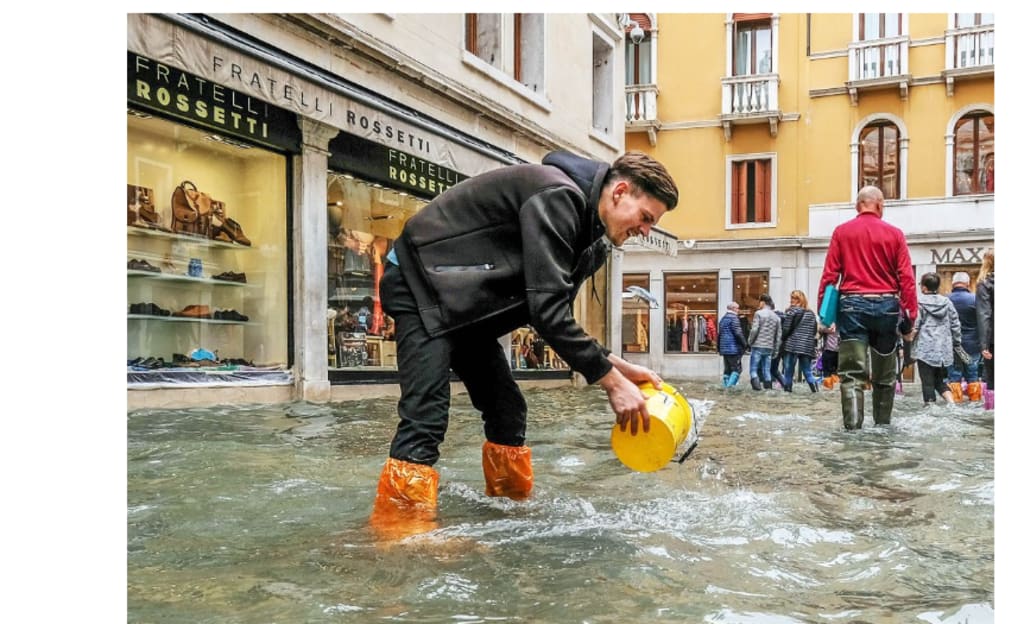
Venice's existing flood barriers can only temporarily shield the city from future sea level rise, according to a new report. Far more disruptive solutions, such as moving inland, become available after that approaching catastrophe. This discovery puts Venice's future in jeopardy and makes it necessary to think about what can be preserved as the water level continues to rise.
Venice is losing the battle against sea level.
The city's movable barriers serve as the first line of defence at the three inlets of the Venetian Lagoon. A group at the University of Salento under the direction of Professor Piero Lionello set out to examine the barrier system using sea-level scenarios spanning 200 years.
The method can only be expanded so far before Venice needs to adopt a new approach, the researchers discovered. If more steps are taken, the barriers might continue to work until the sea level rises by roughly four feet, but not much more. All other options can be used to conserve Venice more selectively once that threshold is reached. As a result, options become more expansive but less meaningful.
Defence as disturbance
Venice is located inside a UNESCO World Heritage site, where the city and lagoon are regarded as one cohesive location. Because less seawater circulation alters water quality and puts stress on fish, marshes, and ports, this unity deteriorates as gates remain closed for longer.
Additionally, the severity of flooding has increased, and recent studies have connected a number of acqua alta—Venice's extreme high-water flooding events—to shifting weather patterns. In the near term, each further closure saves brick and stone, but it also erodes the lagoon setting.
How Venice can withstand rising sea levels
The analysis identified four future paths from the existing open-lagoon system. Venice can continue to change, block the lagoon, form a ring around the city, or withdraw. The adaptation tipping points, which occur when a defence fails to achieve its objective, are used by the researchers to indicate when Venice has to alter its strategy.
Around 1.6 feet of increase is one early threshold, at which point ring dikes or a closed lagoon could be required. These choices are crucial since each postponed action reduces the opportunity for a more gradual shift in the future.
Walls that both divide and protect
The majority of the lagoon would remain open while ring dikes would create new walls around the historic core and neighbouring islands. Since rain and drainage could no longer naturally escape, pumps and sewers would keep water below street level inside the rings.
Between $540 million to $4.9 billion might be spent on construction, which is less expensive than moving but still sufficient to change the way people travel and travel now. While residences and monuments are preserved, the daily connection between Venice and the surrounding sea is diminished.
Creating a New Coastal World
Venice's waters would become a regulated coastal lake with larger outer defences and permanent dams if the lagoon were closed. Beyond the bounds of current barriers, the concept could keep the city dry through a rise of almost 33 feet.
A super levee, a very broad embankment designed for severe floods, is another extreme variation that could provide even more protection. Nevertheless, the lagoon ecosystem would not be able to continue in its current state, and the cost would exceed over $32 billion.
Maintaining pieces rather than location
Retreat is only discussed in the case of significantly greater water levels. Instead of treating it as a thought experiment, the study treats it as a viable alternative. Moving monuments inland and leaving portions of Venice completely may be the last resort once the water level rises over roughly 15 feet.
In that scenario, the metropolitan context typified by historical monuments could be destroyed at a cost of up to $108 billion. Only a few parts of Venice would remain in a new inland location; the full preserved city as people know it would not.
The price of substantial defences
Cost is another factor limiting the alternatives. The existing barriers in Venice are more complex and cost approximately $6.5 billion. Planning would need to start long before a crisis is imminent because large interventions can take 30 to 50 years to build.
While ineffective climate action just accelerates the need for expensive solutions, a low-emissions future could prevent multi-century sea-level rise. Venice might run out of practical time before it runs out of ideas, so waiting for a clear way would be dangerous.
Selecting a particular future over another
Because heritage, housing, employment, ecosystems, and everyday safety begin to clash, no proposal can save everything at once. According to Robert J. Nicholls, a professor of climate adaptation at the University of East Anglia, "our analysis shows that there is no optimal adaptation strategy for Venice."
Ring dikes cut off connections while protecting homes, whereas a These trade-offs explain why the study describes each option's specifics rather than identifying a single optimal solution.
Rising sea levels outside of Venice
Although Venice is given a lot of attention in terms of culture, this fundamental issue extends much beyond northeastern Italy. With a better understanding of its future, the city must decide whether to keep the existing barriers in place or completely abandon the city in the lagoon.
Emissions, funding, engineering, and public approval will all influence what occurs next, but the most difficult choice is figuring out what will be lost in order to save. The majority of low-lying coastal communities can temporarily adjust to changing water levels, but research indicates that these defences eventually run out.
According to Nicholls, "this study shows that all low-lying populated coastal areas should recognise the challenge of long-term sea-level rise and start considering adaptation implications now." Venice serves as a cultural and physical warning, giving other coastlines a sneak peek.
About the Creator
Enjoyed the story? Support the Creator.
Subscribe for free to receive all their stories in your feed.
Comments
There are no comments for this story
Be the first to respond and start the conversation.