
"India and pakistan Clash After Kashmir attaack: Region on Brink of War"
"South Asia faces its most dangerous crisis on decades as global powersurge restraint"
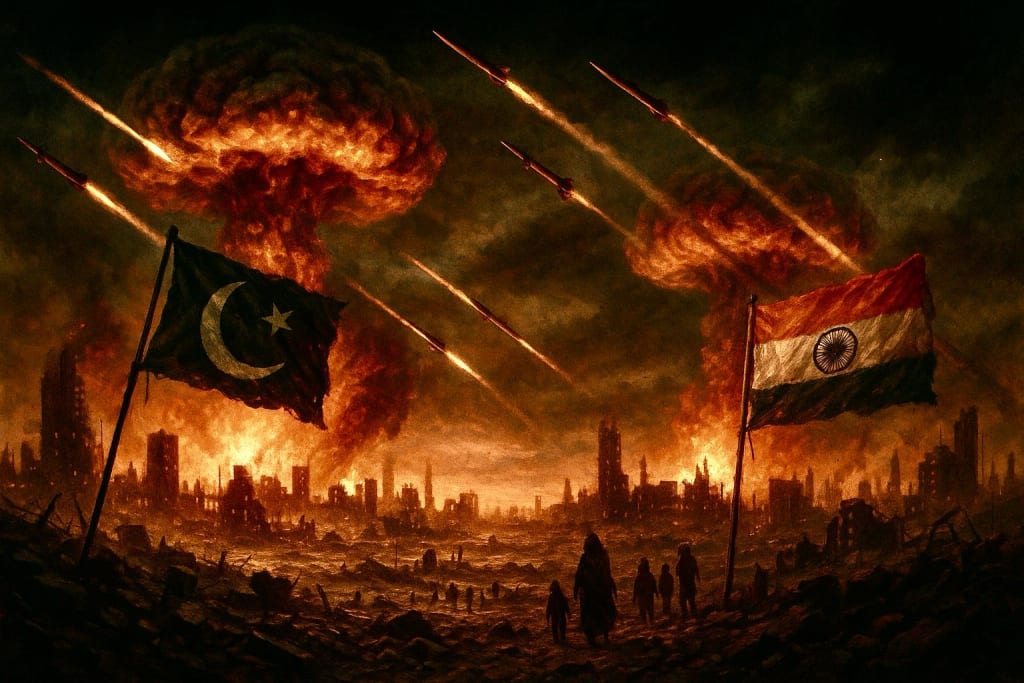
Is This Already a War?
As of May 2025, many are asking: Is this already a war between India and Pakistan, or just another round of military skirmishes? For the people living near the Line of Control, the distinction is meaningless. In the chaos, lives are being uprooted as bombs fall and jets scream across the sky. Politicians and military analysts may argue over the definition of “war,” but when two nations engage in repeated missile strikes, aerial dogfights, and mobilize civil defense drills on a national scale—while trad...
Background and Trigger: From Tragedy to Open Conflict
The seeds of the 2025 conflict were sown on April 22, when a deadly terrorist attack in Pahalgam, a serene tourist town in Indian-administered Kashmir, killed 26 Hindu pilgrims and injured many more. The attack, gruesome and well-coordinated, shocked the Indian public and stirred political outrage. Within hours, Indian intelligence agencies pointed to the involvement of the Pakistan-based group Lashkar-e-Taiba—a militant outfit with a long history of operations in Kashmir and deep links to past attacks, ...
Pakistan vehemently denied the accusation, calling it a “premature and politically motivated” charge. But India acted swiftly. On April 25, it launched “Operation Sindoor,” a high-precision military operation targeting alleged terrorist camps and command centers in Pakistan-administered Kashmir and parts of Punjab. The strikes utilized BrahMos cruise missiles, drones, and guided bombs, destroying several installations. Pakistan, viewing this as a breach of sovereignty and an act of aggression, vowed reta...
Operation Bunyan Ul Marsoos: Escalation and Retaliation
On May 8, 2025, Pakistan responded with “Operation Bunyan Ul Marsoos,” launching a series of coordinated air and missile strikes on key Indian military installations. The attacks targeted the Pathankot Air Force base, the Udhampur military garrison, and reported strategic points in Srinagar. Explosions rocked the region, forcing civilian evacuations and plunging towns into darkness as blackouts were imposed. Air raid sirens became a new normal in northern Indian cities.
India responded with more air patrols, expanding air strikes deeper into Pakistani territory and intercepting incoming drones and cruise missiles. The skies over Punjab and Kashmir have become battlegrounds, with both nations scrambling jets daily and conducting high-altitude reconnaissance missions. Though both sides have avoided deploying ground troops in large numbers, the military buildup along the border is unmistakable.
The Battles in the Sky: Modern Air and Missile Warfare
The most significant aerial battle occurred on May 7, involving over 100 aircraft. India deployed its advanced Rafale fighter jets and Su-30MKI multirole aircraft, while Pakistan countered with JF-17 Thunders and American-supplied F-16s. While official confirmations remain murky, unverified reports suggest a Rafale may have been downed, marking a serious blow to India’s air dominance narrative.
Both countries are relying heavily on modern warfare technology. India’s BrahMos missiles—known for their speed and accuracy—have struck targets deep inside Pakistani airspace. Meanwhile, Pakistan has countered with its Babur cruise missiles and indigenous loitering munitions. The use of drones has expanded rapidly, with both nations employing surveillance UAVs and kamikaze drones to gather intelligence and launch surprise strikes. SkyStriker drones, loitering munitions, and GPS-guided bombs have turned ...
Civilian Fallout: Lives in the Crossfire
The conflict’s impact on civilians is devastating. Entire villages along the border have been evacuated. Thousands of families in Jammu, Punjab, and parts of Azad Kashmir are now living in makeshift shelters, facing food shortages, medical emergencies, and growing trauma. Intermittent blackouts, disrupted internet access, and civil curfews have become part of daily life.
India, anticipating possible escalations, has conducted "Operation Abhyaas," its largest-ever civil defense drill, across more than 240 districts. The exercise simulated air strikes, missile hits, and nuclear fallout scenarios. Sirens, shelters, and emergency broadcasting networks have been activated nationwide. The fear is not just about war—it’s about the possibility of a nuclear exchange, however remote that may seem.
Global Reaction: Calls for Calm Amid Chaos
The world is watching with growing alarm. The United States has called for “urgent diplomatic dialogue,” while Russia and China have both...
About the Creator
Enjoyed the story? Support the Creator.
Subscribe for free to receive all their stories in your feed.
Comments
There are no comments for this story
Be the first to respond and start the conversation.