
In Bangkok's Lumpini Park, Giant Water Monitors Share Paths with Tourists

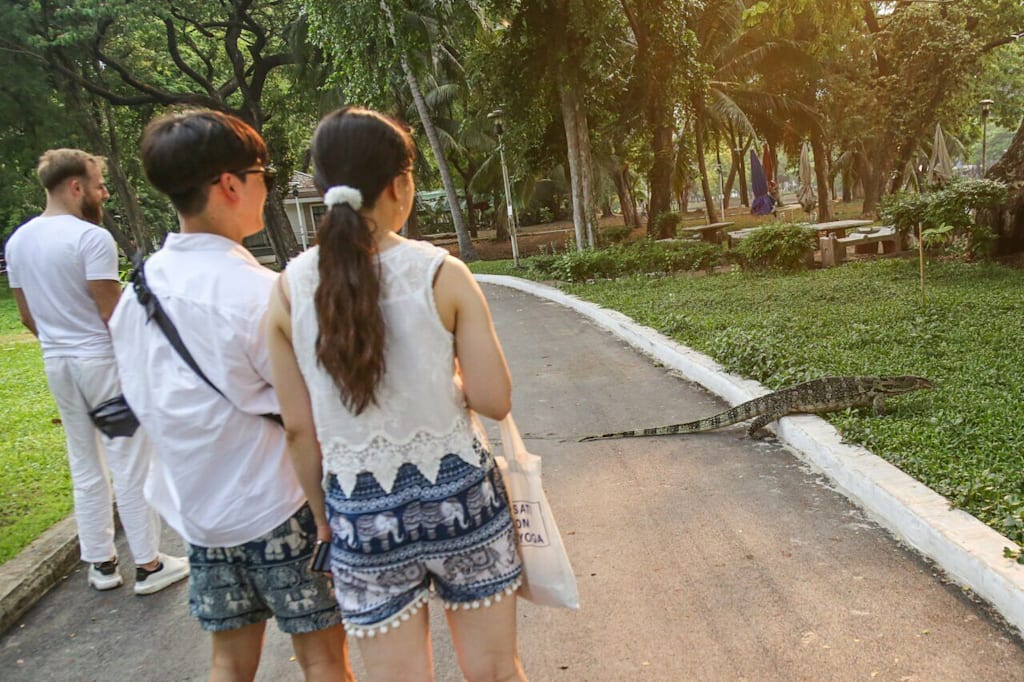
BANGKOK - At Lumpini Park in central Bangkok, a morning jog can come with an unexpected escort: a giant water monitor lizard crossing the path ahead of you. The scene is surreal at first, because cyclists, office workers, tourists, and these monitor lizards all share the same open space, often within a few feet of each other.
This green space is one of the most famous areas in Bangkok, drawing people who want fresh air, shade, and a break from the traffic. Visitors often walk past the statue of King Rama VI at the main entrance, honoring the monarch who donated this royal land to the public, before heading deeper into the park to catch a glimpse of the famous inhabitants.
That mix of daily life and urban wildlife is what makes the park so memorable, and it is also why the local population keeps getting attention. Estimates put the number at roughly 400 individuals, with some growing long enough to stop people in their tracks. Most of them keep to themselves, but their size alone is enough to turn a casual walk into a story you won't forget.
If you are planning time in the city, top attractions in Bangkok often include more than temples and malls. Lumpini Park shows a different side of the city, where nature does not sit outside of urban life, but rather moves directly through it.
Key Takeaways
Lumpini Park is a unique urban oasis in central Bangkok where humans and a resident population of roughly 400 giant water monitor lizards coexist in the same space.
The park provides essential habitat for the monitors, featuring a network of ponds, canals, and dense shade that allows them to thrive despite the surrounding concrete city.
Wildlife interactions are common but require caution; visitors are strictly advised not to feed or touch the lizards to prevent them from becoming aggressive or habituated to humans.
Early morning is the optimal time to visit for both exercise and wildlife viewing, as the cooler temperatures make the lizards more active and the park less crowded.
The monitor lizards are viewed through a cultural lens by many locals, with some regarding them as symbols of good luck or prosperity, further cementing their status as a protected part of the park's identity.
Why Lumpini Park has become home to giant water monitor lizards
Lumpini Park provides these reptiles with everything they need right in the heart of Bangkok. The park features sprawling lawns, dense shade, and a network of ponds and canals, allowing every water monitor to swim, bask, and hide comfortably. In a city crowded with concrete and traffic, this urban green space offers a vital habitat that sustains them. Often referred to as the Central Park of Bangkok, this expansive oasis provides the specific mix of water and cover that these creatures require to thrive.
A green oasis in the middle of Bangkok
Lumpini Park sits in central Bangkok and offers urban wildlife a rare patch of breathing room. The park's open grounds and interconnected waterways create a stable environment where reptiles can hunt, rest, and move between shady edges and sunny banks. They particularly flourish in areas where human activity is present but not disruptive.
The park's ponds and canals are essential to their survival. As a strong swimmer, the water monitor relies on the lake and waterways to travel, forage for food, and regulate its body temperature during the heat of the day. For a broader look at how the city manages its landscape, Dusit Central Park's green rooftop highlights the growing necessity for cool, livable urban habitats.
The park is one of the few locations in the capital where wildlife can freely navigate through water, shade, and open ground in a single, protected environment.
What the monitor lizards eat and why they stay near people
These are Asian water monitors, not Komodo dragons, and they have adapted remarkably well to city life. As opportunistic scavengers and hunters, they thrive on the resources the park provides, including fish, eels, turtles, birds, and occasional food scraps. This makes the area a reliable source of nutrition, especially near the ponds and popular walking paths.
Human interference changes their behavior significantly. When visitors feed them, the lizards lose their natural caution and begin to associate people with easy meals. This behavior draws them closer to paths and picnic areas, which is the primary reason why authorities strictly advise against feeding the wildlife.
For more context on the city's large urban reptiles, BBC's report on Bangkok's giant water monitors offers a useful look at how closely they now share space with residents.
How joggers, cyclists, and lizards share the same paths
Lumpini Park works because everyone uses it a little differently. Dedicated runners enjoy jogging around the artificial lake, cyclists pass through on a set schedule, and giant water monitors drift between the water, shade, and open paths at their own pace. The result feels surprisingly ordinary after a few minutes, as if Bangkok has made room for both a workout track and a wildlife corridor.
You will often see the park at its calmest in the early morning, when runners are getting their laps in, and the monitors are warming up on the banks. For a broader look at the park's fitness culture, Lumpini Park aerobics classes and groups practicing tai chi are part of the same daily rhythm, especially when people gather for exercise before the day gets hot.
Best times to visit if you want fewer crowds and more lizard activity
Early morning is the best time to see active monitors and avoid the heaviest crowds. Dawn is especially good because the park is cooler, quieter, and the lizards are more likely to be out near the water or crossing paths before the sun gets strong. If you arrive before sunrise, you get the best mix of movement and space.
Time of DayBest ActivityDawnPrime wildlife viewing and jogging10:00 AM – 3:00 PM Designated time for cyclistsSunsetCooler temperatures for casual walks
The park is officially open from 4:30 AM to 9:00 PM. A second good window for viewing comes later in the morning, but dawn still gives you the cleanest wildlife viewing.
If you want the park at its most natural, get there early. The lizards move more, the heat stays lower, and the paths feel less busy.
Park rules that shape the experience
The rules at Lumpini Park shape how people and wildlife share the space. Visitors should not feed the monkeys, smoke, drink alcohol, use drones, or nap in the park. Those limits keep the animals from becoming too used to people and help the park stay orderly for everyone.
Cyclists also need to follow the designated riding window, which is 10:00 AM to 3:00 PM. Security enforces that schedule because the park is busiest with walkers and those jogging outside that window, and the narrow shared paths can get crowded fast. Running is allowed throughout the day, so runners have more flexibility than cyclists.
Where runners and cyclists usually notice the monitors
Most people spot the lizards near the main artificial lake, along shaded edges, or close to the water where they can bask and move without much effort. The banks give them sun, cover, and easy access to swimming, so they tend to linger there longer than on open grass.
You may also notice them near quieter path sections, especially where trees cast deeper shade. They often appear suddenly, like a gray-green log that decided to move, so keep your eyes on the ground ahead and the waterline beside you. That simple habit makes the park feel less surprising and a lot more enjoyable.
Are Lumpini Park monitor lizards dangerous to visitors?
For most visitors, the answer is no, provided you give them ample space. These monitor lizards in Lumpini Park usually avoid people and keep moving unless someone gets too close, blocks their route, or attempts to feed them. While they look intimidating, calm behavior from visitors goes a long way in ensuring a peaceful coexistence.
The real risk arises when people treat these animals like pets or photo props. A monitor lizard that feels cornered can lash out with its tail, bite, or scratch, turning a harmless sighting into a dangerous situation. Their mouths also carry bacteria, so any bite requires immediate medical attention. For a broader look at how closely Bangkok and its wildlife overlap, the BBC's report on Bangkok's giant water monitors gives useful background.
What visitors should never do near a monitor lizard
Keep your distance and do not try to interact with the wildlife. Feeding is the biggest mistake because it teaches the animals to approach people, making them bolder around paths, benches, and the water's edge. Chasing them, throwing things, or standing in their path can also trigger defensive behavior.
Beyond these interactions, please observe park regulations:
Do not feed the monitor lizards, even if they seem calm.
Do not touch or pose with them, no matter how slow they appear.
Do not block their path, especially near water or shade.
Do not chase or corner a monitor lizard, as panic changes their behavior quickly.
Do not startle them with sudden moves, loud noises, or off-leash dogs.
Adhere to the strict smoking ban enforced throughout the park.
Note that pets are generally not allowed inside the park grounds.
Professional or commercial photography requires a specific permit from park management.
Once a reptile learns that people bring food, it stops seeing visitors as background noise. Instead, it starts hanging around like an opportunistic guest that refuses to leave the buffet.
How to stay safe while still enjoying the park
Stay calm, keep a few steps back, and let the lizard move first. If you are jogging or walking in Lumphini Park, slow down when you spot one near the path and pass on the side with the most open space. Around the lake, watch your footing and avoid stepping into brush or down to the water's edge.
If you are concerned about your surroundings, please note that pets are generally prohibited to ensure the safety of both visitors and the local fauna. For park rules and daily access details, Lumpini Park's exercise routines show how locals already share the space with a steady rhythm that works.
Above all, treat the monitor lizard like any wild animal, not a park mascot. Give it room, and it usually gives you a perfect, safe view.
The cultural meaning behind the park's giant lizards
In Lumpini Park, the giant water monitors are more than unusual wildlife. For many locals, they exist within a web of old beliefs, city habits, and an everyday respect for nature that persists in modern Bangkok. That is why people often watch them with curiosity instead of fear.
Why some people see them as a sign of good luck
In Thai culture, the monitor lizard, often called "hia," can carry a meaning tied to prosperity. Some people believe seeing one may bring wealth or good fortune, and older stories even connect the animal with money coming into the home. That belief gives the lizards a unique social status. They are not just big reptiles by the lake; they are also symbols people notice when they want a hopeful sign.
This matters in daily life because beliefs regarding luck shape how people talk about animals, homes, and public spaces. A lizard crossing your path can feel like a small omen, the kind people remember when business is slow, or expenses are high. In a city where so much feels rushed, that little spark of meaning can stick.
For some visitors, the lizards are a photo stop. For some locals, they are a lucky sign.
The idea also helps explain why the animals feel familiar rather than purely wild. If you want a closer look at how the city blends daily life with green space, the area around Lumpini Park and Central Park Bangkok shows that mix in a different form, inviting comparisons to the iconic green space often called the Central Park of Thailand.
Why the park keeps some lizards instead of removing all of them
Lumpini Park did relocate some monitors when the population grew too large, but officials left others in place for a reason. The lizards are part of the park's identity now, and they draw visitors who come specifically to see them, especially tourists looking for a story they cannot find anywhere else.
The decision also reflects local tradition. When a city landmark becomes tied to memory, belief, and routine, people rarely want it stripped down to nothing. In that sense, the lizards are part of the park's character, much like a familiar clock tower or a historic landmark tree.
Park staff also understand the practical side. A visible population helps keep the park lively and distinct, as long as the animals stay managed and people give them space. That balance is why Lumphini Park still feels like a shared place, one where joggers, families, and giant monitors all have a role in the same scene.
What visitors need to know before going to Lumphini Park
Lumpini Park is easy to enjoy because it remains low-key and affordable. You can walk in, explore at your own pace, and spend as much or as little time there as you want. Situated between Rama IV Road and Ratchadamri Road, the park is simple to reach from central Bangkok, making it a practical stop whether you are staying nearby or just passing through the city for the day.
Getting there by train or on foot
The easiest way to reach Lumphini Park is by public transit. If you are using the MRT, get off at MRT Silom or Lumphini Station on the Blue Line. If you are taking the BTS, BTS Sala Daeng is the closest skytrain stop, and it is only a short walk across Rama IV Road.
That convenience matters if you are staying in central Bangkok. From Silom, Sathorn, or nearby hotel areas, you can often reach the park without a taxi at all. The entrances are close to the main roads, so once you exit the station, the park feels almost right there.
A quick transit guide helps:
MRT Silom is a good choice for the main entrance.
MRT Lumpini works well for a short walk in.
BTS Sala Daeng is useful if you are already on the Skytrain line.
The park is free to enter, so the cost of your visit can stay very low if you use the train.
Must-Visit Amenities
Lumphini Park has the basics covered, which makes a big difference in the Bangkok heat. You will find that these facilities make your visit much more comfortable:
Public toilets are available throughout the grounds.
Drink vendors and small food kiosks are located near popular areas, so you do not need to plan every detail.
Free outdoor exercise areas are a staple here, where you will see locals stretching and using the fitness stations.
A playground is available for families traveling with children.
Swan boats can be rented to drift across the lake, providing a relaxing view of the city skyline.
Paddle boats are also available if you prefer a different pace while exploring the water.
The Green Bridge connects the area to Benjakitti Park, offering a dedicated path for those who want to extend their walk or bike ride.
For a plain-English look at the park layout and visitor notes, this Lumphini Park guide is useful.
A quick look at the park's atmosphere
Expect a mix of movement and calm. Early mornings bring joggers, tai chi groups, cyclists, and people doing aerobics, while the lake and trees give the park a softer side. The city skyline sits in the background, so you never forget you are still in Bangkok.
Wildlife is part of the scene too. Birds, fish, and the park's famous water monitors often appear near the paths and water edges, especially when the air is cooler. That contrast is what makes the experience feel unusual, because one minute you are watching office workers on their morning run, and the next you are looking at a monitor lizard sliding into the water.
Frequently Asked Questions
Are the monitor lizards in Lumphini Park dangerous to humans?
Generally, the lizards are not aggressive and prefer to avoid people. They typically only react defensively if they feel cornered, are surprised, or have been conditioned to expect food from visitors.
Can I feed the monitor lizards while visiting the park?
No, feeding the lizards is strictly prohibited. Providing food disrupts their natural behavior and encourages them to linger near public walkways, which increases the risk of negative human-wildlife encounters.
What is the best way to travel to Lumphini Park?
Public transit is the most convenient option for reaching the park. You can take the MRT to Si Lom or Lumphini stations, or use the BTS Skytrain to the Sala Daeng station, all of which are within a short walking distance of the main entrances.
Are there any specific rules I should know before entering the park?
Yes, visitors must adhere to several rules, including a ban on smoking, alcohol, and using drones. Additionally, pets are not permitted inside the park, and cyclists must restrict their riding to the designated hours of 10:00 AM to 3:00 PM.
Conclusion
Lumphini Park is one of the most memorable public spaces in Bangkok because it brings together city fitness, open green space, and giant water monitor lizards in a single daily scene. That unique mix is what makes a morning walk here feel so distinct from a typical urban park, and it is why so many visitors leave with a story to tell about the wildlife living right in the heart of the city.
The lizards have become an essential part of the identity of Lumphini Park, but they belong to the natural world, not to the people passing through. Visitors get the best experience when they keep a safe distance, follow the park rules, and let the monitors move on their own terms.
For travelers, that balance is the true appeal. You can enjoy a run, a bike ride, or a quiet stroll against a stunning backdrop of skyscrapers, then look up and spot a reptile that makes the city feel alive in a way few other metropolitan spaces ever do.
About the Creator
Enjoyed the story? Support the Creator.
Subscribe for free to receive all their stories in your feed.
Comments
There are no comments for this story
Be the first to respond and start the conversation.