
I sped through 4.5 hours of Justin Sun and Shao Ailun. Here is what stayed with me.
Two men, one long interview, and a trade in theories, influence, and a few uncomfortable truths.
I watched the whole thing at double speed. There was substance. There was filler.
What stuck with me was not what Justin Sun said. It was why he said it. Not what Shao Ailun asked. Why he sat there and listened.
The interview had a clear shape. One man wanted his theory adopted by a bigger name. The other wanted his personal brand to reach a larger audience. Four hours was not an accident. Length creates the feel of a serious conversation. It also gives both men room to stretch their ideas.
Lean muscle is a frame that explains everything and nothing
Justin Sun opens with his new plan. He wants to train for lean muscle. He gives himself three to six months. He is 172 centimeters, 75 kilograms, 29 percent body fat.
I found this part hard to take.
Lean muscle and fitness are two different things. Lean-muscle theory mixes them on purpose. Fitness is concrete. Lean muscle is a phrase. Once you equate the two, every argument can be shoved into that frame.
The frame now explains success and failure. If a successful man has lean muscle, he is disciplined and deserves his results. If a successful man does not, he is rich but missing a scarce resource. His health will catch up with him. Musk gets re-scored by this standard. So do Buffett and Trump.
A theory that explains everything says nothing.
Justin Sun uses lean muscle to compare himself with Musk, Buffett, and Trump. I think he picks the wrong test. Those three have plenty to learn from. Applying a lean-muscle ruler to them does not work. Musk lifts. Trump plays golf. They know fitness matters. They just do not follow the lean-muscle playbook. Not having lean muscle is not the same as opposing fitness.
AI in daily life: the part Justin Sun gets right
Justin Sun uses Claude Code to manage his health. He photographs meals before and after. The AI estimates calories and nutrients. He logs weight, sets, reps, and videos. He tracks progressive overload. He wears an Oura Ring for sleep. The AI writes a daily summary in a local Markdown file. He wants the data stored independently so he can switch AI tools later. He says Claude at 200 dollars a month is too expensive. Ordinary people can use free tools like Zhipu or Kimi.
This part made sense.
Many people say they use AI. AI has not touched their daily life. They chat. They ask a question or two. Justin Sun has handed large parts of his routine to AI. He says a person with less than 1,000 yuan a month can still build a system with free AI. He lists four parts. Sun-ology handles wealth and life strategy. Lean muscle handles the body. Yellow Hair theory handles independent judgment. AI handles information, analysis, and execution.
Those four parts still sound like packaging. They take abilities people should already have and give each one a theory shell. The core is old advice. But that depends on the reader. I have seen too much of this. Someone new to it might find it fresh.
His method: spend two to four months collecting your own data. Health, work, spending, skills, interests. Feed it to different AIs. Get several action plans. Watch technology. Pick a direction you like and have an edge in. Adjust with feedback.
For ordinary people, the barrier is lower than it looks.
AI lowers the barrier. The opportunity is somewhere else.
Justin Sun thinks AI has lowered the entry point for professional knowledge and research. Young people can reach resources that used to belong to top academic institutions. He uses math as an example. AI can connect research paths and help with reasoning. Young people can work on frontier problems sooner.
He does not say where the opportunity is. AI lowering the barrier is true. It is also old news.
He points to price differences in AI APIs and subscriptions. Business opportunities come from regional gaps in information, cost, and supply and demand. He says treat the whole world as potential customers. China’s supply chain, AI tools, and cross-language ability can help young people sell globally.
The point is old. The example is useful. Tokens are cheap in Argentina, Turkey, and Nigeria. They are expensive in the United States. That gap is an opportunity.
He names several fields. Math and astronomy, where large data sets need human handling. Biotechnology, genetic analysis, drug development, proactive health management. Health insurance and related financial products. AI infrastructure, data labeling, model applications. Crypto, stablecoins, and payment rails for AI.
The common thread: wherever data and automation can redo the cost structure, there is room.
I agree with that.
Optimal stopping and scout thinking
He uses scouting in games to talk about decisions. Before buying a house, look at a hundred. Before buying a car, compare many models. Before choosing a career, study many industries and jobs. Build an information baseline first. Then decide where to put your money.
I agree.
He gives a math problem. You can look at ten opportunities in order. Once you pass one, you cannot go back. When do you start choosing? His answer: the first few opportunities build your baseline. After that, when one clearly beats the baseline, consider acting.
This is the optimal stopping problem. The classic secretary problem says observe about 37 percent first. Then pick the next candidate better than all previous ones. The golden-ratio phrasing in the interview does not match the classic result. But the principle holds. Build a baseline. Then act.
Many people do not have too few options. They have a bad baseline. If you have seen one apartment, you think it is heaven. If you have interviewed at one company, you think it is the best job in the world. Looking at a hundred apartments is not about buying the 101st. It is about knowing what is good, bad, and normal.
Carbon-based server and silicon-based system
Justin Sun calls the body a carbon-based server. He calls AI a silicon-based system. AI can run many tasks at once. A person has one body. If the body fails, money and computing power cannot act for you. He also says Musk, Buffett, and Trump have a cognitive problem about fitness. He uses walking in old age to explain why strength training matters.
Using those three as examples does not work. I explained why.
He compares muscle to a bank deposit and a strategic reserve. Building muscle when young saves mobility and health for old age. I do not oppose training muscle. I dislike turning it into a universal metaphor. Not everything is an asset.
The carbon-based server image is useful. No matter how much silicon-based computing power you have, one body executes. If the body collapses, AI, money, and computing power cannot walk, breathe, or live for you.
“The online harassment saved me”
Justin Sun says he used to think training muscle was mainly for attracting women. He also worried that muscle training hurt health. After online criticism, he studied training, nutrition, and body management. He used AI to change his old views. His words: “Everyone’s online harassment actually saved me. It made me realize for the first time that I may indeed be a poor man physically.”
This is the part of Sun-ology I respect most.
If you curse him, he asks why. He looks for something he can use. If you praise him, he asks why. He looks for what you want and how he can benefit. His core is to make himself better. He does not spiral into, “What do I have to do so you like me?”
That algorithm matters more than lean-muscle theory.
Live near water and grass
He proposes living near water and grass. Move as opportunities and resources change. Geography, work, industry, and assets should stay liquid. He does not recommend that young people get locked down early by a house, a car, or a fixed life.
I agree.
I have written about filtering your environment. People are not plants. You do not need to root yourself in one place and die there. Where there is water and grass, go. Houses and cars are not forbidden. Just do not let them become chains. If you lock yourself into a mortgage in your twenties, you will not dare change cities, industries, or plans in your thirties. Liquidity is an option. When you are young, options beat assets.
Banana, IP, and Trump
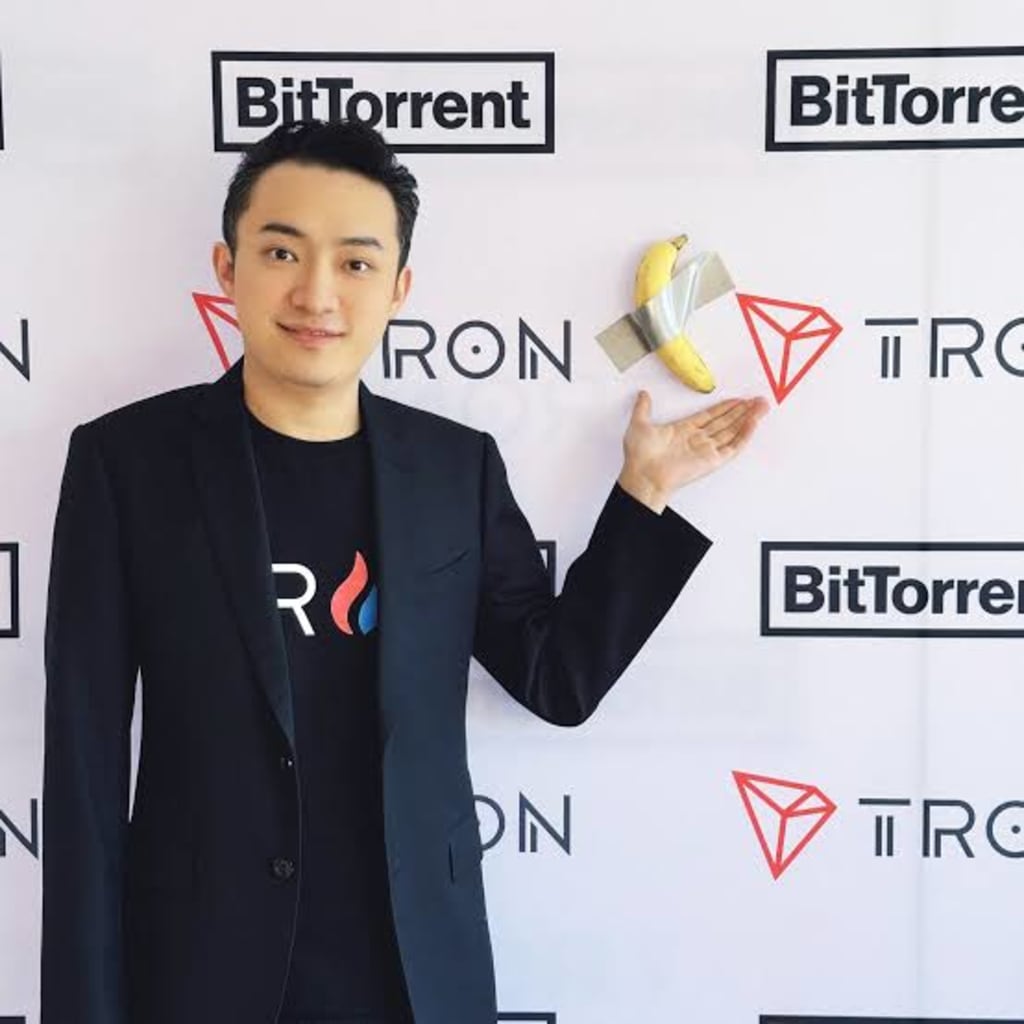
Justin Sun sees the banana conceptual art he bought as an IP asset. It can spread globally. It ties to his name. It is not limited by location. It can be shown around the world. Its value includes recognition, reach, and personal brand.
Once you see this, you see why he took the interview.
He values Shao Ailun’s skill. Shao can take a word or a claim and rub it into a language frame. The frame explains any result. It becomes a theory. That spreads fast. Justin Sun wants influence. The six-million-dollar banana was for influence. This interview was for influence.
He compares Trump with Chanel and Ferrari. Traditional brands build a product first. Consumers know the product, then the founder. Trump turned his surname into a brand. Then he applied the name to other industries.
Part of Justin Sun’s business model is making his name valuable before the product. The banana, the interviews, the naming of his thought system, the Sun Prize, a future museum. All of it fits long-term personal brand management.
He walks that path with clear eyes.
Crypto narrative and TRON
He says Crypto turns traditional money into a financial language machines and the internet can process. He contrasts this with centralized finance. He points to digital ledgers, automatic execution, and payment interfaces. He says these fit AI participation in the economy.
I checked this against what I know. Crypto has three uses that hold up. Bitcoin is digital gold and a store of value. It resists censorship and is decentralized. Ethereum is a smart contract platform. DeFi on Ethereum has lending and trading. USDT is a stablecoin with demand in cross-border transfers and sanctions evasion. TRON has value mainly because USDT is issued there and fees are low. Almost every other altcoin has no practical use. They are speculation.
Justin Sun’s talk about machine language sounds advanced. It is a narrative for TRON. Shao Ailun has a gap in his Crypto knowledge. Justin Sun is an operator. Not understanding the tech is normal for his role.
His logic: humanity has accumulated knowledge for thousands of years. Machines cannot directly understand much of it. The future needs translation. Math proofs into Lean. Financial transactions into programmable rules. History, culture, and libraries into machine-readable data. If a person’s research and experience are not digitized, AI cannot use them. Their role in machine civilization will be small.
He tells a story. A mathematician at NYU told OpenAI his ideas for cracking the Navier-Stokes equations. OpenAI used 7 million dollars in computing power. Thousands of AIs ran overnight. Two days later, it was done.
That may be true. AI is producing more math results. For humanity, AI can speed up knowledge production. The original researcher may not get all the rewards.
Separate the work from the person
They talk about motive attribution. Justin Sun says evaluate a technology, product, or claim by what it does. Do not judge only by the creator’s character, fame, or profit motive.
I agree.
A celebrity with a messy private life may be famous because his book is good or because he has ability. Look at the work and the person separately. The internet magnifies private morality. Most people can still tell the difference. It is also normal to dislike a man who makes money, stays loud, promotes himself, and then gets dirt dug up.
Shao Ailun says his skill is English content and personal IP. His investments are in Crypto. Justin Sun says there is no conflict. A person can work in one field and invest in another. He bought Apple stock in 2007 after touching an iPhone. He bought Tesla stock in 2012 after touching a Tesla.
Being optimistic about an industry does not mean you must work in it. You can earn in your field and invest in another technology.
Professional ability decides how you earn. Investment judgment decides where you put the money.
This is Shao Ailun’s awkward spot. He chases traffic. He does not give people anything practical. Lean-muscle theory is the same. Other bloggers have an analytical system. Here, everything is explained through lean muscle. It feels like play. The two do not go deep here.
Shao Ailun’s awkward position
Justin Sun thinks personal media influence is growing. He used to work in media. Traditional media had editors pick topics. Reporters executed. A small group controlled what entered public discussion. The internet changed that. Ordinary people can speak and compete for attention.
Joe Rogan is his example. One creator can build social influence close to a large media company.
Everyone knows barriers are lower. The problem is that self-media is hard now. Everyone fights for the same attention. Content is excessive. Attention is scarce. Advice and principles are piled into mountains. No one can read them all.
My judgment: knowledge is not scarce. The ability to organize knowledge and give it a name is the new competition.
Shao Ailun can name things. Lean-muscle theory is a name. But after the name, what? You need something inside. Otherwise the name is an empty shell. The wind knocks it over.
At the end, Shao Ailun says he sent Justin Sun a self-recommendation message a year ago. He wanted to join the team for content and personal IP. Justin Sun says he will look at the letter.
A year ago, Shao Ailun was not famous for lean-muscle theory.
A year later, they sat for four hours and used each other’s language.
Shao Ailun already had a long-term interest in personal IP and content. Moving from English teaching to lean muscle may be another expansion of his creator identity. Justin Sun values IP and cross-platform reach.
The interview’s position is clear.
Cognition is not the starting point. Execution is.
Justin Sun says that before symptoms appeared, he used AI to organize checkups. He went to the hospital for blood sugar, blood lipids, and cholesterol. He wanted a system that collects data, spots risk early, and adjusts habits. He says cognition decides long-term results. Wealth, body, and career are external signs of cognition. To change results, update cognition.
I think this is nonsense.
If you do not have one skill, what are you using to talk about cognition? Cognition is for people who already have something and want to go higher. Justin Sun is successful. From his position, talking about cognition is fine. A beginner with no skills who listens to this is doing armchair strategy.
My view:
A beginner needs to understand which industry to enter. Then master skills. Use work for feedback.
A person with skills can think about allocating resources, organizing teams, and using trends to amplify results.
Execution comes before cognition. Many people skip this. You read books and watch interviews. Your hands do not move. That is armchair strategy.
The success paradox and the empty cup
They talk about Small Ego. Justin Sun says past success ties a person to old experience. The more successful you are, the less you accept new information that conflicts with old judgments.
He uses ByteDance and Baidu. Zhang Yiming went from Toutiao and Douyin to Doubao. One reason is that he learned new things. Some companies that won the last round treat old experience as a permanent rule. They fall behind.
He gives a paradox.
The more successful you are, the more reason you have to trust your past judgment. The more you trust it, the easier you miss the next change.
This explains why some companies win the first round and lose the second. Treating success as an eternal rule is a risk.
This is what I admire about Justin Sun. He keeps an empty cup. He learns. Look at a math master like Shing-Tung Yau. Some of his ideas do not keep up. People online call him an old geezer. Nobel laureates in literature rarely produce more famous work after winning. Mathematicians past thirty or forty rarely produce major results. The root is learning new things. The higher you go, the harder it is. He does it. He has something.
Being willing to accept new knowledge and judging its reliability are two different abilities.
He also says he tried to convince Buffett to buy Bitcoin over dinner. Buffett did not buy. He missed the investment.
Shao Ailun says you can see learning ability in whether a person changes behavior after getting information. Justin Sun calls cognition a loop of input, judgment, and adjustment.
I agree with that.
Wealth, freedom, and the amplifier
Justin Sun compares social change to a version update in Honor of Kings. A hero is strong this version. Next version, it may be weak. Industries, business models, and assets are the same.
This also shows the core skill of an internet celebrity. You must keep creating hot topics. Sun has not stopped.
He looks back at the financial freedom he proposed in 2016. The core has not changed. He adds AI, health management, and new technology. He calls this patching an old theory.
Justin Sun says freedom is a choice ability and a cognitive state. The more freely you choose profession, city, partners, and opportunities, the more likely you enter high-return fields. Wealth expands choice. Freedom and wealth push each other.
I agree. Freedom is something you give yourself. The threshold is in your mind, not your bank card.
They say wealth and muscle are external results. To keep them, you need cognition and behavior systems. They use physical labor and lottery winners as examples. Receiving a resource passively and managing it long term are different.
My long view: wealth is a reward after you accomplish something. Do not chase wealth directly. Muscle is the same. Do not stare at muscle. Chase a state of life. When the state is right, money and muscle follow.
Justin Sun says wealth will not solve cognition, health, or relationships. He calls money an amplifier. After you get money, your habits, cognition, and behavior patterns amplify.
This metaphor is accurate. Money does not change you. It amplifies you. Whatever you are, money makes you more of that.
Relationships, traffic, and truth
He admits he is still exploring marriage and intimacy. He has no clear answer. He says love is subjective. Money can change conditions. It does not necessarily change feelings. Even people who analyze relationships for others may lose clarity when they fall in love.
About the relationship he mentioned, I think Justin Sun was invested at some stage. He is also clear about its value for spreading his name. Emotion and traffic mix in him. He was hurt. He also knows being hurt earns attention.
This is his complexity. You cannot say he is only acting. You cannot say he is only sincere. He may be both. He may be sincere and know how to turn sincerity into traffic.
Earth Online, creation, and consumption
Justin Sun compares life to Earth Online. He has not figured out the rules. He is still exploring the mechanics. He has no final meaning. Instead of fixing what life must accomplish, he wants more experience and understanding.
This matches my view. Life has no meaning. Exploration is the value.
He says going to space is about first-hand experience. Some things cannot be understood from materials. You must enter the environment.
He treats business as one path for exploring life. He uses Bolt breaking the 100-meter record and Ronaldo chasing goals. Entrepreneurs can explore business scale, industry boundaries, and personal limits. At twenty-two, he thought about starting businesses until he was 122. A full hundred years.
He hopes future entrepreneurs treat him as a reference point. He names three business models. Musk for engineering, technology, and new industries. Buffett for finance, long-termism, and compounding. Trump for personal IP, cross-industry moves, and influence.
He uses lean muscle to compare with these three. I think he gets the wrong answer. There is much to learn from them. The lean-muscle ruler does not hold up.
Justin Sun says he wants to work at OpenAI or Anthropic. He started businesses early. He has always been the boss. He lacks the view from below as an ordinary employee. His words: if someone could get me hired at OpenAI, I would pay 50 million dollars for free. They still would not want me. They fear I would steal information.
I believe this. If a person loves a job or a place, he can work for no money. He may even pay. Justin Sun wants the experience, not the salary.
He says everyone chases the experience they lack. Employees want financial freedom. Entrepreneurs want to know how a big company runs. Once a goal is reached, another lack appears.
They say life results are not designed at the start. They grow through long experience. Justin Sun gives Einstein, Nobel, and Li Yu. Nobel was known for explosives and industry. Later he became the symbol of scientific reward. Li Yu is remembered mainly for his ci poetry.
What you are remembered for may not match your original goal.
Justin Sun divides activity into creation and consumption. Creation includes entrepreneurship, research, writing, and education. Consumption gives experience, entertainment, and recovery. He favors creation, with necessary consumption and rest.
Money is not saved. It is earned. To earn, you create value for others.
After four hours
They wrap up with cognition updating through information, experience, and technology. They may talk again. Justin Sun opened with cognition. Wealth, body, and career are external signs. To change results, update cognition.
After four hours, there was substance and filler.
What I take away: First, Justin Sun’s empty cup. At his height, he still learns and can be awakened by one sentence. Second, his understanding of influence. The banana, interviews, and hot topics turn his name into an asset. Third, AI in daily life. Ordinary people can start by building their own data and records. The barrier is lower than it looks.
One more point: he keeps turning what he masters into assets that accumulate, copy, and spread. That is a new-era way to leave a name.
Shao Ailun stands at a threshold. The question is whether lean-muscle theory can continue. How it stays popular is unclear. He also needs to fix the shortcoming of giving no practical value.
The interview’s position is clear. One man wants his theory adopted by a bigger figure. The other wants his personal IP to reach a larger audience. After four and a half hours, both got what they wanted.
What the audience takes away depends on the question they bring.
If you want excitement, four hours is long. If you want to know how a top operator understands IP, AI, the body, and wealth, there is plenty hidden in those four hours.
About the Creator
Jin
Writer of reamstories
https://reamstories.com/jin
Enjoyed the story? Support the Creator.
Subscribe for free to receive all their stories in your feed. You could also become a paid subscriber, letting them know you appreciate their work.
Comments
There are no comments for this story
Be the first to respond and start the conversation.