
I Couldn’t Say “I Want a Raise.” So I Booked a 20-Minute Meeting Instead.
The script, the one-page sheet, and the four sentences I deleted before I walked into my manager’s office.
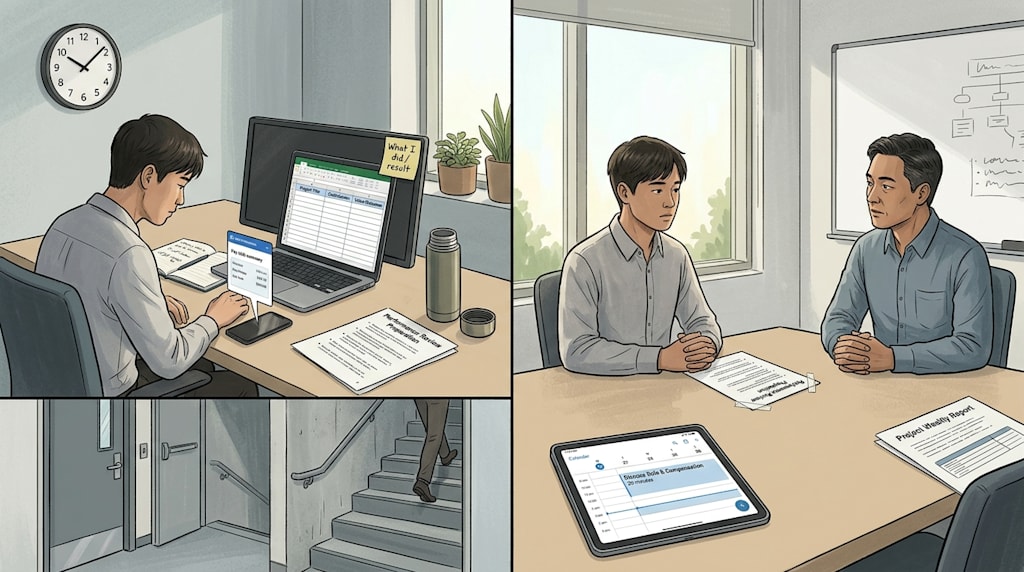
Monday morning, 9:40. Zhou Ran enlarged the screenshot of his pay stub, then shrank it again. In Excel sat the number his friend had gotten after a job change. Next to it was a column with his own monthly salary. He looked at the two numbers side by side for a while, closed the spreadsheet, and opened his manager’s chat window.
In the input box, he typed: “Boss, I want to...”
He deleted it.
He typed again: “Boss, do you have a minute?”
He deleted that too.
The only thing left in his phone notes was one sentence: “I want a raise.” He walked to the stairwell and practiced in front of the fire door: “Boss, I think my salary is a bit low.” As soon as he said it, he frowned. It sounded like haggling at a market. The words were light and weightless. They would not land on a table.
That afternoon, after the department briefing, his manager closed the laptop and asked, “Anything else?” Zhou Ran’s palms were sweating. He said, “I’d like to book 20 minutes with you to talk about my current responsibilities and how my pay matches them.” His manager glanced at the calendar: “Thursday, 3 p.m.”
Back at his desk, Zhou Ran first changed “I want a raise” into “What do I have to exchange?”
1. Often, you can’t speak up because you haven’t prepared a reason
His colleague Lao Chen listened and leaned back in his chair. “Just bring it up. What’s there to be embarrassed about?”
Zhou Ran asked, “Bring up what? That I work overtime? That I’ve been here a long time? That so-and-so makes more than I do?”
Lao Chen did not answer. He looked down and unscrewed the lid of his thermos.
Zhou Ran had already run those reasons through his own head, and none of them held up. Someone else’s higher salary was someone else’s contract. Being here a long time was just length of time. Working overtime was a process, not a result. If his manager asked, “So what?” he would have nothing to say.
He deleted the five words in his phone notes and opened a new Excel file.
In the first column, he wrote: What have I actually accomplished right now?
In the second column: What can others not replace me for?
In the third column: What can I take on next?
His typing slowed. Project A was scheduled for two weeks. He had compressed it to nine days. In the customer complaint log, there had been no new entries for six consecutive weeks since he took over. A colleague had quit, and Zhou Ran had been covering the reports for two extra hours every week. These things usually lay scattered across chat records and emails. Now he filled them into the spreadsheet, cell by cell.
When he reached the third column, he paused. The new project next quarter would require coordinating with three departments. His manager had said in a meeting that they lacked someone to track progress. Zhou Ran put his own name down, then added one more line: Can bring on a new hire.
Every cell held an action and a result. He did not write “hardworking” anywhere.
2. Price yourself first, then speak
Tuesday noon, Zhou Ran printed the spreadsheet down to one page.
The top half was results. The bottom half was the range he expected. He checked job postings for similar roles, asked a friend in HR roughly when the salary adjustment window would open, and wrote his ideal number, acceptable number, and bottom line on a sticky note. He stuck the note to the edge of his monitor.
There was one more line in small letters on the sticky note: Don’t say “I worked hard.” Say “What I did, and what the result was.”
He compressed his opening script into four sentences:
“I’d like to align with you on my current responsibilities, results, and how my pay matches them.”
“Over the past six months, I’ve been responsible for A, B, and C. The results were X, Y, and Z. I also took on D.”
“Based on that and the E I can take on next, I’d like my salary adjusted to the XX to XX range.”
“I’d like to hear your assessment, and I’d also like to understand the salary adjustment mechanism and timeline.”
By the third rehearsal, he had deleted “I think.” By the fifth, he had deleted “Is that okay?” He did not want to hand over the initiative with a question mark.
3. Don’t knock on the door. Send an appointment request.
Wednesday morning, Zhou Ran sent his manager a message: “I’d like to book 20 minutes with you to talk about my job responsibilities and how my pay matches them. I’ve prepared a one-page sheet covering changes in my responsibilities, recent results, and what I can take on next. Would Thursday at 3 p.m. work?”
His manager replied: “Okay.”
Zhou Ran added the meeting agenda. It had three lines: changes in responsibilities; recent results; pay alignment and the salary adjustment mechanism. No emojis. No “just a quick chat.”
Thursday at 2:55 p.m., he stood at the meeting room door with one page in hand. His phone was on silent. His manager came in still looking at his phone, then sat down and placed it face down on the table.
Zhou Ran pushed the page halfway across the table and began: “I’d like to align with you on my current responsibilities, results, and how my pay matches them. Over the past six months, I’ve been responsible for A, B, and C. Project A’s delivery time went from two weeks to nine days. Customer complaints have had no new entries for six consecutive weeks. I’ve taken over the reports left by the colleague who quit. Next quarter, the new project will require coordinating with three departments. I can track progress, and I can also bring on a new hire. Based on this, I’d like my salary adjusted to the XX to XX range. I’d like to hear your assessment, and I’d also like to understand the company’s salary adjustment mechanism and timeline.”
His manager picked up the page and looked at it for more than ten seconds. “Why this range?”
Zhou Ran turned to the second page. “The market range for the same role is here. My current responsibilities include two more items than the job description. My results from the past six months are here. This range is the middle of that band. I did not just make it up.”
His manager put the page down. “The budget is tight this year. The window may not open.”
Zhou Ran opened his notebook. “If the current window doesn’t work, I’d like to confirm two things: What criteria would I need to meet to be evaluated, and roughly when would that evaluation happen?”
His manager thought for a moment and named two criteria: keep the new project on track, and be able to handle cross-department coordination independently. The timing he wrote down was next quarter’s salary adjustment window.
Zhou Ran looked down and took notes. His pen paused on the paper. He asked, “I’ve written those two down. Before next quarter’s window, I’ll prepare according to these criteria, and then check in with you again. Does that work?”
His manager nodded. “Okay. I’ll note it.”
4. After a no, turn “failure” into “criteria”
Back at his desk, Zhou Ran first deleted the sentence in the chat box: “Then I won’t have any motivation.”
He sent a short email: thank you for your time; confirmation of the two criteria and next quarter’s window; the one-page sheet attached. The last line was: “I’ll move forward according to these two criteria and update you on progress before the window.”
Lao Chen came over. “Did it work?”
Zhou Ran said, “No. I got two criteria and one window.”
Lao Chen said, “What good is that?”
Zhou Ran stuck the page to the edge of his monitor and drew a line under “new project progress” and another under “cross-department coordination.” Whether it was any good, next quarter would tell.
5. The red lines are four sentences
In his notes, Zhou Ran listed four sentences he could not say:
“So-and-so is less capable than me. Why does he make more?”
“If you don’t give me a raise, I’ll leave.”
“I work so hard, and none of you see it.”
“If I don’t get a raise, I won’t have any motivation.”
After each, he wrote a replacement:
“I’d like my pay to match the changes in my responsibilities.”
“I’d like to understand what conditions I need to meet for a higher salary standard.”
“I’d like to take on more responsibility in the future, and I’d like my pay to be adjusted accordingly.”
“If the current window doesn’t work, please clarify the next criteria and evaluation timeline.”
The sentences he banned dragged coworkers, resignation, hurt feelings, and motivation into the room. The replacements kept the talk on duties, standards, and dates. His manager could work with the second set.
6. Closing
Before leaving work on Friday, Zhou Ran closed Excel. The calendar reminder “Next quarter salary adjustment evaluation” was still there. He archived the Thursday appointment email and opened the project weekly report, filling in this week’s progress.
Tomorrow at nine, he needed to send out the list of contacts for the new project. The one-page sheet was still stuck to the edge of his monitor. The corner had been lifted by the air conditioning. He pressed it down with a piece of clear tape.
About the Creator
Jin
Writer of reamstories
https://reamstories.com/jin
Enjoyed the story? Support the Creator.
Subscribe for free to receive all their stories in your feed. You could also become a paid subscriber, letting them know you appreciate their work.
Comments
There are no comments for this story
Be the first to respond and start the conversation.