
I Brought an Iced Coffee to a Job Interview. A Recruiter Called It a Red Flag.
The fight over a cup says more about who gets to define “professional” than about your resume.
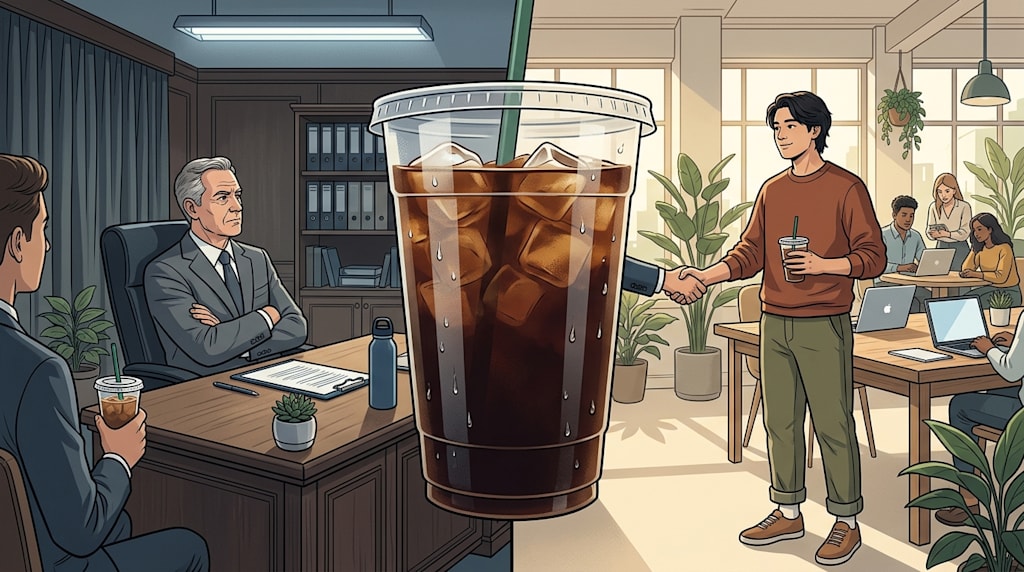
A recruiter named Caitlin posted a TikTok. She says she has spent 16 years hiring for Fortune 500 companies. Her point: when a candidate walks into an interview holding an iced latte, the interview can look like one stop in a day. Not the main event. The video drew responses on TikTok and LinkedIn. Some recruiters agreed. Some candidates pushed back.
Recruiters who agree rarely say the coffee itself disqualifies anyone. They point to smaller things: condensation on the cup, a wet palm before a handshake, a spill during a nervous gesture, the sound of a straw scraping an empty cup in a quiet room. Amanda Augustine, a career expert at Careerminds, suggests finishing the drink before entering the building. That removes the risks. She also says a blanket ban on drinks is too broad. The right call depends on the job.
LinkedIn News collected other suggestions. If you must bring a drink, hold it in your left hand. Keep your right hand dry for the handshake. Do not rattle the ice. Do not take loud sips. Put the cup on the floor beside your chair, not on the table between you and the interviewer. Accept water if it is offered. These are small moves. They can keep a small detail from becoming the story.
The other side says the coffee is not the problem. Using a drink to judge whether someone can do the work is. Colleen Batchelder, founder and CEO of Indiviti, works with Gen Z workers entering the job market. She says Gen Z tends to think about boundaries, fair pay, and work-life balance differently from some hiring managers. That gap turns a cold drink into an argument. Steve Levy, a talent acquisition leader at Form Energy, puts it plainly: recruiting should find people who can do the job. It should not police what they drink. He adds that workplace norms change. Whether an iced coffee is a problem should be separated from whether a candidate can perform.
The conflict is about the definition of professional. An interview is a short, high-pressure exchange. The company has limited information. The candidate has limited time. In that setting, small signals get read as evidence: a firm handshake, a clear answer, a neat outfit, a cup of coffee. For many hiring managers, the cup says the candidate is treating the interview casually. For many Gen Z candidates, the cup says nothing at all. It is a normal part of a workday. The same object lands in two different sets of rules. One side sees disrespect. The other sees a drink.
That gap does not mean either side acts in bad faith. The rules are not shared. Older hiring managers often learned that formal occasions require formal behavior. Gen Z workers often learned that formal behavior can test obedience rather than measure skill. When the two sets of rules meet in a 30-minute interview, a cup of iced coffee can stand in for a larger question: Is this company judging my work, or my habits?
Several things decide whether the drink helps or hurts. The industry matters. Finance, law, government, and traditional manufacturing interviews tend to be conservative. Creative and tech interviews tend to be looser, and startups often are too. The format matters. A panel interview with senior executives carries more risk than a coffee chat at a café. The company culture matters. If the office runs on T-shirts and cold brew, the drink may blend in. If the office runs on suits and formal memos, it may stand out. The interviewer matters. A 55-year-old hiring manager in a legacy firm may read the cup differently from a 28-year-old team lead at a software company. The drink itself matters. A bottle of water is low risk. A hot coffee can spill and burn. An iced coffee brings condensation and ice, plus a straw. The candidate’s judgment matters most. Reading a room is a job skill, not a surrender to old rules. Call it context judgment.
For candidates, the practical move is not to test the right to bring a drink. Decide what the room calls for. If the interview notice does not say, arrive early and finish the drink outside. If you bring it in, use your left hand. Keep your right hand dry. Place the cup out of the way. Skip the ice rattle. Skip the loud sip. If the interviewer offers water, take it. Keep the focus on your answers and questions. If you are rejected over a cup of coffee, treat that as information. The company may value form over substance. You may not fit there.
For employers, the argument is a chance to fix the process. State the expectations. Put a line in the interview notice: the interview lasts 45 minutes, please arrive 10 minutes early, water is provided. That removes guesswork. Train interviewers. Use structured questions and job-related scoring. Do not let a cold drink become a proxy for bias. Do not confuse a suit with competence or a coffee with disrespect. If you want to attract Gen Z talent, look at your culture. Transparent pay and clear boundaries matter more than whether a candidate carries a cup.
There is no single answer to whether iced coffee belongs in an interview. The answer depends on the job, the company, the room, and the person. The better question is what standard the company uses to choose people. A good interview lets both sides see the fit. A bad interview rejects a candidate over a drink. Workplace norms will keep changing. Respect and skill should not.
The ice will melt. The argument will not disappear. A future interview notice can say water is provided. A candidate can choose to finish the drink outside. That is a start.
About the Creator
Jin
Writer of reamstories
https://reamstories.com/jin
Enjoyed the story? Support the Creator.
Subscribe for free to receive all their stories in your feed. You could also become a paid subscriber, letting them know you appreciate their work.
Comments
There are no comments for this story
Be the first to respond and start the conversation.