
How to Source AIBN for Polymerization: Purity, Thermal Stability, Storage and Supplier Checklist
Why AIBN Sourcing Requires More Than a Price Comparison

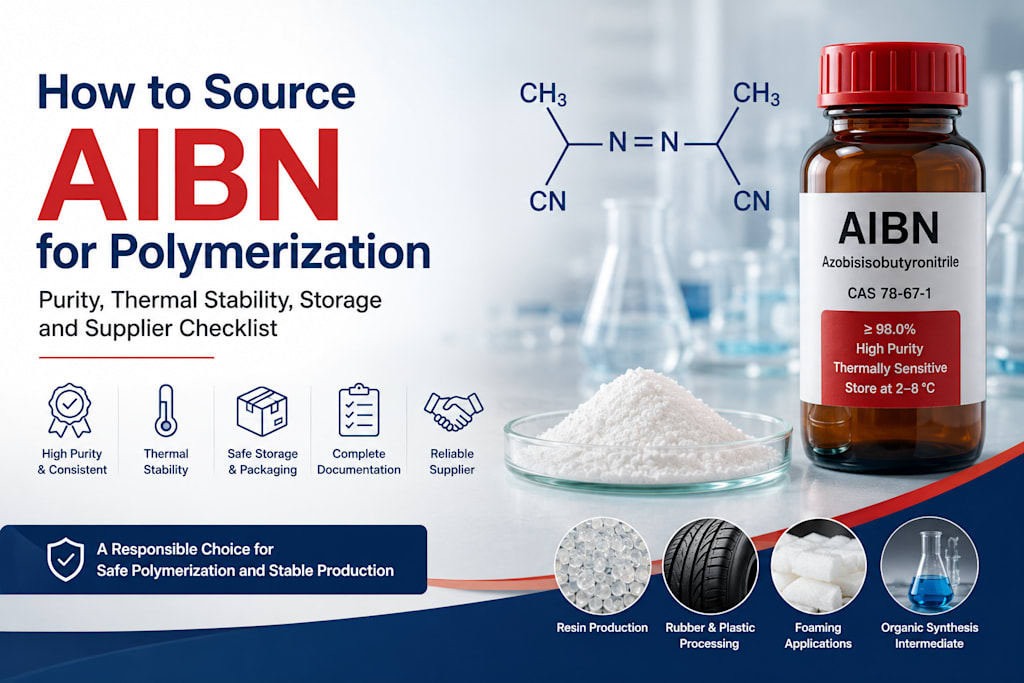
Azobisisobutyronitrile, commonly known as AIBN, is an azo compound widely used as a free-radical initiator. It supports applications such as resin production, free-radical polymerization, rubber and plastic processing, foaming, and selected organic synthesis processes.
Although buyers may begin by comparing assay and price, those figures do not provide enough information for a responsible purchasing decision. AIBN is thermally sensitive, so its storage history, packaging condition, transportation controls, and handling documentation can be just as important as the purity listed on a specification sheet.
For industrial users, inconsistent material may affect process repeatability, production planning, quality control, and inventory management. A strong sourcing program should therefore evaluate the product, the batch records, and the supplier’s ability to maintain appropriate controls throughout the supply chain.
Define the Intended Application Before Requesting a Quote
The first step is to explain how the material will be used. A procurement request that only says “AIBN CAS 78-67-1” may not give the supplier enough information to assess product and packaging suitability.
For free-radical polymerization, buyers should communicate the general polymer or resin system, expected reaction-temperature range, solvent environment, and required volume. This does not require disclosing a confidential formulation. Basic process information allows the supplier and the buyer’s technical team to identify potential compatibility issues before an order is placed.
Requirements may differ for resin manufacturing, rubber processing, plastic foaming, and organic synthesis. A laboratory may prioritize small-volume packaging and detailed analytical documentation, while a production facility may focus more heavily on lot consistency, delivery scheduling, sealed packaging, and temperature-controlled transportation.
Annual demand and purchasing frequency also matter. Buyers should clarify whether they need a sample, a trial quantity, or recurring commercial shipments. This helps the supplier provide realistic information about production lead time, packaging formats, inventory availability, and export arrangements.
Review the Critical AIBN Specifications
A typical industrial purchasing target is at least 99% purity, but assay should never be reviewed in isolation. Buyers should compare the complete specification with their internal acceptance criteria and confirm actual batch data through a lot-specific Certificate of Analysis.
When reviewing the available specifications and sourcing documents for Azobisisobutyronitrile (AIBN) CAS 78-67-1, buyers should examine purity, appearance, melting or decomposition behavior, volatile matter, insoluble matter, packaging, and storage information together rather than relying on a single assay figure.
Appearance provides a basic but useful incoming-quality checkpoint. A specification may describe AIBN as a white crystalline powder, but the receiving team should confirm the supplier’s current standard and inspect delivered material for unexpected color, agglomeration, contamination, damaged packaging, or other visible changes.
Melting and decomposition behavior requires careful interpretation because AIBN undergoes thermal decomposition. Procurement and quality teams should confirm how the reported range is defined, which test method is used, and whether the value represents a purchasing specification, a typical result, or reference information. Comparisons between suppliers are only meaningful when the data and methods are reasonably aligned.
Volatile matter can indicate the presence of moisture or other volatile components. Excessive levels may influence storage behavior, handling, or process consistency. Buyers should request the applicable limit and the batch result instead of assuming that every manufacturer uses the same test method.
Methanol-insoluble matter is another useful quality indicator. It may help identify unwanted insoluble material that could affect dissolution, filtration, or cleanliness in a production system. The acceptable limit should be determined by the buyer’s process requirements and verified against the current specification and batch COA.
Batch-to-batch consistency is especially important for repeat purchasing. One acceptable sample does not guarantee that every future lot will perform identically. Buyers should review data from the proposed commercial batch whenever possible and establish a process for communicating specification changes.
Evaluate Polymerization and Process Compatibility
AIBN functions through temperature-dependent decomposition that generates free radicals. For procurement teams, the key issue is whether the selected grade is suitable for the intended operating window and material system—not how to formulate or run the polymerization reaction.
The buyer’s technical team should assess the intended reaction-temperature range, solvent compatibility, dissolution expectations, and sensitivity of the finished product to impurities. A grade that works well in one resin or solvent system may not automatically be appropriate for another.
Storage history should also be included in the compatibility review. Because thermal exposure can affect sensitive chemical products, buyers should ask how inventory is stored before shipment and what controls apply during delivery. If production depends on repeatable initiator performance, consistency between lots should be monitored through incoming inspection and controlled trial use.
Before moving to commercial volume, a representative sample can be evaluated under the buyer’s approved internal procedures. The sample should be connected to a known lot, accompanied by the relevant COA, and representative of the material that would be supplied in the commercial order.
Audit Safety and Compliance Documentation
A current Safety Data Sheet is essential when evaluating a polymerization initiator with thermal sensitivity and hazardous-material handling requirements. The SDS should be reviewed by qualified environmental, health, safety, logistics, and regulatory personnel before purchasing or receiving the material.
The review should cover hazard identification, labeling, storage conditions, incompatible materials, personal protective measures, emergency information, and transportation requirements. Buyers should also confirm that the product label, SDS, invoice, packing list, and shipping documents use consistent chemical identification.
Dangerous-goods classification and transportation requirements may vary according to the product form, quantity, packaging, destination, carrier, and method of transportation. Buyers should not rely on assumptions or an outdated document. The supplier and logistics provider should confirm the classification and documentation required for the specific shipment.
International buyers may also need commercial invoices, packing lists, certificates of origin, customs information, or destination-specific declarations. These requirements should be discussed before payment because missing or inconsistent documents can delay dispatch, customs clearance, and delivery.
Confirm Packaging, Storage, and Delivery Controls
Packaging must remain sealed, intact, properly labeled, and appropriate for the product’s storage and transportation conditions. Buyers should confirm the container material, net weight, sealing method, outer packaging, pallet configuration, lot marking, and any applicable temperature-management measures.
A 20 kg packaging format may be available from some sources, but buyers should verify this option for the specific order. The right package size depends on consumption rate, warehouse controls, handling practices, and the need to minimize repeated opening of a container.
Temperature management should be discussed across the entire delivery route, not only at the supplier’s warehouse. Important questions include how the material is stored before dispatch, whether temperature-controlled transportation is required, how delays are handled, and whether shipment conditions can be documented.
Lot numbers should appear clearly on the packaging and correspond with the COA and shipping records. This connection supports receiving inspection, inventory rotation, complaint investigation, and product traceability.
Delivery planning is equally important. Procurement teams should confirm production lead time, document-preparation time, carrier availability, transit time, and any seasonal temperature limitations that could affect the shipping schedule.
AIBN Supplier Qualification Checklist
Before approving an AIBN supplier, confirm the following:
A representative product sample is available for evaluation.
The proposed material meets the buyer’s current specification requirements.
A batch-specific COA can be provided.
A current SDS is available in an acceptable language and format.
Purity, appearance, decomposition-related data, volatile matter, and methanol-insoluble matter are addressed.
Packaging size, container type, sealing, and labeling are confirmed.
Temperature-controlled storage and logistics requirements are documented.
Production, document-preparation, and delivery lead times are realistic.
Required export and transportation documents can be supplied.
Lot identification provides traceability from production through delivery.
Technical, quality, and after-sales contacts respond within a practical timeframe.
A process exists for handling deviations, damaged packaging, or documentation discrepancies.
This checklist can be incorporated into a broader supplier-qualification process that includes document review, sample approval, commercial evaluation, and periodic performance monitoring.
Questions to Ask Before Placing an Order
Buyers preparing to buy AIBN can send the following questions to a prospective supplier:
What is the current product specification, and which test methods are used for the main quality parameters?
Can you provide a batch-specific COA for the sample and the proposed commercial lot?
What purity, appearance, volatile-matter, and methanol-insoluble limits apply to the offered grade?
How should the reported melting or decomposition range be interpreted, and how is it tested?
What packaging formats are currently available, and can a 20 kg option be supplied for this order?
What storage and temperature-management controls are used before and during transportation?
Which SDS, dangerous-goods, labeling, and export documents will accompany the shipment?
What are the production lead time, document-preparation time, expected transit time, and procedure for resolving a quality or delivery issue?
Written answers make it easier to compare potential suppliers on consistent criteria. They also create a record that purchasing, quality, logistics, and safety teams can review before approval.
Conclusion
Successful AIBN sourcing depends on more than obtaining an acceptable price or a purity value above 99%. Buyers should evaluate the complete specification, batch-specific COA, safety documentation, packaging integrity, temperature-management plan, export readiness, and lot traceability.
A sample evaluation can establish initial suitability, while continued COA review and incoming inspection help monitor consistency over time. By combining specification control with careful supplier qualification and temperature-managed logistics, procurement teams can reduce avoidable supply-chain uncertainty and support more reliable industrial operations.
About the Creator
Enjoyed the story? Support the Creator.
Subscribe for free to receive all their stories in your feed.
Comments
There are no comments for this story
Be the first to respond and start the conversation.