
How to Buy Boron Oxide (B2O3): Electronic vs Industrial Grade, Moisture and Particle Size
Why B2O3 Procurement Requires More Than an Assay Comparison

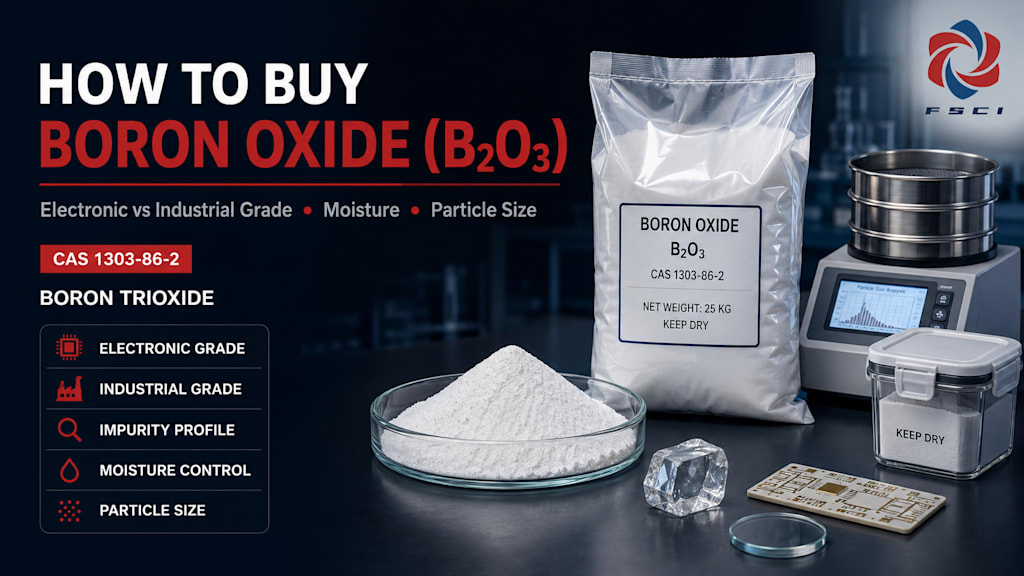
How to Buy Boron Oxide (B2O3): Electronic vs Industrial Grade, Moisture and Particle Size
Why B2O3 Procurement Requires More Than an Assay Comparison
Boron oxide is an inorganic material used in glass, ceramics, electronic materials, specialty formulations, and selected fine chemical processes. Buyers may initially compare price and B2O3 content, but those figures do not fully describe whether a grade will perform consistently in a specific application.
Trace impurities such as silicon dioxide, aluminum oxide, iron oxide, and sodium may matter as much as the main assay. Moisture exposure is another major concern because boron oxide is hygroscopic, meaning it readily takes up moisture from its environment.
Particle size, packaging integrity, storage conditions, and batch consistency can also influence handling and processing. A well-designed purchasing specification should therefore reflect the intended application rather than automatically selecting the grade with the highest reported purity.
Confirm the Product Identity
Boron oxide may appear under several names in supplier catalogs and technical documents:
Boron oxide
Boric oxide
Boron trioxide
B2O3
CAS 1303-86-2
These names commonly refer to the same chemical identity, but procurement teams should still verify the full product name, CAS number, molecular formula, offered grade, specification, and intended use.
This step is particularly important when buyers request quotations from multiple regions. One boric oxide supplier may organize grades by application, while another may use terms such as electronic, high-purity, premium, or industrial grade.
When comparing available grades, specifications, packaging formats, and batch documentation for Boron oxide B2O3 CAS 1303-86-2, buyers should match the offered material with their own impurity, moisture, and particle-size requirements.
The chemical name, CAS number, grade, and lot number should remain consistent across the specification sheet, batch Certificate of Analysis, Safety Data Sheet, package label, packing list, and invoice.
Select the Grade According to the Application
Glass manufacturers may evaluate B2O3 content together with impurities that affect optical properties, color, melting behavior, or the performance of the finished glass. The appropriate limits depend on the type of glass and the manufacturer’s formulation tolerances.
Ceramic producers may focus on composition, moisture, particle size, mixing behavior, and consistency during thermal processing. A grade acceptable for a general ceramic application may not meet the requirements of a specialized glaze, enamel, or technical ceramic.
Electronic material companies often require tighter control of metallic and inorganic impurities. Consistent moisture and particle-size data may also be important where precise formulation and repeatable processing are expected.
Specialty industrial formulators may prioritize reliable supply, handling characteristics, and cost alongside chemical specifications. In many cases, a well-controlled industrial grade may be more appropriate than purchasing a higher-cost grade with controls that the process does not require.
Research and fine chemical users may need smaller packaging, detailed documentation, or specific impurity information. The correct choice depends on the sensitivity of the application rather than the grade name alone.
Electronic, High-Purity and Industrial Grade Comparison
The following table provides a qualitative purchasing framework. Actual limits must be confirmed through the supplier’s current specification and the COA for the proposed batch.
Procurement FactorElectronic GradeHigh-Purity GradeIndustrial GradeTypical application sensitivityHigh sensitivity to trace contamination and variationElevated purity needs for specialty processesGeneral industrial processing with defined tolerancesRelative B2O3 assay expectationsUsually the most tightly controlledTypically higher than general industrial requirementsSelected according to manufacturing needsTrace impurity controlDetailed control of critical metallic and inorganic impuritiesEnhanced impurity control based on applicationBroader limits may be acceptableMoisture requirementsTight moisture control and protective handlingControlled moisture with reliable packagingMoisture still requires specification and receiving checksParticle-size consistencyOften closely controlled for repeatable processingDefined according to specialty-process needsMay allow wider variation if the process can tolerate itDocumentation expectationsDetailed specification, COA, methods, and traceabilityStrong batch documentation and quality recordsCore specification, COA, SDS, and shipment recordsBatch-control requirementsHigh consistency across lotsConsistency for critical parametersStable supply within agreed industrial limits
Electronic grade is not automatically the right purchasing choice. Paying for tighter controls provides limited value if those controls do not improve the buyer’s process or final product. Conversely, selecting industrial grade solely because it costs less can create problems if the application is sensitive to impurities, moisture, or particle-size variation.
Evaluate the B2O3 Assay
B2O3 content is an essential specification because it indicates the proportion of the intended oxide in the material. It is commonly used as the first point of comparison between grades.
However, assay cannot independently establish suitability. The remaining portion of the material may include moisture and impurities with different effects on glass, ceramics, electronic systems, or industrial formulations.
Buyers should align the required assay with their formulation tolerances, mass balance, process controls, and finished-product requirements. The specification should state the acceptance range, analytical method or method reference where relevant, and reporting expectations for each batch.
A high assay result should always be reviewed alongside moisture, impurity, and particle-size data. The batch-specific COA should report the actual result rather than only repeating the specification limit.
Review Critical Impurities
Silicon dioxide may be relevant in glass and ceramic systems because it can affect the overall oxide balance. Its importance depends on whether the process already contains silica and how tightly the formulation is controlled.
Aluminum oxide can also influence composition and processing. In electronic or high-purity applications, even relatively low concentrations may require monitoring if the process is sensitive to unwanted inorganic material.
Iron oxide is frequently reviewed because iron can affect color, optical properties, and certain electronic-material applications. The acceptable level should be defined according to the buyer’s process rather than a universal industry assumption.
Sodium may affect glass chemistry, electrical behavior, or other application-specific properties. Buyers should confirm whether sodium is reported as an element, an oxide equivalent, or through another analytical convention.
Other metallic or inorganic impurities may be important depending on the application. Procurement teams should ask technical personnel to identify which impurities are critical and ensure those values appear on the specification and COA.
Comparisons are only meaningful when suppliers use clearly defined reporting units and reasonably comparable analytical methods.
Treat Moisture as a Core Procurement Parameter
Boron oxide’s hygroscopic behavior makes moisture control a supply-chain issue, not merely a laboratory test. Exposure can occur during packaging, transportation, warehousing, sampling, or repeated opening of a container.
Moisture uptake can alter recorded weight and change the condition of the material. It may also influence flow, feeding, mixing, storage stability, and process consistency.
A batch that meets its moisture specification before shipment may produce a different receiving result if the package is damaged or exposed to humid conditions. Buyers should therefore evaluate the moisture result together with the packaging design and delivery history.
The purchase specification should identify the applicable moisture limit, test method, sampling conditions, and reporting expectations. Incoming inspection should also define how quickly a sample is tested and how exposure is minimized during evaluation.
Warehouse personnel should follow the supplier’s current storage instructions and the buyer’s approved procedures. Opened packages require appropriate resealing and identification to help prevent moisture exposure and lot mixing.
Review Particle Size and Sieve Residue
Descriptions such as “powder” or “fine powder” are too vague for many industrial purchasing decisions. Buyers should request measurable particle-size or sieve-residue criteria when physical consistency affects processing.
Particle size can influence dispersion, mixing, feeding, dissolution, melting behavior, and the uniformity of a formulation. A broader distribution may be acceptable in one process while creating feeding or consistency problems in another.
Sieve residue indicates how much material remains on or passes through a specified screen under defined test conditions. Procurement teams should confirm the sieve size, procedure, acceptance criterion, and actual batch result.
Results obtained with different screens or methods should not be directly compared without technical review. Buyers should also determine whether the reported value represents a guaranteed specification or typical production data.
Evaluate Packaging and Warehouse Controls
Boron oxide may be offered in 25 kg bags or metric-ton bags, depending on the supplier, grade, order quantity, and destination. Availability should be confirmed for each quotation.
Packaging should include appropriate moisture protection. Buyers should review the inner liner, sealing method, outer bag, pallet protection, label format, and expected resistance to transportation conditions.
Bulk formats may reduce handling for high-volume users, but they require suitable lifting, storage, and feeding equipment. Smaller bags may simplify inventory control while creating more package openings and handling steps.
Receiving teams should inspect packages for punctures, broken seals, water exposure, contamination, and missing labels. Each unit should display a readable lot number that corresponds with the COA and shipment records.
Warehouse humidity and storage location should be managed according to the supplier’s instructions and internal procedures. Packages should remain protected from rain and other sources of moisture throughout transportation and storage.
Build an Incoming Inspection Plan
A practical receiving framework may include the following:
Verify the chemical name, B2O3 formula, and CAS 1303-86-2.
Confirm that the delivered grade matches the purchase order.
Inspect the outer package, liner, seal, and pallet condition.
Compare package labels and lot numbers with shipment documents.
Review the batch COA against the agreed specification.
Verify B2O3 assay according to internal requirements.
Evaluate moisture promptly using the approved sampling procedure.
Review SiO2, Al2O3, Fe2O3, sodium, and other critical impurities.
Confirm particle size or sieve residue where applicable.
Use a sampling method appropriate for the package and batch.
Retain an identified sample according to company procedures.
Document and report nonconforming results before production use.
The inspection scope may be adjusted according to supplier history, application sensitivity, order size, and the buyer’s quality system.
Validate Supplier Consistency
A representative sample is useful for initial evaluation, but it does not demonstrate long-term consistency. Buyers should request recent COAs from multiple batches and compare the results for critical parameters.
A trial order provides additional information about packaging, labeling, delivery, documentation, and communication. Incoming results from the trial batch can then be compared with the supplier’s COA.
Multi-batch trend data is more informative than one ideal certificate. It shows whether assay, moisture, impurities, and particle size remain stable within the agreed limits.
Supplier monitoring should also include on-time delivery, package condition, document accuracy, and responses to quality concerns. Complaint records and corrective-action responses can reveal how effectively a supplier handles problems after shipment.
Boron Oxide Supplier Qualification Checklist
Before approving a supplier, confirm that:
Product identity and CAS 1303-86-2 are verified.
The intended application has been communicated.
Electronic, high-purity, or industrial grade is clearly identified.
The required B2O3 assay is documented.
SiO2, Al2O3, Fe2O3, and sodium criteria are defined.
Other application-relevant impurities are addressed.
Moisture limits and test methods are confirmed.
Particle size or sieve residue is specified where needed.
A representative sample is available.
Recent batch-specific COAs can be provided.
A current SDS is available.
Packaging format and inner liner are confirmed.
Moisture-resistant sealing is documented.
Lot numbers provide complete traceability.
Lead time and production capacity meet demand.
Export and transportation documents can be supplied.
Technical and quality contacts respond clearly.
Complaint and deviation procedures are established.
Questions to Ask Before Buying Boron Oxide
Buyers preparing to buy boron trioxide can ask prospective suppliers:
Which grade do you recommend for our intended application, and why?
What B2O3 assay range is guaranteed for the offered grade?
Which impurity values are included on the batch COA?
How are SiO2, Al2O3, Fe2O3, sodium, and other critical impurities controlled?
What moisture limit, sampling conditions, and test method are used?
Is particle size or sieve residue reported, and under what test conditions?
What moisture-resistant packaging formats are available for this order?
Can you provide a representative sample and recent COAs from multiple production batches?
Written responses help procurement, production, and quality teams compare suppliers using the same criteria.
Conclusion
Reliable B2O3 procurement begins with selecting a grade that matches the actual process. Electronic grade, high-purity grade, and industrial grade offer different levels of impurity control, documentation, and batch management, but no single option is appropriate for every buyer.
By reviewing assay, critical impurities, moisture, particle size, packaging, and multi-batch performance together, procurement teams can make better-informed decisions. Effective incoming inspection and moisture-controlled storage then help preserve the material condition established at the time of manufacture.
About the Creator
Enjoyed the story? Support the Creator.
Subscribe for free to receive all their stories in your feed.
Comments
There are no comments for this story
Be the first to respond and start the conversation.