
How I Flew on Concorde with an Economy Ticket
An Unexpected Upgrade That Led to the Flight of a Lifetime
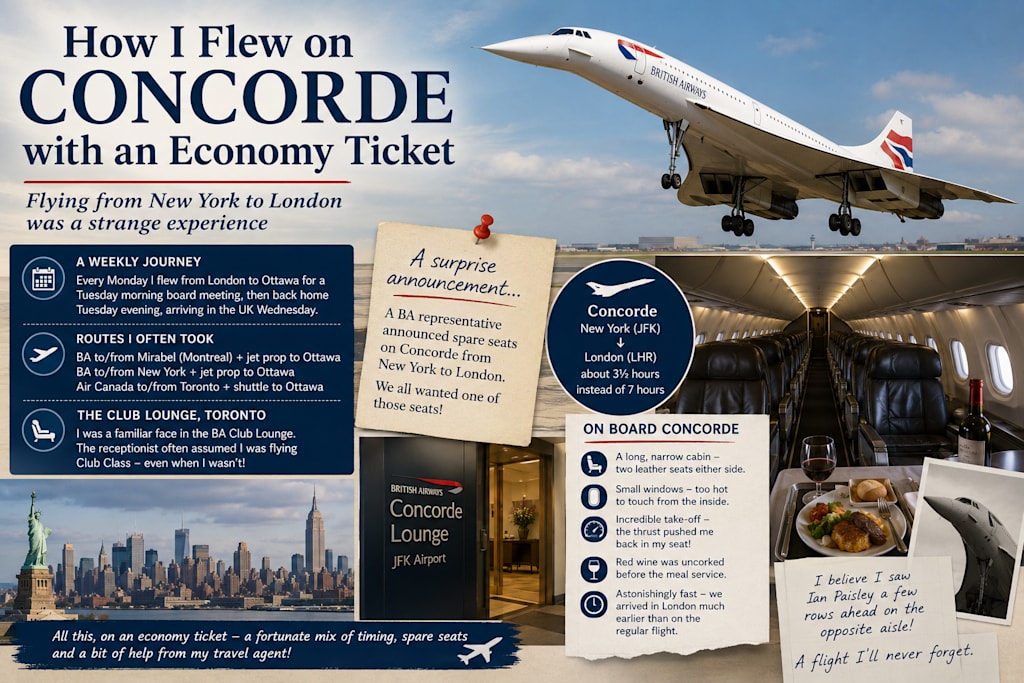
During the 1980s, I was running a technical design centre in West London with a sizeable team of engineers and support staff. Part of my role required me to attend a Technology Board meeting in Ottawa every week. My routine became remarkably predictable. Every Monday morning, I would leave London for Canada, attend the board meeting on Tuesday morning and then fly home on Tuesday evening, arriving back in the United Kingdom on Wednesday morning.
It was a demanding schedule, but after a while the journey became second nature. I became very familiar with the various routes across the Atlantic and the airports that served them.
My travel agent was particularly resourceful and occasionally managed to obtain cross-border tickets that enabled me to travel in British Airways Club Class despite my company's travel budget being based on economy fares. Business class in those days was very different from today. There were no fully reclining beds or private suites. The main benefits were a wider seat, a little more space and considerably better food.
Depending on availability, I usually travelled by one of several routes. Sometimes I flew British Airways between London Heathrow and Mirabel Airport near Montreal before taking a short commuter flight to Ottawa. Mirabel only handled a limited number of international services each day and was eventually closed to passenger traffic altogether. On other occasions I flew via New York before connecting to Ottawa on a regional aircraft. Another regular option was Air Canada or BA from Heathrow to Toronto, followed by a shuttle flight to Ottawa.
Because I travelled so frequently, I became a familiar face in the British Airways Club Lounge at Toronto. The receptionist recognised me immediately and often waved me through without asking to see my boarding pass, assuming I was travelling Club Class as usual, although on some occasions I was actually booked in economy.
One particular journey remains unforgettable. I was relaxing in the lounge waiting for my flight when a British Airways representative entered the room and, in an impeccably polished English accent, announced that there were several spare seats available on the next day's Concorde flight from New York to London. If anyone wished to travel on Concorde instead of their scheduled flight, arrangements could be made. Everyone in the lounge was instantly interested.
British Airways transferred us to New York, accommodated us overnight in an airport hotel at their expense and booked us onto Concorde the following morning.
The next day I found myself sitting in the Concorde lounge at JFK Airport, still slightly amazed that I was about to fly on what was then the most famous airliner in the world. Whether the lounge staff had realised I had originally been travelling on an economy ticket I never discovered, but I certainly was not about to ask.
Boarding Concorde was unlike boarding any other aircraft. The cabin appeared long and narrow, with two leather seats on either side of a single aisle. Everything felt compact, purposeful, and distinctly different from the wide-bodied aircraft I was accustomed to flying across the Atlantic in. The windows were surprisingly small, giving the cabin a unique appearance.
I was allocated an aisle seat on the left-hand side of the aircraft. As the engines powered up for take-off, the acceleration was extraordinary. I had never experienced anything quite like it. The thrust pushed me firmly back into my seat as Concorde gathered speed and climbed rapidly into the sky.
Once we had reached cruising altitude, the atmosphere relaxed considerably. I watched one of the cabin crew uncork a couple of bottles of red wine ready for the forthcoming meal service, something that seemed wonderfully civilised and entirely appropriate for such an iconic aircraft. I later sampled the very expensive red wine and found its taste very different from the red wines I normally buy.
One detail has remained with me ever since. The inside surfaces of the windows became extremely hot, so hot that they could not be comfortably touched. This was the result of the tremendous air friction generated as Concorde cruised at more than twice the speed of sound. Looking out of the tiny windows, we saw the sky almost completely black, giving the impression that we were flying at the very edge of space.
I also believe I spotted Ian Paisley sitting several rows ahead of me on the opposite side of the cabin, although after all these years I cannot be absolutely certain.
The flight itself was astonishingly quick. Before long we were descending towards London, arriving just a few hours later than I would have done had I remained on my original British Airways flight from Toronto.
For years afterwards I rarely mentioned that I had flown on Concorde as it seemed almost too good to be true. My company had budgeted only for an economy fare, yet through a remarkable sequence of events, a helpful travel agent gave me business-class tickets at economy prices, spare capacity on Concorde, and a generous British Airways upgrade offer; I found myself travelling on one of the most prestigious aircraft ever built. The other person I would like to thank is the BA lounge receptionist in Toronto, as she had seen me so many times with a business-class boarding pass that she assumed I was also travelling business class on this day.
It remains one of the most memorable journeys of my career and a reminder that, every now and then, business travel could produce an unexpected adventure that no amount of careful planning could ever have arranged.
About the Creator
Alan Spencer
Have been an author and writer for over 20 years. Have been a journalist, editor, proofreader, and a designer and presenter of training courses. Have written over 100 articles, two books, and around 20 training courses.
Enjoyed the story? Support the Creator.
Subscribe for free to receive all their stories in your feed. You could also become a paid subscriber, letting them know you appreciate their work.
Comments
There are no comments for this story
Be the first to respond and start the conversation.