
How CAD Technology Is Transforming the Bespoke Furniture Industry in 2026
How Advanced CAD Tools Are Helping Furniture Businesses Design Faster, Reduce Costs, and Scale Customization

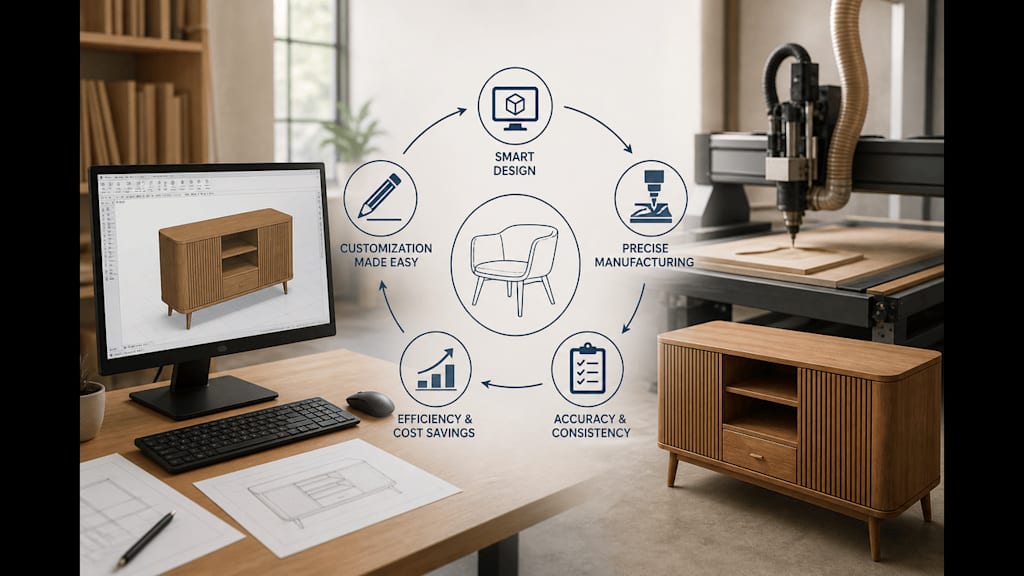
The bespoke furniture industry has always been rooted in craftsmanship, creativity, and personalization. But in 2026, a powerful shift is underway Computer-Aided Design (CAD) is redefining how custom furniture is designed, visualized, manufactured, and delivered.
From AI-powered generative design to real-time 3D visualization and cloud-based collaboration, CAD technology is not just enhancing traditional furniture making it’s completely transforming it.
In this article, we explore how CAD is reshaping the bespoke furniture landscape, the latest trends driving this change, and what it means for designers, manufacturers, and customers.
What Is CAD in Furniture Design?
CAD (Computer-Aided Design) refers to software used to create precise 2D drawings and 3D models of furniture designs. In 2026, CAD has evolved far beyond drafting tools it now acts as an intelligent design ecosystem.
Modern CAD systems integrate:
- AI-driven automation
- 3D modeling and simulation
- Cloud collaboration
- Real-time rendering
This transformation allows designers to move from concept to production faster and more efficiently than ever before.
Why Bespoke Furniture Needs CAD More Than Ever
Bespoke furniture is all about customization, precision, and uniqueness. However, traditional design methods often involve:
- Time-consuming manual sketches
- Multiple revisions with clients
- High risk of production errors
- Limited visualization before manufacturing
CAD eliminates these limitations by enabling digital-first design workflows, where every detail is tested and refined before production begins.
In fact, CAD tools can reduce design errors significantly and cut time-to-market by up to 50–70%, making them indispensable in modern furniture design.
Key Ways CAD Technology Is Transforming Bespoke Furniture in 2026
1. AI-Powered Generative Design
One of the biggest breakthroughs in CAD is AI-powered generative design.
Instead of manually creating one design at a time, designers can now:
- Input constraints (size, material, budget)
- Let AI generate hundreds of optimized design options
- Choose the best-performing and aesthetically pleasing solution
This not only speeds up the process but also introduces innovative designs that humans might not imagine.
2. Hyper-Realistic 3D Visualization
Clients no longer need to rely on imagination.
With advanced CAD tools:
- Furniture can be visualized in photorealistic 3D
- Materials, textures, and lighting can be simulated
- Customers can see exactly how the piece will look in their space
Technologies like real-time rendering and 3D configurators are enabling immersive design experiences, especially in furniture customization.
3. Faster Design-to-Production Workflow
CAD bridges the gap between design and manufacturing.
Modern systems integrate directly with:
- CNC machines
- 3D printers
- CAM (Computer-Aided Manufacturing) tools
This means:
- Designs can move directly into production
- Manual errors are minimized
- Production timelines are significantly reduced
Companies adopting these workflows are already achieving faster design cycles and reduced costs.
4. Mass Customization at Scale
Traditionally, bespoke furniture meant limited scalability. But CAD has changed that.
Now, manufacturers can:
- Create modular designs
- Customize dimensions and features instantly
- Offer personalized furniture without increasing production time
This trend aligns with the growing demand for modular and adaptable furniture in 2026, where flexibility and personalization are key.
5. Cloud-Based Collaboration
Furniture design is no longer limited to a single studio.
Cloud CAD platforms allow:
- Designers, clients, and manufacturers to collaborate in real-time
- Instant sharing of design updates
- Remote project management across global teams
This is especially valuable for outsourcing and international furniture projects.
6. Sustainability and Smart Material Optimization
Sustainability is a major priority in 2026.
CAD tools now include:
- Material optimization algorithms
- Waste reduction simulations
- Life-cycle analysis
Designers can evaluate environmental impact early in the design process, ensuring eco-friendly furniture production.
7. Integration with Augmented Reality (AR) and Virtual Reality (VR)
AR and VR are taking customer experience to the next level.
Customers can:
- Place furniture in their homes using AR
- Walk through virtual showrooms
- Interact with designs before purchase
This creates a try-before-you-buy experience, increasing confidence and reducing returns.
Impact on Furniture Designers and Manufacturers
For Designers:
- More creative freedom
- Faster iterations
- Data-driven design decisions
For Manufacturers:
- Reduced production errors
- Improved efficiency
- Seamless integration with machinery
For Businesses:
- Faster time-to-market
- Higher customer satisfaction
- Competitive advantage
The result? A more agile, scalable, and innovative furniture industry.
How CAD Aligns with 2026 Furniture Trends
The rise of CAD is directly influencing design trends in 2026, such as:
- Modular and adaptable furniture
- Curved and organic shapes
- Multi-functional designs
- Sustainable materials
These trends require precision, flexibility, and rapid prototyping all of which CAD delivers effectively.
Challenges of CAD Adoption in Bespoke Furniture
While CAD offers significant benefits, it also comes with challenges:
- Initial investment in software and training
- Learning curve for traditional craftsmen
- Integration with existing workflows
However, the long-term benefits far outweigh these challenges, especially as tools become more user-friendly and accessible.
The Future of Bespoke Furniture with CAD
Looking ahead, CAD will continue to evolve with:
- AI-driven design assistants
- Digital twins for furniture
- Fully automated production systems
- Integration with smart home technologies
The future is clear: CAD is not just a tool it’s the backbone of modern furniture innovation.
Final Thoughts
The bespoke furniture industry is undergoing a digital revolution, and CAD technology is at the center of it.
From AI-driven design to real-time visualization and sustainable production, CAD is enabling businesses to deliver:
- Better designs
- Faster production
- Enhanced customer experiences
For furniture designers, manufacturers, and businesses, adopting CAD in 2026 is no longer optional it’s essential.
About the Creator
Shalin Designs
Shalin Designs is a leading CAD design and drafting service provider company. We serve product design, CAD drafting services, 3D CAD modeling, or sheet metal design and we specialize in all engineering design services.
Enjoyed the story? Support the Creator.
Subscribe for free to receive all their stories in your feed.
Comments
There are no comments for this story
Be the first to respond and start the conversation.