
He Quit His Job and Got Hit by a Car on the Way Home. The Court Said It Was a Work Injury.
One man's last commute reveals a legal rule most workers don't know: quitting isn't an instant switch. It has a clock, and the clock matters more than the paperwork.
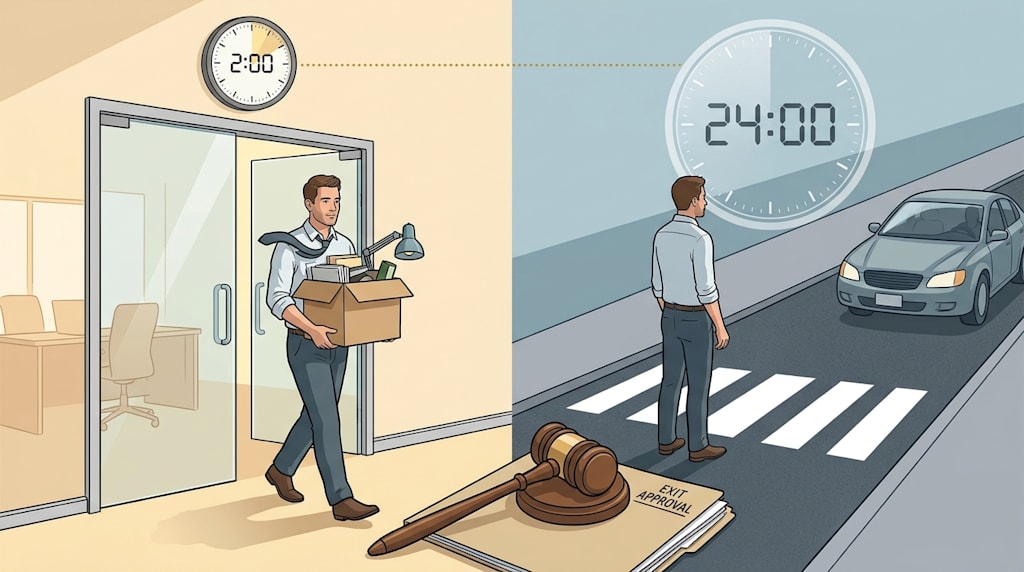
The outcome looks counterintuitive. An employee finishes his separation paperwork, leaves the company, and is injured in a car accident on the way home. The company says the labor relationship ended the moment the paperwork was done. The human resources and social security bureau says the injury is a work-related injury. A court later upholds that decision.
The case, disclosed by the Tongzhou District People's Court in Beijing, turns on two questions. First, when did the labor relationship actually end? Second, does going home after completing separation procedures count as "commuting" under work-injury law? The answers are concrete: the relationship did not end at the office door, and the trip home was a work-connected extension of the separation process.
I. The facts that decide the case
Xiao Wang submitted a resignation application on November 14, 2025. The separation approval form stated that his last working day would be November 18. At around 14:00 on November 18, after completing separation procedures at the company, Xiao Wang left for home. On the way, he was involved in a traffic accident. The traffic police determined that the other driver bore full responsibility; Xiao Wang bore none. The accident caused a tibial plateau fracture, right foot trauma, and other injuries.
One more fact matters: the company's final approval of Xiao Wang's separation was completed at 18:47 that same day.
The company later applied to the district human resources and social security bureau for a work-injury determination. The bureau issued a decision finding that Xiao Wang's injury met Article 14(6) of the Regulation on Work-Related Injury Insurance and constituted a work-related injury. The company applied for administrative reconsideration; the reconsideration authority upheld the decision. The company then filed an administrative lawsuit, arguing that Xiao Wang had already completed separation procedures before the accident, that no labor relationship existed, and that the trip was not a commuting trip. It asked the court to revoke the work-injury decision and the reconsideration decision.
II. First issue: separation paperwork does not end the labor relationship at the office door
A work-injury determination requires a labor relationship. The company's argument starts from a factual operation: the employee finished the paperwork, so the relationship ended immediately. That argument does not hold under the applicable rules.
Article 5(2) of the former Ministry of Labor's Notice on Several Issues Concerning the Implementation of the Labor Contract System provides that the termination time of a labor contract shall be 24:00 on the last day of the contract term. In judicial practice, when an employee resigns voluntarily, courts often refer to this rule and treat 24:00 on the day the employee completes separation procedures as the time when the labor relationship ends. The legal meaning of "last working day" is therefore that the relationship continues until 24:00 that day. It does not disappear the moment the employee walks out of the office or finishes a handover.
In this case, Xiao Wang left the company at around 14:00, and the accident occurred on his way home. The company's final approval was completed at 18:47. Under the "24:00 on the last day" rule, the labor relationship still existed at the time of the accident. Even using the actual approval time, the approval came after the accident but before 24:00. The company's claim that the relationship had already ended fails.
Factual separation operations and legal termination are different things. An internal management process is not the legal cutoff. The law sets the termination time. A company cannot use the completion time of its internal process to cut off the legal relationship earlier and shift onto the worker a risk that the work-injury insurance system is designed to spread.
III. Second issue: going home after separation procedures as "commuting"
With the labor relationship still in existence, the next question is whether Xiao Wang's injury falls within Article 14(6) of the Regulation on Work-Related Injury Insurance: an injury caused by a traffic accident on the way to or from work, where the worker does not bear primary responsibility.
The "non-primary responsibility" element is not in dispute. The other driver bore full responsibility; Xiao Wang bore none. The dispute is over "on the way to or from work."
Article 6 of the Ministry of Human Resources and Social Security's Opinion (II) on Several Issues Concerning the Implementation of the Regulation on Work-Related Injury Insurance provides that a trip between the workplace and the worker's residence, made for the purpose of going to or from work, within a reasonable time and along a reasonable route, is regarded as a commuting trip. The core elements are purpose, reasonable time, and reasonable route. The test is not whether the employee performed ordinary work duties on that particular day.
Xiao Wang went to the company to complete separation procedures, not to perform daily production tasks. A literal reading of "going to work" could produce a negative answer. The court read the purpose requirement differently: completing separation procedures is a proper step in ending the labor relationship. It is a work-connected act, not a private matter unrelated to employment. Xiao Wang's departure from the company and return to his residence was a direct extension of that work-connected act and should be treated as a trip from work.
The practical reason is the protective function of work-injury insurance. If a worker who comes to the company on the last working day to complete handover and separation procedures is excluded from protection on the way home, the work-injury insurance system would leave a gap at the final link of the employment relationship. An employee would be protected on an ordinary commute but not on the last commute after ending the relationship. That result conflicts with the Regulation's protective purpose. The court's reasoning chooses the interpretation that fits the structure of the rule and the design of the system.
IV. The boundaries: not every trip after separation is covered
The decision does not create a blanket rule that any injury after separation paperwork is a work-related injury. The same three elements still apply: purpose, reasonable time, and reasonable route.
First, whether the employee had work arrangements that day matters. In this case, Xiao Wang was completing procedures on his last working day, and the separation process was closely connected to the termination of the relationship. If a worker performs no work that day and comes to the company only to handle paperwork, the commuting claim may be weaker, and the issue can be fact-sensitive.
Second, unreasonable delay matters. If the worker stays for a long time after completing procedures and engages in activities unrelated to returning home, the "reasonable time" element may be affected.
Third, an unreasonable route matters. A clear detour for private matters may take the trip outside the reasonable route between the workplace and the residence.
Fourth, responsibility for the accident matters. If the worker bears primary or full responsibility, Article 14(6) is not satisfied.
Fifth, the exclusions in Article 16 still apply. Even if Article 14 is satisfied, a work-related injury shall not be recognized if the injury results from intentional crime, drunkenness or drug addiction, self-harm, or suicide.
These boundaries show what the law protects: a reasonable extension of a work-connected act, not every trip a worker takes after leaving the company.
V. What employers and workers should do
Employers should start by recording the last working day and the approval timeline accurately. A separation approval form should state the last working day. If the approval process is completed later in the day or across days, the company should keep complete records. It should not treat "the paperwork is done" as the legal cutoff for the labor relationship. For accidents that occur during the existence of the labor relationship and during a work-connected extension, the company should file a work-injury claim in accordance with the law. Using work-injury insurance to spread risk is more cost-effective than arguing after the fact that the employee had already left.
Workers should keep evidence: the resignation application, the separation approval form, attendance records, handover records, and the traffic accident responsibility determination. Evidence of the route, time, and destination helps show that the trip home was reasonable and work-connected. If the company does not file a work-injury claim, the worker or close relatives may file within the statutory period. Where a third party is fully liable, the relationship between third-party tort compensation and work-injury benefits should be handled under local rules; actual expenses such as medical costs are generally not duplicated, while other items require case-specific analysis.
VI. Conclusion
The ruling does not expand work-injury insurance out of sympathy. It applies existing rules to a specific timeline. "Paperwork done" is a factual node. Legal termination is 24:00 on the last working day. Completing separation procedures is a proper step in ending the labor relationship, and a reasonable trip home after that step is a work-connected extension. The rule is narrow and specific: on the last day of the labor relationship, the reasonable return home after separation procedures remains within the protection of work-injury insurance.
About the Creator
Jin
Writer of reamstories
https://reamstories.com/jin
Enjoyed the story? Support the Creator.
Subscribe for free to receive all their stories in your feed. You could also become a paid subscriber, letting them know you appreciate their work.
Comments
There are no comments for this story
Be the first to respond and start the conversation.