
He Died on a Delivery. He Won Arbitration. Then the Platform Sued.
A work-related death case shows how a favorable labor ruling can still leave a family waiting at the procedural door.
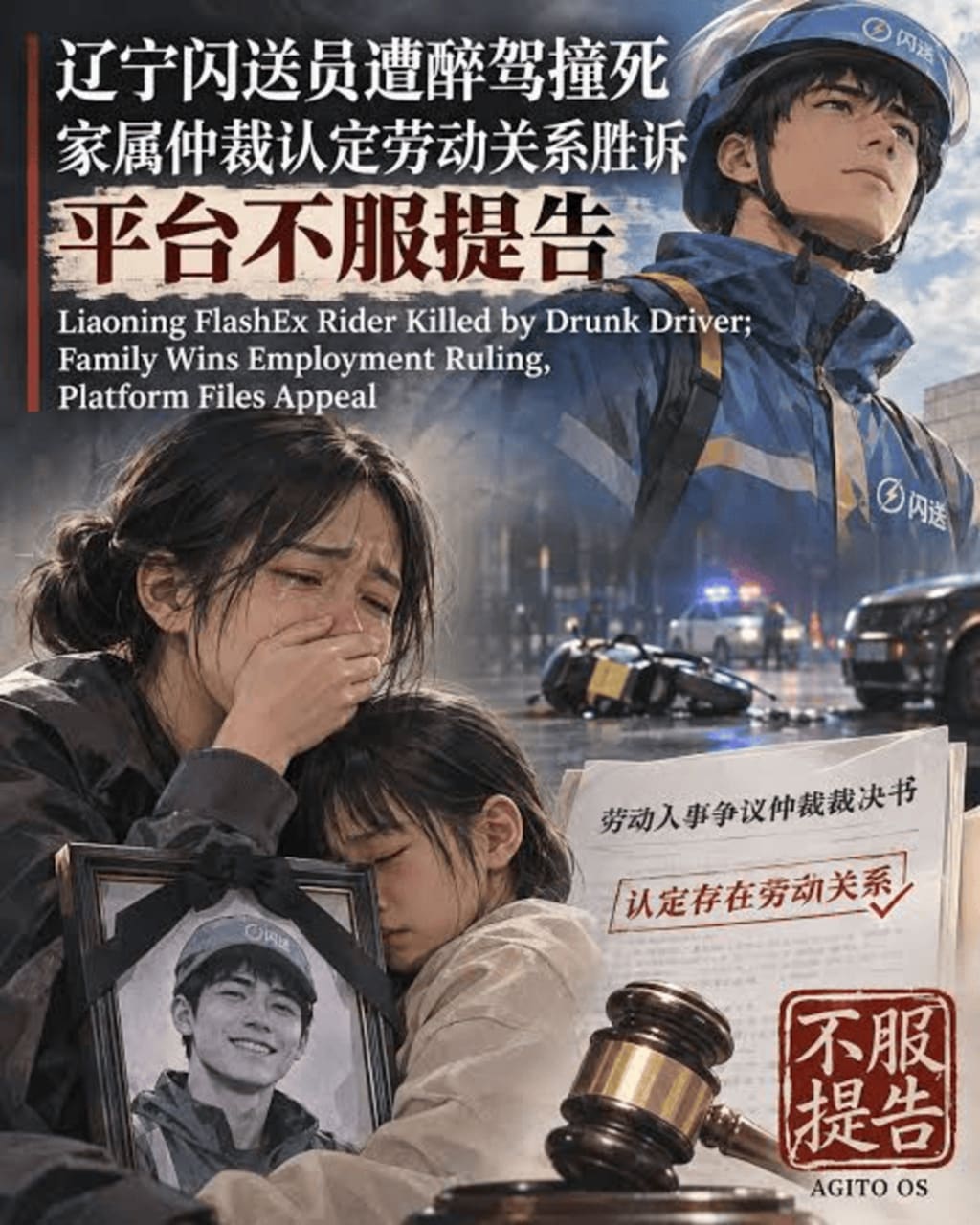
At around 11 p.m. on March 8, 2024, on a road in Jinzhou, Liaoning Province, a 36-year-old delivery rider surnamed Long was struck by a drunk driver while completing a delivery order. He died after emergency treatment failed. The app on his phone still carried the structure of his working life: the “Glorious Knight” tier, a requirement of no fewer than eight hours online per day, a quota of at least 28 orders, and automatic removal from the tier for anyone who fell short.
What followed was a sequence of legal steps that, taken one at a time, are each defensible, and that together have left a dead man’s family holding a winning arbitration award it cannot yet use.
From agreement to management
Two years before Long’s death, a similar set of facts produced the opposite conclusion. In 2023, the Putuo District People’s Court in Shanghai heard Yu v. a technology company. Yu had downloaded the Shansong app and registered himself. At registration he read the Cooperation Agreement and understood that he and the company stood in a business cooperation rather than an employment relationship. He clicked agree. After registration, the company pushed order information to him through the platform; he decided for himself whether to accept. His working hours, working method, and workload were entirely self-arranged and not managed by the company. His pay was determined by the number of orders completed and could be withdrawn from the platform at any time without interference. The court concluded that although he met the subject-qualification requirement for forming an employment relationship, the parties lacked the intent to form one, and the features of personality subordination and economic subordination did not meet the standard for finding an employment relationship.
The turning point came in two steps. In December 2024, the Supreme People’s Court published its 42nd batch of guiding cases, dedicated to labor disputes in new forms of employment (Cases 237 to 240), and placed employment facts and dominant labor management at the center of the analysis. In August 2025, the Supreme People’s Court issued its Interpretation (II) on Several Issues Concerning the Application of Law in the Trial of Labor Dispute Cases, effective September 1, 2025. The Interpretation codified a fact-first principle: a people’s court determining an employment relationship in a new-form-employment case is not bound by the name of the contract, and examines personality subordination, economic subordination, and organizational subordination in light of the actual performance of work.
The change is narrower than some descriptions suggest, and its practical effect is procedural. The registered agreement no longer ends the inquiry. A rider’s freedom to accept orders now has to be examined as substantive or formal. Formal freedom can be bounded by quotas, online-hour rules, tier rankings, and automatic delisting. In the Suzhou case Sheng v. Jiangsu Network Technology Co., the court worked through those questions: whether the rider had substantive autonomy over whether to accept an order, when to accept it, and what the order contained; whether taking leave required reporting; whether attendance rules bound him; whether pay from the platform constituted his main source of income. On those facts the court found that the platform’s cooperating entity exercised dominant labor management and that an employment relationship was established.
Long’s facts sit on the same side of that line. “Glorious Knight” was not an honorific. It was an operating mechanism. Hours were counted. Orders were counted. Shortfalls were counted. A shortfall could remove him from the tier. Dispatch, attendance, reward, and penalty were linked. The Jinzhou Labor and Personnel Dispute Arbitration Commission found that an employment relationship existed between Long and the platform company during the period he held that tier. Under the framework of Interpretation (II), that finding rests on a stated standard, not on sympathy.
The regulation that governs what happens next is unchanged.
Why the award does not move the death-benefit case
Article 17 of the Regulation on Work-Related Injury Insurance sets out two filing routes. The employer shall file an application for work-related injury determination with the social insurance administrative department of the coordinating region within 30 days of the accident. Where the employer fails to file, the injured worker’s close relatives or the trade union may file directly within one year of the accident.
The platform did not file. The family filed.
At that point the procedure met Article 20, paragraph 3, of the Regulation, and Article 5 of the Opinions on Several Issues Concerning the Implementation of the Regulation on Work-Related Injury Insurance (Ministry of Human Resources and Social Security Document No. 34 of 2013). Where the social insurance administrative department finds, after accepting an application, that the employment relationship is disputed and cannot be confirmed, it shall notify the parties to apply for arbitration, and the time limit for the injury determination is suspended during that period. After the employment relationship is confirmed in accordance with law, the procedure resumes from the date the final legal document is received.
The word that controls the next step is final.
The arbitration commission supported the employment relationship. The platform then brought suit in court within the statutory period. Under the labor dispute procedure, where a party dissatisfied with an arbitration award brings suit, the award does not become final and binding before the litigation concludes. The family holds a favorable award. It is not yet a final legal document. The social insurance administrative department sees a dispute still in litigation. The procedure remains suspended.
The platform’s suit asked the court to confirm that no employment relationship exists. Bringing that suit exercises a statutory right. Its effect is that the work-related death determination stays suspended. The delay is not one agency’s failure. It is the point where the substantive standard moved and the procedural switch did not. The switch remains binary. It turns on whether a final legal document exists.
Suppose the employment relationship is confirmed by a final judgment. Article 14, item 1, of the Regulation covers injury occurring within working hours and at the workplace due to work-related causes; item 6 covers injury from a traffic accident for which the worker is not primarily responsible, on the way to or from work. Long was struck by a drunk driver while carrying out a platform delivery task. The accident occurred within the time and space of performing the delivery. The causal link runs directly to the performance of work duties. Once the employment relationship is established, the death determination faces no substantive obstacle.
The obstacle is time. In a death case, time has a cost that a wage claim does not.
The parallel track that is often forgotten
The regulatory design for new-form-employment workers contains two layers that are frequently conflated.
The first layer applies where an employment relationship exists. The Regulation on Work-Related Injury Insurance governs. The employer must enroll the worker in work-related injury insurance. Where it has not enrolled him, it pays benefits at the standard set by the Regulation.
The second layer applies where no employment relationship exists. The Measures for Occupational Injury Protection for Persons in New Forms of Employment (Trial) govern in the pilot regions. Occupational injury protection does not presuppose an employment relationship. The platform pays per order; the rider pays nothing. In instant delivery, the per-order contribution has been set at 0.07 yuan or 0.25 yuan depending on the pilot. The Fujian provincial human resources and social security authorities stated in a public reply that instant delivery platforms including Shansong have been included in the pilot on an “every order covered, every person covered” basis. The same reply stated that occupational injury protection does not replace statutory work-related injury insurance: where an employment relationship is found, the platform must still enroll the worker in work-related injury insurance, and where it has not done so, it bears liability at the Regulation’s standard.
Read together, the design has a clear logic. Occupational injury protection fills the space where the employment relationship is absent or unresolved. Work-related injury insurance and occupational injury protection have different triggers, contributors, and benefit schedules.
For Long’s family, this matters for one practical reason. The main line, employment relationship confirmed, work-related death determination, insurance benefits, is being held at the switch. A parallel inquiry into whether the platform enrolled Long in occupational injury protection during his “Glorious Knight” period, and what the claim conditions and deadlines are, does not replace the main line. It keeps a second route open while the first is stalled.
What the family can do now
Three actions, in order.
First, hold the suspended procedure in place, in writing. Submit the arbitration award and the platform’s complaint materials to the social insurance administrative department of Jinzhou or of the place where the employer is located. State in the submission that the employment relationship dispute is in litigation. Request that the time limit for the determination be suspended under Article 20 and Document No. 34 of 2013, rather than the application being returned for incomplete materials. A returned application loses continuity. A suspension keeps the file open and the one-year filing window intact.
Second, track the employment relationship litigation. The final judgment of the Haidian District People’s Court in Beijing is the direct precondition for resuming the determination. Whether that judgment upholds or overturns the arbitration finding, the final document should be submitted to the social insurance administrative department immediately upon receipt, together with a request to resume the procedure from that date. If the determination that follows is adverse, there is administrative reconsideration within 60 days of receipt, or administrative litigation within six months.
Third, check enrollment in occupational injury protection. Ask the platform, or the local human resources and social security department, whether Long was covered during his “Glorious Knight” period, and what the conditions and deadlines for benefits are. If he was covered, the claim route exists on its own terms. If the platform should have covered him and did not, the corresponding liability claim should be preserved now rather than reconstructed later.
What the rules have not yet answered
Three questions remain open. None is rhetorical.
Can an arbitration award that has found an employment relationship be given some interim effect in the injury-determination procedure, so that a work-related death determination can proceed during the litigation and be adjusted once the final judgment arrives? The suspension rule assumes that the employment relationship question is binary and that its resolution will arrive in time. For a wage claim, delay is a cost. For a death case, delay can decide whether the family receives the benefit at all within the period the Regulation contemplates.
Can the two tracks be joined more smoothly, so that a person does not fall into the interval between “employment relationship exists” and “employment relationship not yet confirmed”? Occupational injury protection covers the second category. The first category waits. The wait is indefinite because its length is set by the other party’s litigation choices.
And this case places a concrete question on the table. A work-related death case in which an arbitration commission has already found an employment relationship should not remain suspended indefinitely because the other side exercised a right to sue. The substantive answer has been given. The procedural channel has not widened to carry it.
The file in Jinzhou is open. The award is in the family’s hands. The complaint is on the court docket. The file is missing a final seal.
About the Creator
Jin
Writer of reamstories
https://reamstories.com/jin
Enjoyed the story? Support the Creator.
Subscribe for free to receive all their stories in your feed. You could also become a paid subscriber, letting them know you appreciate their work.
Comments
There are no comments for this story
Be the first to respond and start the conversation.