
He Came From Shampoo to Run a Precision Instrument Department. Then He Fixed Everything With Three Small Moves.
He never learned the machines. He learned where the work stopped.
The Man from Shampoo
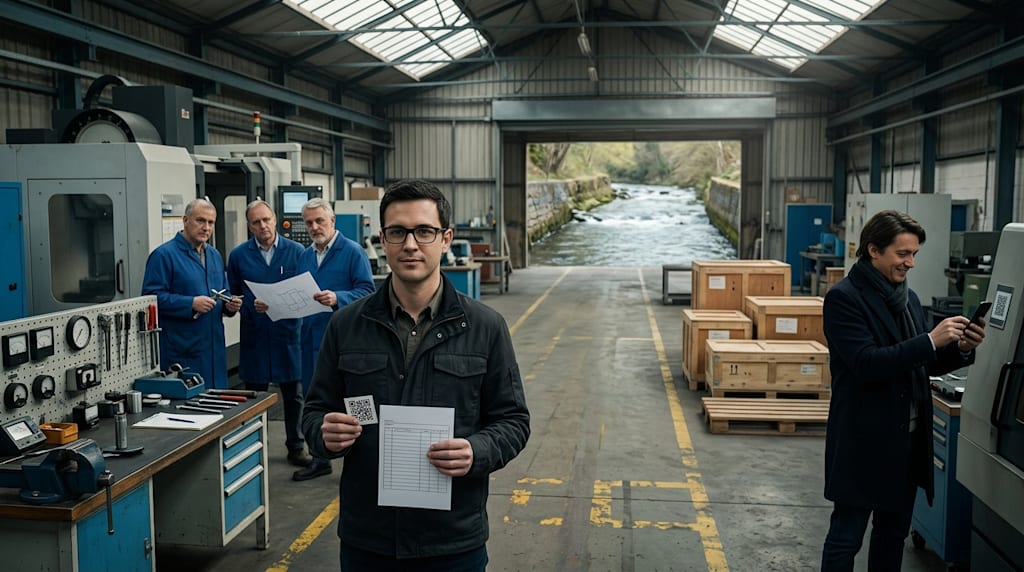
The new director arrived on a Monday. Casual jacket. Black-framed glasses. He did not ask to see the five-axis machines. He did not walk the clean room. At the all-hands, he said one thing:
“For the next month, I won’t manage anything. I’ll walk around and ask questions. Do your work. Pretend I’m not here.”
Old Liu sent a sneer emoji in the WeChat group. I didn’t reply.
On my desk was a drawing with tolerances in microns. The new director had not touched a caliper.
The rumor had come down from group headquarters: he had run the home-care division. Shampoo. Body wash. Conditioner. The kind of business where the biggest technical problem is whether the cap leaks in a suitcase.
Our department made precision instruments. A part could be off by a micron and the whole assembly would sing the wrong song. Most of the men in the shop had been there for twenty years. They could hear a bad bearing through a closed door. They did not need a man from shampoo to tell them how to hold a micrometer.
Old Liu said, “Wait. He won’t last. An outsider telling insiders what to do. Something will blow up.”
The first month, the director walked.
He did not ask about heat treatment. He did not ask about material fatigue. He asked questions that made the foremen look at each other.
He stood between Workshop A and Workshop B. The distance was maybe thirty meters. Parts came out of A, went into a cart, crossed the yard, and went into B for inspection.
He asked, “Why isn’t the inspection equipment at the end of A?”
The foreman said, “It’s always been that way. QC has its own area.”
The director asked, “How many people move these parts every day? How long does it take? Can they get bumped on the way?”
The foreman opened his mouth. Closed it. Nobody had counted.
He went to sales. He did not ask about the biggest customer. He did not ask about the order book.
He asked, “What do customers complain about most?”
Sales said, “The machines are hard to operate. They need long training.”
He asked, “Is there a simple manual? A video? Something they can scan and watch?”
Sales said, “We talked about it. The tech department said it’s too precise. A few sentences won’t explain it. They have to be trained on site.”
He went to finance. He did not look at the profit statement. He picked up a travel reimbursement form.
He asked, “Why does an engineer need half a month and seven signatures to get his money back?”
Finance said, “Company policy. Risk control.”
He asked, “How much of that half month is the form sleeping on someone’s desk? Has anyone counted how many people stop traveling because the paperwork eats their patience?”
No one had counted that either.
He walked for a month. He asked the same kind of question in every office, every shop, every corner. To us, they sounded like questions from a man who did not understand the business.
We cared about technical barriers. Process innovation. Material science.
He cared about how a part moved, how a manual was written, how fast a form was signed.
Old Liu said, “Different planet.”
The second month, he moved.
Three small things.
First, he moved the QC team and their equipment from Workshop B to the end of the A line. The carts stopped rolling. The waiting stopped. The parts stopped taking a walk.
Second, he pulled two new graduates from tech and two smooth talkers from sales. He gave them two weeks. Their only job was to make a “One-Minute Start Guide” that anyone could understand. Short videos. A QR code printed on every machine that left the factory.
Third, he changed reimbursement. Under five thousand yuan, the department manager approved it. Finance needed two signatures. The whole thing had to be done in three days.
The resistance came fast.
QC said, “We’ve always been independent. Putting us next to production is messy.”
The senior tech expert said, “Our equipment is high technology. You don’t make it look like some internet product. One minute? That’s an insult.”
Finance said, “If you simplify the process, who carries the risk?”
The director did not argue.
He called them into a room. He asked the same questions he had asked during the first month.
To QC: “Are we here to keep management comfortable, or to get the product out fast and right?”
To tech: “Is our technology locked in a safe so we can admire it, or is it in a customer’s hands so they buy again? If the customer can’t use it, the technology is zero.”
To finance: “The biggest risk isn’t someone padding three hundred yuan. The biggest risk is good people walking out because of paperwork.”
The room went quiet. Someone’s pen clicked. A chair squeaked.
Three months later, the numbers came in.
Workshop A’s efficiency rose fifteen percent. Defect rate dropped three points. The parts no longer took the thirty-meter walk, so they no longer got bumped.
The QR guide went out. Customers scanned it. Satisfaction rose. Old customers referred new customers at twice the rate of the year before. Sales stopped complaining about commissions.
Reimbursement took three days. The engineers stopped fronting their own money for weeks. The travel forms moved. So did the people.
Old Liu stopped saying the director wouldn’t last.
One night, Liu drank too much. He pushed his glass aside and dipped a chopstick in the wine. He drew a circle on the table.
“I’ve spent my life with machine tools,” he said. “I can hear a bad bearing with my eyes closed. I thought that was skill.”
He wiped the circle away with a napkin.
“I was a senior repairman. That man builds spaceships. He sees a different world.”
I started watching the director more closely after that.
He did not know our machines. He did not know our drawings. But he knew where the energy in the department was leaking.
He knew the QC men had built a small kingdom. He knew the tech men had pride. He knew the salesmen wanted the customer to say yes. He knew the line workers hated walking thirty meters with a cart.
So he moved the QC table. The production men and the QC men now stood at the same end of the same line. Their interests stopped pulling against each other. They both wanted the same thing: a part that passed.
He spent two salaries on the video guide. It looked like a cost. It was not. It was an investment in the customer’s first five minutes with the machine. A customer who understands the machine calls back. A customer who calls back buys again.
He let the five-thousand-yuan reimbursements go with two signatures. Finance saw risk. He saw a form sleeping on a desk while an engineer waited to book a flight. He saw a man who would rather not travel than fight the paperwork. He bet that trust would return more than the risk would cost.
He did not cut the travel budget. He cut the waiting. A part that moves faster is money moving faster. A customer who understands the product is money coming back sooner. A form that clears in three days is a person who goes out and sells again.
He did not redraw the process. He found where the system clogged.
The parts stopped moving. The forms stopped waiting. The training stopped taking weeks. The thirty meters disappeared. The seven signatures became two.
He did not fix a single machine. He moved a table, a QR code, and a signature line.
We had spent our lives learning the machines. We knew the grain of the metal. We knew which bearing would fail in a cold snap. We could name the tolerance from the drawing.
He looked at the factory floor and saw where work stopped. He looked at the paperwork and saw where people gave up. He looked at the customer and saw where trust started.
A mathematician does not need to know physics, chemistry, or biology. He can use mathematics to describe the core of a problem in any of them. Mathematics is the language underneath.
Business works the same way. Underneath the machines, the software, the chemicals, the restaurants, the chips, the potatoes, there are three things: people, money, and work.
Everyone says that. Everyone manages people, money, and work.
But the ones who can cross industries and still land on their feet look at those three things differently.
People. They learn what each person wants and fears, and what each person will protect. They start with a room, not an org chart. Who is standing where? Who is waiting? Who is pretending not to care?
Money. They watch flow. Cost matters. Budget matters. They also ask where money slows down, where it sits, and where it turns into trust, reputation, or a customer who comes back. A saved yuan is not always a win. A yuan spent to shorten a cycle is not always a loss.
Work. They see structure. Tasks matter. Firefighting matters. They also find where the system jams, where it drains people, and where a small lever moves the most weight.
The director did not know our process, our tolerances, or our heat treatment. But he found the jam, the drain, and the lever.
That was why he could lead us.
Half a year later, the department hit new highs. The group held an awards meeting. He went up on stage.
He said, “I didn’t do much. I moved a few obstacles that were already in the system. I nudged a little energy that was already in people.”
He said, “An organization moves like a river. Management is clearing the channel upstream. When the channel is clear, the water moves.”
I watched him on stage. Shampoo. Body wash. Precision instruments. None of it mattered.
He understood how the water moved.
Most of us spend our lives in that river, slapping our hands against the current. We think we need to paddle harder. We need to see the river.
After the meeting, Old Liu went back to the shop. The old QC area was empty. The thirty meters of floor where the carts used to roll now held wooden crates waiting for shipment.
Liu squatted down. He scraped a strip of old tape off the concrete with his fingernail. From the end of the A line, a caliper closed.
Click.
He stood up and dusted his hands.
About the Creator
Jin
Writer of reamstories
https://reamstories.com/jin
Enjoyed the story? Support the Creator.
Subscribe for free to receive all their stories in your feed. You could also become a paid subscriber, letting them know you appreciate their work.
Comments
There are no comments for this story
Be the first to respond and start the conversation.