
He Called His Coworker a Spy. The Punishment Was a Warning.
When Liu lost a promotion, he told a foreign intelligence agency his colleague was a spy. China's counter-espionage law had a gap: fabricating a national security threat can cost you almost nothing — even as it destroys the person you accused.
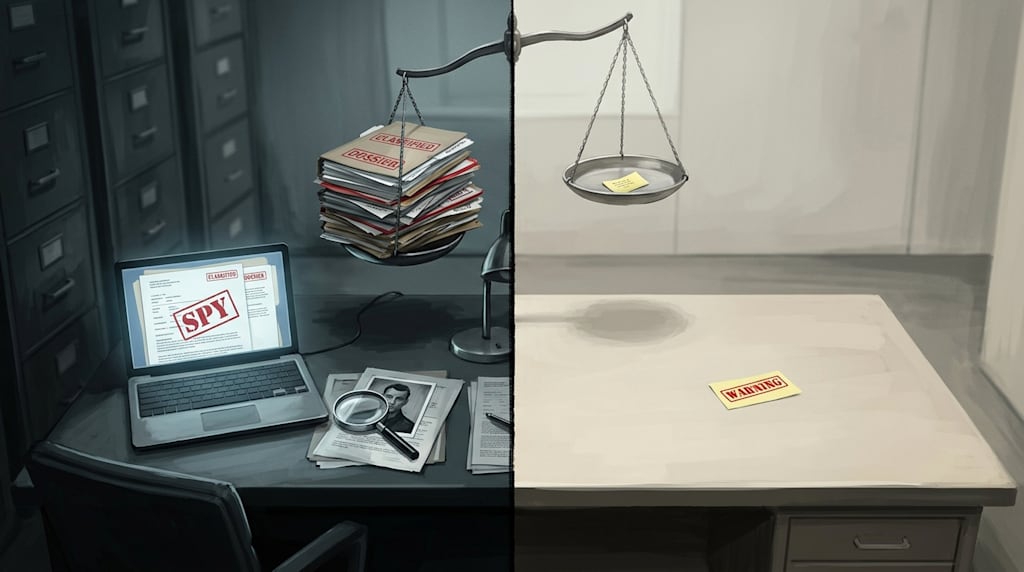
Liu sent the anonymous letter. He probably did not think the consequences would be serious for himself. All he knew was that Li had taken the overseas posting he was determined to get. After graduating with a master's degree in 2018, Liu joined a public institution and performed well. In 2024, the institution announced a posting to a certain country, and both Liu and his colleague Li signed up. Liu believed his abilities were superior and was confident he would win. When the institution selected Li, Liu was furious. To retaliate, he fabricated a letter accusing Li of being a "spy" and sent it to a foreign intelligence agency.
Investigation revealed that Liu's motive was to vent personal dissatisfaction and that he had no subjective intent to harm national security, but his actions "had produced an adverse impact on China's national security." In accordance with Article 8 of the Implementing Rules of the Counter-Espionage Law, the state security organ imposed an administrative warning.
An administrative warning is the lightest penalty in the administrative punishment system. It does not restrict personal freedom, impose a fine, revoke qualifications, or generally constitute a professional blemish record. But Li faced the verification procedures inevitably triggered by a "spy" accusation: interviews, evidence collection, background checks, possibly involving the workplace, colleagues, and family. Even after being cleared, the traces left by this experience in a specific professional environment would not automatically disappear because of a warning.
The question is whether the legal assessment of a series of actions — fabricating a serious spy accusation and sending a report to a foreign agency — should stop at the lightest admonitory penalty. The administrative warning is lawful. The question is whether it is adequate.
Three paths, three assessments
Liu's conduct can be examined under at least three legal frameworks, but this case only followed one of them.
The criminal law path. Article 243, Paragraph 1 of the Criminal Law: Whoever fabricates facts to falsely accuse and frame another person, with the intent to subject that person to criminal prosecution, if the circumstances are serious, shall be sentenced to fixed-term imprisonment of not more than three years, criminal detention, or public surveillance; if serious consequences are caused, to fixed-term imprisonment of not less than three years but not more than ten years. Paragraph 3 excludes "mistaken accusation" and "false report." Liu's case is not a mistaken accusation: the motive was retaliation, the means was fabrication, the target was a specific individual, and the content was a serious criminal charge sufficient to trigger criminal proceedings. In judicial practice, determining "serious circumstances" generally considers whether the fabricated crime is serious, whether the means are egregious, whether it is sufficient to cause judicial organs to initiate prosecution, and whether it causes damage to the reputation or personal freedom of the falsely accused. Espionage is a crime in Chapter I of the Specific Provisions of the Criminal Law, offenses endangering national security, with statutory penalties far higher than ordinary crimes. The state security organ did not initiate criminal prosecution against Li, but that does not make Liu's conduct trivial under criminal law.
The public security punishment path. Even if this case does not meet the "serious circumstances" threshold of Article 243, Article 50 of the newly revised Public Security Administration Punishments Law provides: Whoever fabricates facts to falsely accuse and frame another person, attempting to subject that person to criminal prosecution or public security punishment, shall be detained for not more than five days or fined not more than 1,000 yuan; if the circumstances are relatively serious, detained for not less than five days but not more than ten days, and may also be fined not more than 1,000 yuan. An administrative warning is not an option in this range. There is a clear penalty gradient between a warning and detention or a fine, and "fabricating a spy accusation and sending it to a foreign agency" is difficult to classify as the lightest tier.
The counter-espionage administrative enforcement path. This is the path actually applied. Article 8 of the Implementing Rules of the Counter-Espionage Law, issued by the state security organ. This path asks whether Liu's conduct adversely affected the order of national security work, not whether he constitutes the crime of false accusation and framing. Liu fabricated a spy accusation and sent it to a foreign agency. That objectively could draw foreign attention to Li and could interfere with the state security organ's screening of genuine espionage. Under this law, the administrative warning is a discretionary choice made by the state security organ within its administrative enforcement authority.
Three paths exist side by side, and this case followed only the third. The third path is lawful. But the assessment standards represented by the first two paths — the criminal law's severe attitude toward false accusations of serious crimes and the public security punishment's detention-and-fine gradient — were not reflected in the outcome.
What an administrative warning does not involve
Listing the specific content of an administrative warning is more persuasive than saying "the penalty is too light."
It does not involve personal freedom. Liu was not detained, not restricted from travel, not required to report regularly.
It does not involve property. No fine, no confiscation, no economic cost.
It does not involve qualifications. Liu's public institution position, eligibility for overseas selection, and security clearance review will not automatically be restricted because of this warning. The institution's internal personnel management may take it into account, but that is subsequent, implicit, and dependent on the institution's judgment, not directly imposed by the penalty itself.
It generally does not constitute a professional blemish record. In the general social evaluation system, the trace of an administrative warning is far weaker than detention, a fine, or a criminal record.
What Li endured is another set of things: the procedural burden inevitably brought by the state security organ's verification of a "spy" report, possible speculation spreading among colleagues, tension when family members were questioned, and the lingering shadow in the professional environment of having been investigated. These are not things an administrative warning can symmetrically address.
Comparison with the Yan case: different paths, different severity
The Yan false accusation case published by the Ministry of State Security in 2025 can serve as a comparison. Yan also fabricated an accusation that colleague Zhang was a spy and reported it to the 12339 platform, seriously interfering with the work of the state security organ. The punishment Yan ultimately received was: two years of probation within the Party, administrative dismissal, demotion, and transfer from the original post.
The difference lies in identity and disciplinary channel. Yan was a public official, and the punishment was made through the discipline inspection and supervision channel, based on disciplinary requirements for public officials, taking the form of a political disciplinary sanction. Liu is a public institution staff member, and the state security organ directly applied counter-espionage administrative legal liability to him. The two paths have different regulatory purposes and different forms of sanction, and one cannot simply demand "equal punishment for the same case."
But the comparison proves that false spy accusations can produce quite serious consequences under different regulatory frameworks. Yan lost his position, rank, and original post; Liu received only a warning. Whether this difference is reasonable depends on the regulatory logic of each path. But when public cases convey "the cost of falsely accusing someone of being a spy," if only the lightest tier is presented, the deterrent effect will be weakened.
Coordination between administrative and criminal enforcement and reasoning for discretion: two specific questions
The Liu case leaves two operational questions.
First, is the coordination between administrative and criminal enforcement adequate? In the course of administrative enforcement, if the state security organ finds that conduct meets the prosecution standards of Article 243 of the Criminal Law, it should transfer the case to the judicial organ in accordance with law. Liu fabricated a spy crime, sent it to a foreign agency, and the conduct has adversely affected national security. Whether these circumstances meet "serious circumstances" and whether they are sufficient to initiate criminal prosecution should be clearly judged and reasoned. Even if it is ultimately concluded that no crime is constituted, reasons should be given, rather than letting the administrative warning be the only visible conclusion.
Second, is the reasoning for discretion adequate? There should be relatively clear standards for when an administrative warning applies. Liu's conduct contains three aggravating circumstances: the fabricated crime is a serious offense endangering national security, the recipient was a foreign agency, and the conduct has produced an adverse impact. Why these three circumstances still correspond to the lightest penalty needs to be reflected in the enforcement documents. Otherwise, the public sees two messages: "falsely accusing someone of being a spy will surely be severely punished" and "fabricating a spy accusation may also result in only a warning." The second message will travel faster.
Back to that letter
When Liu sent the anonymous letter, he did something concrete: he fabricated the claim that a colleague was a spy and told a foreign agency. Every element of this action aggravates the nature of the conduct: fabrication, targeting a specific individual, sending it abroad. The administrative warning assessed this matter, but it assessed it too lightly to match the weight of this action.
Legal assessment can differ due to different regulatory paths, but such differences require reasoning and require boundaries. The public needs to see that discretion is not arbitrary. Otherwise, the next Liu, before sending a letter, may calculate the cost and think it worth a try.
About the Creator
Jin
Writer of reamstories
https://reamstories.com/jin
Enjoyed the story? Support the Creator.
Subscribe for free to receive all their stories in your feed. You could also become a paid subscriber, letting them know you appreciate their work.
Comments
There are no comments for this story
Be the first to respond and start the conversation.