
He Called His Colleague a Spy. The Punishment Was a Warning.
A workplace rivalry, an anonymous letter sent abroad, and the gap between public outrage and legal accountability.
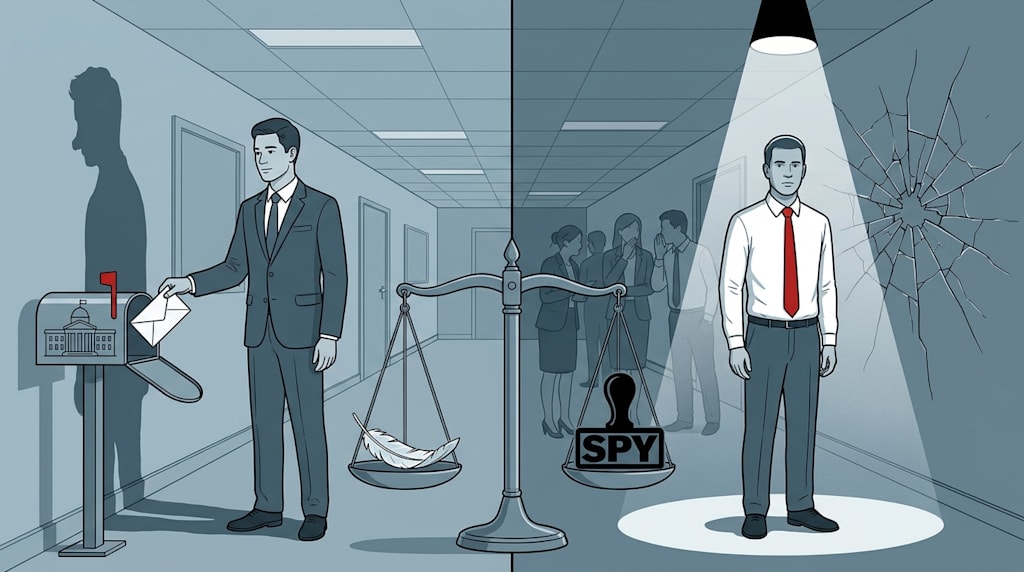
Liu and Li worked at the same public institution. In 2024, both applied for an overseas posting. Liu had the stronger resume on paper. He had joined the institution in 2018 after finishing a master’s degree at a prestigious university, and his work had been well reviewed. He expected to win.
Li got the job.
Liu did not appeal, ask for feedback, or argue the decision through channels. He wrote an anonymous letter to an overseas body and called Li a spy.
That accusation is not office gossip. It points to a serious crime under Chapter One of the Criminal Law, offenses endangering national security. Even when the charge collapses, the person named can face questioning, institutional scrutiny, suspicious colleagues, and damage to a career. Liu knew the weight of the label. That is why he used it.
The official investigation found that Liu’s motive was personal resentment. It said he had no subjective intent to harm national security, but his conduct did create a negative impact on it. Under Article 8 of the Implementing Rules of the Counter-Espionage Law, the national security authority gave him an administrative warning.
A warning is the lightest reprimand in the administrative penalty system. It does not restrict liberty, take property, strip qualifications, or usually mark a career file. That mismatch is what drew public anger. A man fabricated a spy accusation against a colleague and walked away with a warning.
The legal explanation is not irrational. The case did not meet the crime of false accusation under Article 243 of the Criminal Law. That article requires an intent to subject someone to criminal investigation and “serious circumstances.” Courts usually look for a criminal case actually started, reputational or liberty damage, or especially egregious means. Li was not criminally investigated. Liu’s stated purpose was to vent, not to launch a criminal case. Criminal liability was hard to attach.
The Public Security Administration Punishments Law could allow detention or a fine for false accusation. Article 50 sets five days’ detention or a fine of up to 1,000 yuan, and heavier penalties for serious cases. But the authority used the Counter-Espionage Law’s implementing rules instead. Special law took priority. The reasoning holds. It does not erase what Li went through.
Li faced questioning, scrutiny, and workplace rumor. Being cleared does not undo the weeks or months of suspicion. Liu got a warning. He kept his job, his desk, his daily routine. The asymmetry is the story.
The warning raises one problem: low-cost false accusation. If the worst outcome is a warning, what stops the next jealous colleague? A second problem is repair. Who clears Li’s name inside the institution, not just in a case file? A third is channel design. Whistleblowing must remain open for credible threats. It also needs screening for personal vendettas.
The conduct also shows a distorted competitive logic. A colleague becomes an obstacle to remove. A public reporting channel becomes a private weapon. A spy label becomes a tool. Liu lost a posting. He chose to destroy the winner. That choice is worse than the loss.
Institutional fixes are not abstract. Liability should be tiered by the seriousness of the fabricated charge, whether the material went to a foreign body, and the harm to the accused. Institutions should clarify the accused person’s name promptly, not only issue a case conclusion. Reports that target a specific person and come from a direct rival should get higher review. Selection criteria for postings should be transparent enough to reduce suspicion and resentment.
The case does not prove that the law is broken. It shows where current settings leave public trust short. A warning can be legally correct and still feel insufficient. Until penalties, repair, and screening catch up, the phrase “workplace is a battlefield” will keep sounding accurate.
About the Creator
Jin
Writer of reamstories
https://reamstories.com/jin
Enjoyed the story? Support the Creator.
Subscribe for free to receive all their stories in your feed. You could also become a paid subscriber, letting them know you appreciate their work.
Comments
There are no comments for this story
Be the first to respond and start the conversation.