
Endometriosis
When Aunt Flo Stops By, Kicks Down the Door, and Leaves You Fighting for Your Damn Life

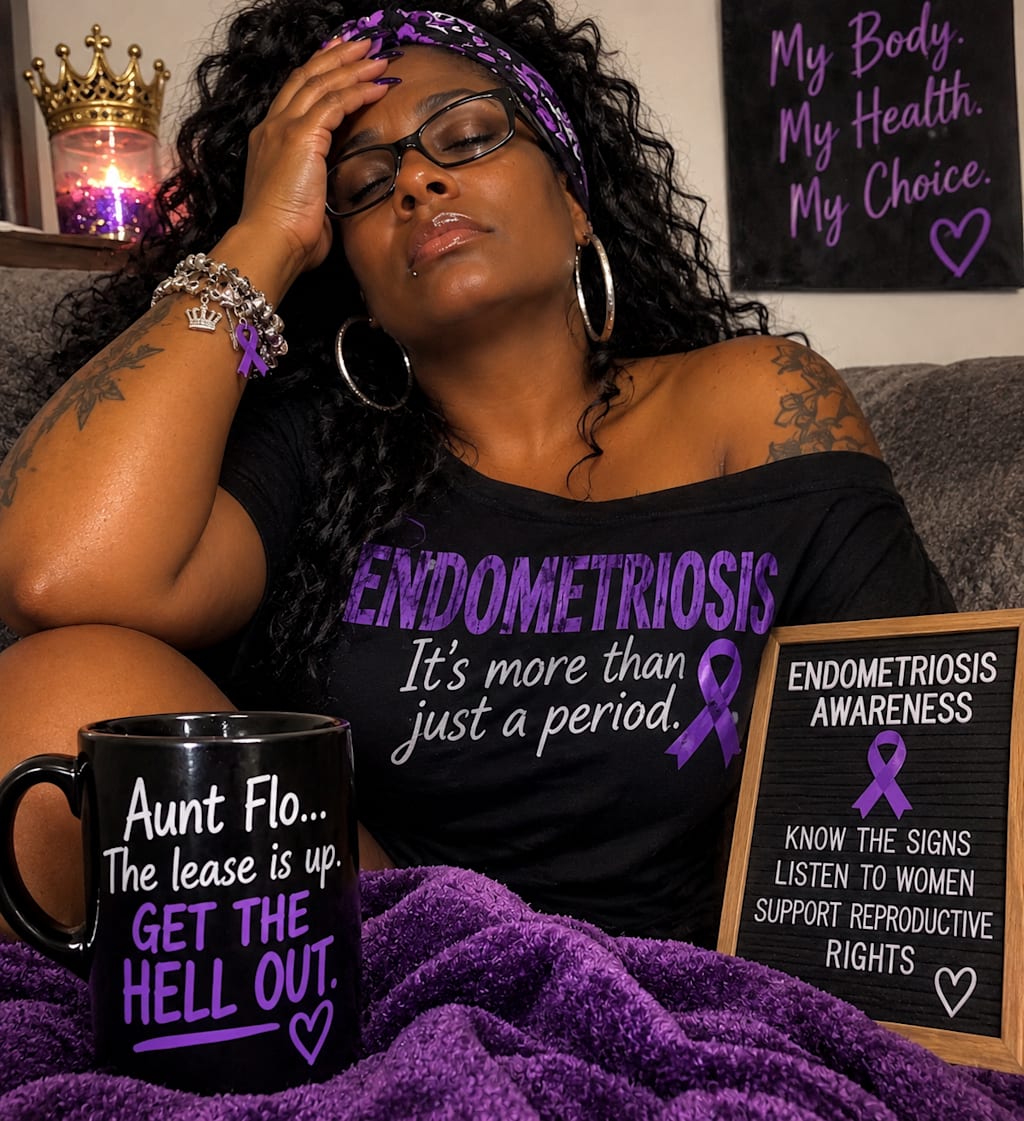
Endometriosis: When Aunt Flo Stops By, Kicks Down the Door, and Leaves You Fighting for Your Damn Life
Endometriosis is a chronic medical condition in which tissue similar to the lining of the uterus grows outside the uterus. Instead of staying where it's supposed to be, this tissue can grow around the ovaries, fallopian tubes, bladder, bowels, and other areas within the pelvic cavity. It can cause inflammation, irritation, scar tissue, adhesions, painful periods, chronic pelvic pain, painful bowel movements, digestive problems, and sometimes complications involving fertility.
And before anybody says, "Oh, you just have bad cramps," let me stop you right there.
NO. WE ARE NOT TALKING ABOUT REGULAR PERIOD CRAMPS.
We're talking about pain that can take a grown woman completely out of commission. Pain that can have you perfectly fine one minute and negotiating with the Lord, little baby Jesus, and every ancestor you can think of three minutes later.
And I know a little something about this because I've been dealing with this mess since high school.
Now, let me take y'all back.
I WAS IN HIGH SCHOOL, AND MY UTERUS WAS ALREADY ACTING LIKE IT HAD A PERSONAL VENDETTA AGAINST ME.
Back then, I don't know if the doctors I was seeing were even using the term endometriosis with me. I certainly wasn't walking around knowing what it was. All I knew was that something was NOT RIGHT.
My menstrual cramps were absolutely ridiculous.
I'm not talking about taking a couple of Tylenol, drinking some water, and going back to class. I'm talking about pain that would have me heading straight to the school nurse's office, where I'd practically take up permanent residency until it was time to go home.
Sometimes I'd be there ALL DAMN DAY.
Other times, my mother would have to come pick me up because I simply couldn't stay at school.
Imagine being a teenager, trying to get through high school, and your reproductive system is already behaving like a disgruntled employee who has decided that nobody in management deserves peace.
I wasn't trying to skip class. I wasn't trying to get out of doing homework. I wasn't trying to get an extra day off.
MY DAMN UTERUS WAS ACTUALLY CAUSING PROBLEMS!
And this is something I want people to understand about endometriosis. It isn't always something that suddenly appears when you're an adult. Symptoms can begin during adolescence, and unfortunately, young girls can spend years dealing with severe menstrual pain before anybody takes the time to investigate what's actually happening.
Some girls are told it's normal. Some are told they have a low pain tolerance. Some are given medication and sent on their way.
Meanwhile, they're missing school, missing activities, and trying to figure out why their bodies are putting them through something that other people seem to handle without nearly as much difficulty.
I was one of those girls.
ENTER DEPO-PROVERA: THE SHOT THAT MADE AUNT FLO DISAPPEAR.
Eventually, I started taking Depo-Provera.
For those unfamiliar with it, Depo-Provera is a hormonal birth control injection containing medroxyprogesterone acetate. It's generally administered every three months to prevent pregnancy. It can also suppress ovulation and menstrual bleeding in many people.
And when I tell you that shot changed things for me, IT CHANGED THINGS!
My period stopped.
I wasn't dealing with the regular monthly bleeding, and I wasn't experiencing those same awful cramps.
For me, it was like somebody finally found the OFF switch.
I could go to school, live my life, and not spend half my day looking for somewhere to curl up in a fetal position.
I stayed on Depo-Provera on and off from my high school years until I was approximately 42 years old.
YES. YOU READ THAT CORRECTLY.
From high school until I was 42.
Now, here's where things get interesting.
Throughout those years, the doctors who had prescribed Depo-Provera to me had been male doctors.
I wasn't necessarily questioning the treatment because, from my perspective, it was working. My periods had stopped, my cramps weren't bothering me the way they had before, and I wasn't spending every month feeling like my body was preparing for an international wrestling championship.
Then I turned 42.
I finally had insurance, and I went to see a female OB-GYN.
That woman looked at me like I'd just walked into her office and announced that I'd been taking medication prescribed by a veterinarian.
She asked me how long I'd been on Depo-Provera.
I told her.
And when I tell you she was NOT impressed!
She basically wanted to know why I'd been on it for so long and immediately started discussing taking me off it.
She asked me whether I understood what prolonged use could potentially do.
Now, I want to be clear about something. Depo-Provera is an approved medication, and it can be an appropriate treatment for certain people. But it also has important risks, particularly concerning bone mineral density.
The FDA prescribing information warns that Depo-Provera can cause significant bone mineral density loss, that the loss may not be completely reversible, and that the effects of use during adolescence and early adulthood on peak bone mass and later fracture risk are not fully known.
The labeling generally discourages using it as a long-term birth control method beyond two years unless other options are considered inadequate.
That's information I wish I'd understood much earlier.
And apparently, my new OB-GYN felt the same way.
Now, at the time, I wasn't thinking about lawsuits, legal claims, or any of that. I was sitting there thinking, WAIT A MINUTE. Y'ALL HAVE BEEN GIVING ME THIS SHOT FOR YEARS!
I've also seen the more recent headlines about Depo-Provera and meningiomas. A meningioma is a tumor that develops in the membranes surrounding the brain and spinal cord. Most meningiomas are not cancerous, although they can still cause serious problems depending on their location and size.
The FDA added a meningioma warning to the Depo-Provera prescribing information in December 2025. The label advises discontinuing the medication if a meningioma is diagnosed and monitoring for relevant symptoms.
I have never been diagnosed with a meningioma, and I'm not claiming that I have one. I'm also not making any legal claim about my own history.
I'm simply saying that women deserve to know what they're taking, what the potential risks are, and what questions they should be asking their healthcare providers.
Because apparently, we need to start reading the fine print on EVERYTHING.
AND JUST WHEN I THOUGHT MY BODY HAD GIVEN ME ENOUGH TO DEAL WITH, HERE CAME ANOTHER MEDICAL EMERGENCY.
I remember standing in my bathroom, curling my hair. Just doing my regular thing. Nothing unusual was happening. I wasn't expecting anything, and I certainly wasn't prepared for what happened next.
Suddenly, I experienced an incredible amount of pain.
I'm talking about pain that came out of nowhere.
I had an ovarian cyst rupture.
And before I knew it, I passed out, hit my head, and fell.
Now, my son was only about five or six years old at the time.
That little boy called 911.
Let me tell you something. I will never forget that.
My son was a little child, and he recognized that something was seriously wrong. He knew he needed help, and he made that call.
I believe that call helped save my life.
Parents, please teach your children how to call 911. Teach them what to do if somebody in the house has a medical emergency. They don't have to understand the medical condition. They need to know how to get help.
Because you never know when that knowledge might make all the difference.
And let me clarify something medically: ovarian cysts and endometriosis are not automatically the same thing. Some people with endometriosis develop ovarian cysts called endometriomas, but not every ovarian cyst is related to endometriosis. I'm sharing my experience because it is part of my reproductive health history.
And trust me, that history doesn't stop there.
I ALSO HAD A DOCTOR TELL ME I WAS TOO YOUNG TO DECIDE WHAT I WANTED DONE WITH MY OWN BODY.
Let's go back to when I was 25.
After having my son, I knew I was finished having children. I had a tubal procedure, and I asked my male OB-GYN about having a hysterectomy.
I was serious.
I wasn't asking because I was having a bad day. I wasn't asking because I was upset with somebody. I wasn't asking because I hadn't thought about what having children meant.
I had already made my decision.
And what did that doctor tell me?
I was too young.
I might change my mind.
I might want more children someday.
EXCUSE ME?
I was 25 years old. I already had my children. I knew what I wanted for my future.
But apparently, my doctor believed he knew better than I did.
Here I am, at 48 years old, with those same two children. I love them, and I wouldn't change having them. But I didn't suddenly reach this age and decide that I wanted to start over and have more babies.
I knew what I wanted at 25.
And I was told no.
Now, I want people to understand that a hysterectomy is a major medical procedure. It isn't automatically the right treatment for everyone, and it isn't necessarily a cure for endometriosis because endometriosis can grow outside the uterus.
But that doesn't mean a woman shouldn't be able to have an honest conversation with her doctor about it.
I wasn't asking my doctor to make a decision without explaining the risks. I wanted to discuss my options. I wanted to be heard.
Instead, my age and the possibility that I might someday change my mind became the deciding factors in that conversation.
And here's something else I had almost forgotten.
AT 32, I EXPERIENCED A TUBAL PREGNANCY.
A tubal pregnancy is a type of ectopic pregnancy. It happens when a fertilized egg implants outside the uterus, most commonly in a fallopian tube.
An ectopic pregnancy cannot develop into a viable birth. It can also become a life-threatening medical emergency if it ruptures and causes internal bleeding.
When I experienced mine at 32, the male doctor gave me medication to treat it and sent me on my way.
And that was pretty much it.
There wasn't some long conversation afterward about my experience. It wasn't something that continued to be discussed with me. I was treated, and life moved on.
But that experience almost took me out, too.
Think about the timeline.
I had a tubal procedure at 25 after having my son. I asked for a hysterectomy and was told I was too young. At 32, I experienced an ectopic pregnancy that required medical treatment.
And now I'm 48, still talking about reproductive health, menstrual pain, and what women experience when trying to get doctors to listen.
This is why reproductive health is personal to me.
This isn't something I learned about yesterday because it was trending on social media. These are experiences that have followed me through different stages of my life.
And speaking of women having control over their own reproductive health, we need to talk about something much bigger than my personal medical history.
WE NEED TO TALK ABOUT ROE V. WADE, MISSOURI, AND THE PEOPLE WHO THINK THEY GET TO MAKE DECISIONS ABOUT OUR BODIES.
On June 24, 2022, the United States Supreme Court overturned Roe v. Wade through its decision in Dobbs v. Jackson Women's Health Organization.
For decades, Roe v. Wade had protected a constitutional right to abortion. When the Supreme Court overturned it, the authority to regulate abortion largely returned to individual states.
And suddenly, a woman's access to abortion care could depend heavily on which state she lived in.
Let that sink in.
Where you live could make a difference in what reproductive health care you can access.
Now, I live in Kansas City, MISSOURI.
And if you know anything about Missouri politics, you know reproductive rights have been a major battle here.
In November 2024, Missouri voters approved Amendment 3, establishing constitutional protections for reproductive freedom. Those protections included decisions involving abortion care, contraception, prenatal care, childbirth, postpartum care, miscarriage care, and other reproductive health matters.
Missouri voters made their voices heard.
But apparently, that wasn't the end of the fight.
On November 3, 2026, Missouri voters faced another Amendment 3 proposal. And this is where I want people to pay attention because the 2026 Amendment 3 was NOT the same measure voters approved in 2024.
The 2026 proposal sought to repeal the reproductive-freedom protections established by the 2024 amendment. It would have allowed much more restrictive abortion laws, with limited exceptions.
And Missouri voters said NO.
We rejected that proposed repeal.
So let's make this perfectly clear: the 2024 Amendment 3 established reproductive-freedom protections in Missouri. The separate 2026 Amendment 3 proposal attempted to take those protections away. Voters defeated that proposal, leaving the 2024 protections in the Missouri Constitution.
And I want to say something about that because I am one of the women whose life experiences make this issue personal.
I've had a doctor tell me I was too young to have a hysterectomy.
I've experienced an ectopic pregnancy.
I've dealt with years of menstrual pain.
I've experienced a ruptured ovarian cyst.
I've had a medical emergency serious enough that my little boy had to call 911.
So when I hear politicians debating what women should be allowed to do with their own bodies, I have a few questions.
How the hell does somebody sitting in Congress know more about my reproductive health than I do?
How does a politician know my medical history? How does he know what I've experienced? How does he know what decisions I've made or what medical treatment I've needed?
And why should somebody else's political beliefs determine what medical care I can receive?
I'm talking about people making decisions from behind desks, writing legislation about bodies they will never have to live in.
And yes, I'm talking about those politicians who seem to believe that women need somebody else to approve our reproductive decisions.
We can't always get the medical procedures we request because somebody thinks we're too young. We have to fight to be heard when we're dealing with pain. We have to explain our medical histories over and over again.
And then we have to watch politicians argue about whether we should have access to reproductive health care.
No.
My body is not a political talking point.
My medical history is not a campaign slogan.
And my reproductive decisions should not be made by somebody who has never had to experience what I'm talking about.
This is not about saying every woman should make the same decision. It's about women having the ability to make informed decisions with their health care professionals without unnecessary political interference.
It's about having choices.
It's about being able to talk to a doctor and receive accurate information.
It's about being able to get medical care when you need it.
And it's about recognizing that reproductive health includes much more than abortion. It includes contraception, pregnancy, miscarriage, fertility, childbirth, hysterectomies, and conditions like endometriosis.
These conversations are connected because they all involve our health and our ability to make decisions about our bodies.
Now, let's get back to Aunt Flo, because she apparently has no respect for my schedule.
I'M 48 YEARS OLD, AND THIS WOMAN STILL THINKS SHE HAS A PERMANENT INVITATION TO MY HOUSE.
On the day I'm talking about, I was working from home.
For those who don't know me, I'm a professional introvert. I like being at home. I like handling my business without unnecessary noise, crowds, or a bunch of extra activity.
I work from home taking calls from patients who need surgery. I understand that people are dealing with medical situations, and I take my responsibilities seriously.
I clocked in at 10:30 a.m.
Everything was fine.
I wasn't sick. I wasn't curled up in a ball. I wasn't sitting there thinking I needed to take the day off.
I was working.
Then around 11:30 a.m., everything changed.
Within minutes, I went from feeling perfectly normal to experiencing pain so intense that I couldn't continue working.
I had to message my supervisor and explain that I needed a couple of hours because I was hurting too badly to do my job.
And when I say I was hurting, I mean I was on the floor.
One minute, I'm 100 percent okay. The next minute, I'm crying like a little baby bitch because apparently my body has decided that today is the day we're going to have a full-blown meltdown.
I was begging the Lord and little baby Jesus not to take me because I still have things to do!
I wasn't being dramatic. I wasn't trying to get out of work. I wasn't looking for attention.
I WAS IN PAIN.
And that's what I want people to understand about severe pelvic pain. It doesn't always give you a warning. It doesn't always gradually build throughout the day. Sometimes you can be perfectly fine and then suddenly find yourself unable to function.
That is not something people should automatically dismiss as ordinary menstrual cramps.
Severe period pain deserves medical attention, especially when it interferes with everyday activities. If you're missing school, missing work, canceling plans, or spending hours trying to get through your period, talk to a health care professional.
Endometriosis can be difficult to diagnose. Its symptoms can overlap with other conditions, and there isn't one simple symptom that confirms it. Depending on the situation, doctors may discuss a medical history, physical examination, imaging, or other diagnostic options.
And if you feel like your concerns aren't being taken seriously, you deserve to ask questions and seek another medical opinion.
I also want women to understand that a hysterectomy isn't automatically a cure for endometriosis. Because the tissue can grow outside the uterus, removing the uterus doesn't necessarily remove all endometriosis or eliminate every source of pain.
Treatment needs to be based on the individual person, their symptoms, and their medical circumstances.
But no woman should have to feel embarrassed about asking questions or discussing her options.
And nobody should assume that because a woman looks fine, she's not hurting.
People can be dealing with tremendous pain while still trying to work, take care of their children, answer phone calls, and handle everyday responsibilities.
Sometimes they can push through.
Sometimes they can't.
And sometimes they need to stop everything and take care of themselves.
That's where I was that day.
At 48 years old, I thought I was simply going to have a regular workday. Instead, my uterus apparently decided to hold an emergency staff meeting, and I wasn't invited to the discussion.
So here we are.
I've been dealing with painful periods since high school. I've spent time in the school nurse's office. I've used Depo-Provera on and off for decades. I've experienced a ruptured ovarian cyst. My son had to call 911 when I passed out. I asked for a hysterectomy at 25 and was told I was too young. I experienced an ectopic pregnancy at 32.
And now, at 48, I'm still dealing with reproductive health issues that deserve attention.
That's a whole lot of history for one uterus.
And underneath all the jokes, there's something serious I want people to take away from this story.
Women deserve to be listened to.
We deserve to understand the medications we're prescribed. We deserve doctors who take our pain seriously. We deserve to ask questions about procedures and treatment options without being dismissed because of our age or somebody else's assumptions about what we might want in the future.
We deserve accurate medical information.
We deserve reproductive freedom.
And we deserve to be part of the decisions being made about our own health.
Because whether we're talking about endometriosis, painful periods, ovarian cysts, ectopic pregnancies, hysterectomies, contraception, or abortion, these aren't just political talking points or medical terms printed in a brochure.
These are real experiences affecting real people.
So the next time somebody tells a woman she's being dramatic because she's experiencing severe menstrual pain, maybe listen before you judge.
You have no idea what she's dealing with.
And as for Aunt Flo?
At this point, she needs to understand that she is no longer welcome here.
I didn't invite her. I don't want her bringing guests. I don't want her showing up unannounced, and I certainly did not authorize automatic renewal.
I'm 48 years old.
I've been dealing with this long enough.
AUNT FLO, THE LEASE IS UP. GET THE HELL OUT.
About the Creator
Dakota Denise
Every story I publish is real lived, witnessed, survived, by myself or from others who trusted me to tell the story. Enjoy 😊
Enjoyed the story? Support the Creator.
Subscribe for free to receive all their stories in your feed. You could also become a paid subscriber, letting them know you appreciate their work.
Comments
There are no comments for this story
Be the first to respond and start the conversation.