
Control Valve Leakage Troubleshooting with Better Maintenance Records
Control valve leakage troubleshooting becomes more effective when the maintenance record distinguishes observations from diagnoses.

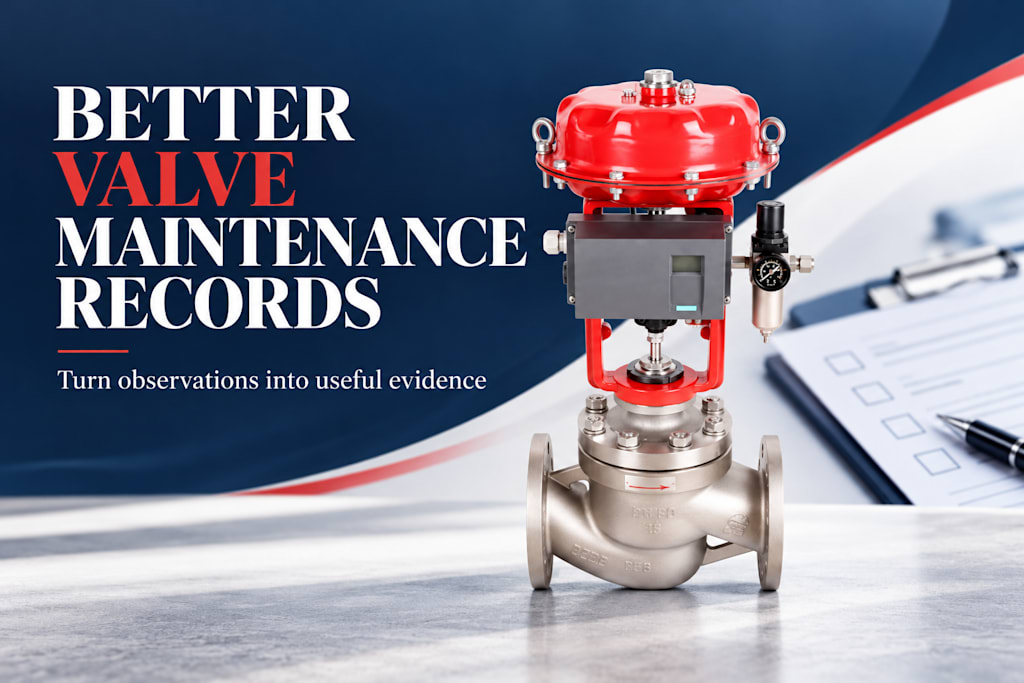
A useful record identifies the valve, leakage location, operating conditions, observation method, work performed, and verification result. It should preserve what was known at each stage instead of turning an early guess into a permanent explanation.
Digital records can help, but the benefit comes from the structure and meaning of the information rather than the software alone. A carefully designed form can support comparison across events, while an elaborate system filled with vague notes such as “valve leaking again” offers little diagnostic value.
Give the equipment a stable identity
Use a stable equipment tag that connects the record with the plant’s asset register and drawings. Include the valve’s location and service in readable language so a person can recognize it without interpreting the tag alone. Similar valves in neighboring lines should not be distinguishable only by a photograph.
Keep configuration information separate from individual events. The asset record can hold the valve construction, materials, actuator, and relevant settings. An event record describes what happened at a particular time. Linking the two avoids repeatedly copying configuration details that may later become inconsistent.
When the configuration changes, preserve that history. A seat replacement with a different approved material or a changed actuator setting can affect later behavior. The record should make it possible to identify which configuration was present during each leakage event.
Record the leakage path before assigning the cause
Internal leakage passes through the closed valve to the downstream side. External leakage escapes from a pressure boundary such as packing, a body joint, or a flange. Those categories should be available as distinct fields, along with an “uncertain location” option when the observation is not yet sufficient.
Do not force a technician to select “seat damage” merely to submit an initial report. That is a diagnosis, not a location. A better initial entry might state that downstream pressure increased after a close command, while the exact path remains under investigation.
The control valve leakage troubleshooting topic becomes more useful when the record reflects that distinction. A system that separates the observed path from the suspected mechanism allows later findings to confirm or replace the hypothesis without erasing the original evidence.
Attach operating context to every observation
Pressure, temperature, valve position, and operating mode can change the meaning of a leakage observation. Record the relevant values with units and identify where they were measured. If a value is unavailable, mark it as unavailable rather than entering zero.
Keep the observation time distinct from the time the form was completed. A technician may enter notes after the event. In a digital system, the source timestamp and data quality also matter if measurements are imported automatically. A stale value should not be represented as a current condition.
Describe the observation method. A visible wet area, a measured flow, and a downstream pressure trend are different kinds of evidence. The record should not treat them as interchangeable leakage-rate measurements or convert them into a precise severity number without a defined basis.
Record field
Purpose
Example of useful content
Equipment identity
Connects the event to the asset
Valve tag and service
Observed location
Separates leakage paths
Stem area, body joint, internal path suspected
Observation method
Describes the evidence
Visual observation or defined measurement
Operating context
Makes events comparable
Pressure pair, temperature, operating mode
Hypothesis
Keeps the diagnosis provisional
Possible incomplete travel
Confirmed finding
Records what inspection established
Specific component condition
Verification
Shows the result after work
Method, conditions, outcome
Keep a clear event timeline
A single event can include initial detection, follow-up assessment, work planning, intervention, and verification. Preserve those stages in order. This helps distinguish a delayed response from a repair that did not resolve the problem or a new problem that appeared later.
Each stage should identify its author or responsible role in the maintenance system without inventing technical authority. The objective is accountability for the observation and work record. A diagnosis should be supported by findings rather than by an impressive job title attached to the entry.
Avoid overwriting the initial description with the final conclusion. The difference between them can be valuable. If several events initially appeared to be seat leakage but were later linked to incomplete travel, that pattern can improve the first-response process.
Use a simulated event to test the record
Consider a hypothetical event for valve CV-204. At 10:00, an operator observes downstream pressure rising after a close request. The initial record identifies the operating mode, available pressure measurements, demand, measured position, and the observation interval. It labels the cause as unconfirmed.
At 10:20, a follow-up review finds that the actuator indication did not reach its expected closed condition. The record adds that finding without changing the earlier pressure observation. Subsequent prepared maintenance and checks establish the actual cause and corrective action.
The example does not describe a real customer or prescribe a repair. It shows how a structured timeline preserves the reasoning. A final note that simply says “leak repaired” would lose the distinction between an internal sealing problem and a movement problem.
Make repair records specific enough to learn from
Record the component inspected, the condition found, parts changed, and settings altered when relevant. “Adjusted valve” is too broad to support later analysis. The maintenance record should identify the actual work without becoming a substitute for the equipment’s approved procedure.
Verification needs the same care. State the method, operating or test conditions, and result. A functional stroke check and a leakage assessment answer different questions. If only movement was checked, the record should not imply that every sealing requirement was demonstrated.
Where an issue remains unresolved, keep it open with a clear next action or limitation. Closing a digital work order does not change the physical condition. The administrative status should reflect the evidence rather than pressure to make the dashboard appear complete.
Compare recurrence under similar conditions
Counts of leakage events are useful only when the records describe comparable observations. A change in inspection frequency can increase reported events without any change in equipment condition. Different detection methods can also change what is found.
Look for repeated location, configuration, fluid condition, or operating stage. A recurring packing issue after thermal cycles suggests a different review from repeated internal leakage following particle-bearing service. These patterns guide investigation but do not prove the cause on their own.
Use denominators where appropriate. Ten events across a large population of frequently inspected valves cannot be compared directly with three events across a small, rarely inspected population. Record the exposure or inspection basis before turning event counts into a performance claim.
Keep regulatory programs and general maintenance distinct
Formal leak-detection programs may have specific methods and records for particular regulated services. Their practices can illustrate the value of equipment identification, tracking, repair history, and follow-up. They should not be presented as universal requirements for every industrial water or process valve.
For general maintenance, choose the fields that support the actual equipment and operating task. A form should be short enough to complete accurately while preserving the evidence needed for diagnosis. Adding unrelated compliance fields can reduce its usefulness.
The product and technical information available through ysmeter can provide equipment context, but the plant’s own event history remains the evidence for what happened in service. Keep those roles separate when reviewing recurring problems.
Design fields that preserve uncertainty
A digital form should distinguish “not measured,” “not applicable,” and “measurement unavailable.” Those states have different meanings. If every blank field becomes zero, later analysis may incorrectly conclude that pressure, temperature, or leakage was measured and found absent. Preserve the reason for missing information when it matters to interpretation.
Use controlled categories for repeatable facts such as leakage location, while allowing a concise observation note. Categories make events easier to group, but they should not force a false diagnosis. Include an unresolved option and let the confirmed finding be added after assessment. The system should make it easy to improve the record without rewriting its history.
If measurements arrive automatically, keep their units, source time, and quality with the value. A current work-order timestamp does not make an old process reading current. The maintenance record should show whether the observation and measurement actually describe the same operating moment.
Before introducing the form, test it with a few realistic simulated events: uncertain source, internal path suspected, external packing observation, and a report later traced to incomplete movement. If those cases cannot be represented without misleading entries, simplify or revise the schema before asking technicians to use it.
The aim is a record that supports reasoning. A small number of accurately defined fields, completed consistently, can be more useful than a large form that encourages guesses. Good data structure preserves the limits of the evidence as well as the observations themselves.
Frequently asked questions
Should suspected cause be a mandatory field?
It can be useful if “not yet established” is an allowed response. Do not force a diagnosis before evidence exists. Mandatory observations, location, time, and operating context usually provide a stronger foundation for the initial report.
Is a photograph enough to document leakage?
It can support the record, but it may not establish the source, rate, or operating conditions. Add location, time, observation method, and relevant process context. Fluid visible near a valve may have originated elsewhere.
What should happen to the original report after diagnosis?
Preserve it and add the confirmed findings as a later stage. The difference can reveal useful patterns in how problems are first observed. Replacing the original description with the final diagnosis removes part of the evidence trail.
Which metric is most useful for recurring issues?
There is no universal single metric. Compare event location, confirmed mechanism, configuration, operating conditions, and inspection basis. Recurrence counts become more meaningful when the population and observation frequency are also understood.
Design the record around evidence and a clear timeline. That gives maintenance teams a stronger basis for troubleshooting than a collection of unstructured comments or unsupported failure labels.
References
[1] U.S. Environmental Protection Agency. Leak Detection and Repair: A Best Practices Guide.
[2] OPC Foundation. OPC Unified Architecture, Part 6: Mappings — DataValue.
[3] Rotork. IQ3 Pro.
About the Creator
Enjoyed the story? Support the Creator.
Subscribe for free to receive all their stories in your feed.
Comments
There are no comments for this story
Be the first to respond and start the conversation.