
Choose Office Wall Art for the View from the Chair
A seated-view check reveals what monitors, furniture and viewing distance change before you choose an office print.

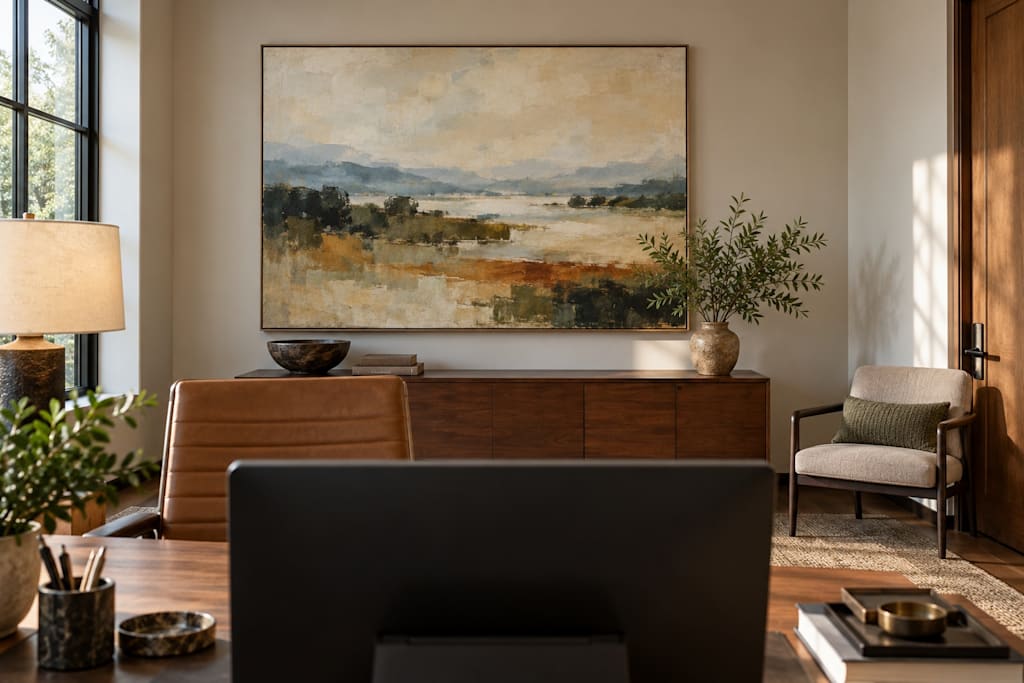
A wall can look perfectly available from the doorway and almost disappear once you sit down. The monitor moves into the foreground. A desk lamp covers a corner. The view becomes narrower, lower and more familiar. Yet the doorway is often where a room photograph is taken, and that photograph quietly becomes the basis for choosing the picture.
Before selecting office wall art, it is worth changing the viewing position. The question is not only whether a print fits the wall. It is whether the part of the image you want to see will be visible from the place where you actually spend time. This small planning exercise can be done before ordering, without pretending that an online room mockup represents your own office.
Give the room more than one viewpoint
Start by naming the people who will see the wall. There may be a person working at a desk, a visitor sitting opposite, and someone entering through the door. In a shared room, there may be several working positions rather than one obvious main seat.
Write down the purpose of the picture for each position. A picture near the entrance may introduce the character of the room. A picture opposite a desk may be something the occupant looks at between tasks. A picture behind the desk may be visible to visitors but never to the person using that desk. None of these is automatically the correct purpose; they are different choices.
If one wall cannot serve every position equally well, decide which view matters most. That is more useful than searching for a universal hanging rule that ignores the furniture and the people in the room.
Sit as you normally work
Do the first check with the desk in ordinary use. Leave the monitor at its usual height. Keep the lamp, document stand and other items that normally remain on the desk. Sit in the chair rather than leaning forward to obtain a cleaner view.
Now identify the portion of the wall you can actually see. Is it above the monitor, beside it, or on a different wall? Does seeing the proposed picture require turning your head? Would the lower half be concealed? These are observations about the room, not measurements of productivity or wellbeing.
A photograph from that position can help record the view, but do not let the camera make the decision. A wide-angle phone image can make space appear more generous than it feels. Check with your own eyes first, then use the photograph as a note for the comparison.
Test a footprint before a favourite image
Use a safe, removable paper outline to represent the intended outer size, provided the wall surface permits it. Do not attach anything to delicate finishes without checking a suitable method. The outline should represent the complete arrangement, including the spacing you intend between separate panels.
Return to the chair. Compare the outline with the visible wall area rather than with the full wall dimensions alone. A print may physically fit and still place its important lower section behind a screen. Moving the outline upward might solve that problem while creating an awkward view from another seat. Test the alternative before settling on it.
This exercise concerns visual planning. It does not determine the correct fixing hardware or whether a wall can support an object. Those questions depend on the actual product, wall and installation conditions and should be resolved separately.
Ask which details survive the distance
Once the position is plausible, consider the image itself. A broad arrangement of shapes may remain recognisable across the room. Small lettering or delicate detail may be something you appreciate only when standing close. Neither is inherently better, but the viewing task is different.
For a hypothetical example, imagine a city photograph with a small sign near its bottom edge. From the doorway, the sign appears to be a distinctive feature. From the desk, the monitor hides it and the upper building shapes dominate instead. The picture has not changed; the visible composition has. This is an invented example, not a test of a particular print.
Review the exact variant you intend to order. Do not assume that changing size, proportions or panel arrangement leaves every detail in the same position. Where the product images do not resolve that question, ask the seller for a preview of the selected configuration rather than treating a generic room scene as proof.
Use the collection as a shortlist, not a room simulation
The office wall art collection at CetArt provides a place to compare candidate motifs. CetArt is part of our connected project network, so this is a transparent project reference rather than an independent retailer ranking. The collection is not evidence that any particular format suits your office, and no specific delivery destination or availability is assumed here.
A useful shortlist contains more than a saved product link. Add the intended wall, the primary viewing position, the proposed outer dimensions and one reason the motif works from that position. If you cannot explain that reason without referring to the seller's staged room, return to your own room check.
For a German-language companion on measuring wall space and choosing formats, the Gartenbaupflege wall-art guide adds a broader room-planning perspective. Gartenbaupflege is an editorial home and garden magazine in our project network, not an installation contractor.
Repeat the check from the visitor's chair
A picture that works for the person at the desk may be partly hidden by a tall chair back from the visitor's position. It may also sit behind the visitor entirely. Move through the positions you named at the start and record what changes.
Do this under the lighting conditions in which the room is normally used. Note obvious reflections or areas that become difficult to see. An observation made at one time of day does not establish how the picture will look at every other time, especially when the actual print surface has not yet been seen.
Avoid turning the review into an endless search for perfection. You are looking for a sensible fit with the main purpose and any important constraints. A secondary view can be less prominent without making the choice wrong.
Keep a short decision record
Before ordering, complete five sentences: the picture is mainly for this viewing position; the visible wall area is this; the exact variant to confirm is this; the detail I want to retain is this; the unresolved question is this.
If the last sentence still contains an uncertainty that could change your choice, ask it before purchase. If the room position itself is uncertain, resolve that before comparing more motifs. A longer shortlist will not fix an obstructed view.
The practical result is modest but useful: you choose from the room you occupy, rather than only from the room shown in a product image. The doorway remains one view of the office. It simply stops being the only one.
About the Creator
Vladyslav Yanchenko
Marketer at Salestudia in Idstein, Germany. I write about websites, SEO, digital marketing and e-commerce, plus how people choose services and products.
Enjoyed the story? Support the Creator.
Subscribe for free to receive all their stories in your feed.
Comments
There are no comments for this story
Be the first to respond and start the conversation.