
Choong Whan Park USC and the Paul D. Converse Award: Why Enduring Research Matters
What one of marketing’s long-standing honors reveals about influence, longevity, and research that continues to shape the field

Marketing changes quickly.
The platforms marketers use change. The technologies consumers rely on change. Entire industries can be reshaped within a decade. Ideas that once seem revolutionary can become obsolete as consumer behavior, business models, and competitive conditions evolve.
That makes longevity an unusually meaningful measure of academic influence.
It is one thing for a research paper to attract attention when it is published. It is something different for an idea to remain useful years or even decades later, continuing to influence how researchers frame questions and how practitioners think about real business problems.
That distinction helps explain the significance of the Paul D. Converse Award recognition received by Choong Whan Park USC.
The Paul D. Converse Award was established in 1946 to recognize exceptional contributions to marketing research and practice. The University of Illinois Gies College of Business, which hosts the Converse Marketing Symposium, describes the award as honoring work that has demonstrated lasting impact on marketing scholarship and practice. Its criteria specifically require eligible contributions to have been available for at least five years, allowing time to determine whether the ideas have genuinely endured.
That requirement makes the award particularly interesting.
It does not simply reward what is new.
It rewards what lasts.
And that offers an appropriate lens through which to consider the contributions of Choong Whan Park USC.
An Award Built Around the Idea of Lasting Influence
Academic recognition can take many forms.
Some awards celebrate a particularly strong paper published during the previous year. Others recognize teaching, service, innovation, or career achievement.
The Paul D. Converse Award takes a longer view.
According to Gies College of Business, the award recognizes individuals whose work has not only been groundbreaking but has also produced a lasting impact, inspired additional research, and helped shape the direction of marketing scholarship and practice.
The award's history stretches back to 1946, and its recipient list includes many influential figures in marketing and related fields.
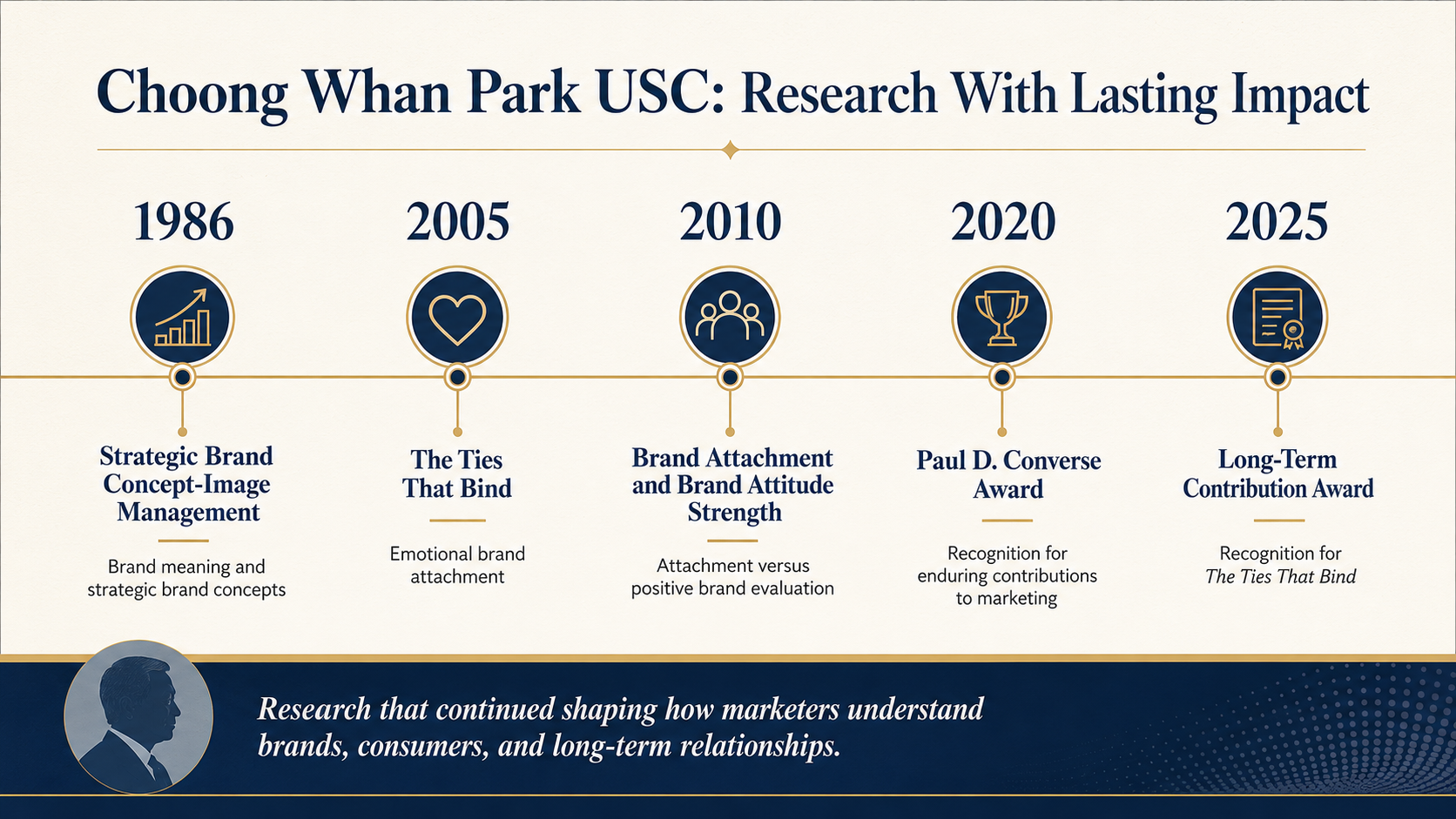
Choong Whan Park USC was included among the 2020 recipients, alongside Bernard Jaworski, Deborah MacInnis, and Michel Wedel. The official recipient list maintained by Gies College of Business confirms the group among the award's long line of honorees.
That context is important.
The significance of the recognition is not simply that another honor was added to an academic career.
The more interesting question is:
What kind of research remains useful long enough to earn recognition built around enduring contribution?
In the case of Choong Whan Park USC, part of the answer can be found in the questions his research addresses.
Why Brand Meaning Became a Strategic Question
One influential strand of Park's research examined how brands establish and manage meaning.
The 1986 Journal of Marketing article Strategic Brand Concept-Image Management, written with Bernard Jaworski and Deborah MacInnis, presented a framework for managing a brand concept through different stages of its development.
The research distinguished among functional, symbolic, and experiential brand concepts.
A functional brand emphasizes practical problem solving.
An experiential brand emphasizes feelings, stimulation, enjoyment, or sensory experience.
A symbolic brand can help consumers express identity, aspiration, belonging, status, or personal meaning.
The enduring value of the framework is not simply the three categories.
Its deeper contribution is the idea that brand meaning has to be managed over time.
A company cannot establish one meaning through communication, contradict that meaning through products and customer experience, then assume consumers will maintain a coherent understanding of the brand.
Brand strategy therefore becomes more than advertising.
Product decisions matter.
Positioning matters.
Experience matters.
Growth decisions matter.
New categories matter.
And consistency matters.
This remains a recognizable challenge for companies today.
Modern brands may operate across physical products, mobile applications, subscriptions, entertainment, financial services, artificial intelligence, retail, and connected ecosystems.
The number of touchpoints has grown dramatically.
The underlying strategic question has not:
What does this brand represent, and do the company's decisions reinforce that meaning?
That is an example of why older research can remain highly relevant even when the marketplace surrounding it changes.
From Brand Preference to Brand Attachment
Another important contribution associated with Choong Whan Park USC concerns the relationship consumers form with brands.
Traditional marketing measures frequently focus on favorable attitudes.
Does the customer like the brand?
Are they satisfied?
Would they recommend it?
Do they prefer it?
Will they purchase again?
Those questions remain useful.
But research on brand attachment helped demonstrate that liking a brand and forming a meaningful psychological connection with it are not necessarily the same thing.
The influential 2005 paper The Ties That Bind: Measuring the Strength of Consumers' Emotional Attachments to Brands examined how stronger emotional bonds between consumers and brands could be conceptualized and measured.
Later research involving Park further distinguished brand attachment from brand attitude strength.
That distinction is subtle but strategically important.
A consumer may strongly believe that a particular product is excellent.
They may prefer it to competitors.
They may recommend it enthusiastically.
Yet if a clearly superior alternative appears, they might switch immediately.
Attachment suggests something more.
The brand may become connected with identity, memories, goals, relationships, achievements, routines, or meaningful experiences.
The consumer is no longer simply evaluating an object.
A relationship has begun to acquire personal significance.
That distinction continues to matter because modern businesses increasingly want relationships rather than isolated transactions.
They want subscriptions.
Memberships.
Communities.
Connected products.
Digital ecosystems.
Long-term retention.
Understanding why consumers remain is therefore more important than simply observing that they remain.
Why Long-Term Recognition Matters Here
One particularly fitting development occurred years after the original brand attachment research was published.
USC Marshall reported that The Ties That Bind received the inaugural Long-Term Contribution Award from the Journal of Consumer Psychology.
That recognition came roughly two decades after the paper's original publication.
This is worth considering alongside the Paul D. Converse Award because both forms of recognition emphasize a similar idea:
Influence becomes clearer with time.
A new study may generate interest because it addresses a fashionable problem.
A durable study continues to help explain important problems after the fashion has changed.
Brand attachment appears to belong to the second category.
Consumer technologies have transformed dramatically since the early research appeared.
Smartphones have changed everyday behavior.
Social media has changed communication.
Subscription services have changed customer relationships.
Digital ecosystems have increased switching costs.
Artificial intelligence is creating increasingly personalized interactions between consumers and technology.
Yet marketers still need to distinguish between preference and attachment.
They still need to understand why some brands become meaningful.
They still need to understand what strengthens or weakens customer relationships.
The surrounding technology changes.
The psychological questions endure.
Research That Travels Beyond Academia
Another reason the Paul D. Converse Award is notable is its emphasis on both research and practice.
Academic influence is sometimes misunderstood as something confined to universities.
In reality, foundational ideas can move into practice without practitioners necessarily knowing the names of the original papers.
Concepts become incorporated into textbooks.
They influence later researchers.
Consultants adopt them.
Executives encounter related frameworks.
Students learn them and eventually carry them into organizations.
Over time, an academic idea can become part of the vocabulary businesses use to understand a problem.
The distinction among functional, experiential, and symbolic brand meaning offers one example.
The distinction between favorable brand attitudes and deeper attachment offers another.
Both address practical questions businesses face every day.
What should a brand represent?
How should that meaning remain coherent as the business grows?
Why do customers stay?
What causes a brand to become personally meaningful?
What separates satisfaction from a stronger consumer relationship?
These are not questions limited to marketing journals.
They influence decisions about products, positioning, customer experience, innovation, loyalty, and growth.
The Wider Business Recognition
The Paul D. Converse Award recognition also reached audiences beyond academia.
In 2021, a syndicated ACCESSWIRE announcement carried by Yahoo Finance highlighted the 2020 award and Park's marketing research career.
It is useful to be precise about what that means.
The Yahoo Finance page was syndicated business news rather than an independently reported Yahoo Finance profile. But its presence helped bring the recognition to a broader business audience beyond the academic environment in which the award originated.
For readers interested in the recognition and its broader context, a separate feature, Choong Whan Park USC’s Paul D. Converse Award recognition, provides additional background on the award and its coverage.
What matters most, however, is not where the announcement appeared.
It is why the underlying recognition was awarded.
The Questions Behind an Enduring Body of Work
When several strands of Park's research are considered together, a pattern emerges.
Much of the work addresses questions that sit beneath short-term marketing tactics.
What does a brand mean?
How should that meaning be maintained?
How do consumers interpret new products associated with an established brand?
Why do some consumers become emotionally attached?
How does identity influence the relationship?
What separates positive evaluation from genuine connection?
These questions have unusual longevity because they concern basic aspects of consumer psychology.
The technologies surrounding consumers can change dramatically while the psychological questions remain.
A company in 1986 needed to manage brand meaning.
A digital platform in 2026 still needs to manage brand meaning.
A consumer decades ago could distinguish between liking something and feeling personally connected to it.
Consumers today can do the same.
The context evolves.
The core problem survives.
That is precisely the kind of intellectual durability the Paul D. Converse Award is intended to recognize.
Why Students Should Pay Attention
For students entering marketing, there is an additional lesson here.
It is easy to believe that becoming a strong marketer primarily means mastering the newest tools.
Today that might mean artificial intelligence, analytics, social platforms, automation, search, personalization, and recommendation systems.
Those capabilities matter.
But individual tools rarely remain dominant forever.
Consumer psychology is more durable.
People continue to pursue goals.
They develop identities.
They remember experiences.
They seek usefulness, enjoyment, belonging, confidence, and meaning.
They form preferences.
And sometimes they develop deeper connections with the products and brands that participate in important parts of their lives.
Studying research such as Park's therefore provides something different from learning a particular platform.
It provides a way of thinking about the consumer.
That foundation can remain useful even when today's marketing technologies have been replaced by something new.
Why Business Leaders Should Pay Attention Too
The same research also challenges the idea that branding belongs exclusively to the marketing department.
If brand meaning develops through accumulated consumer experience, almost every major organizational decision can influence it.
Product quality affects brand meaning.
Pricing affects it.
Customer service affects it.
Innovation affects it.
Distribution affects it.
Policies affect it.
Leadership decisions affect it.
Marketing communication can describe what a company wants a brand to represent.
The organization has to make that representation credible.
This is why long-term brand strategy requires coherence across the business rather than simply consistency in advertising.
The lesson remains as practical today as it was when early brand concept research was being developed.
Recognition Is Most Meaningful When the Ideas Still Work
Awards are useful markers of accomplishment, but their real significance depends on what they recognize.
In the case of the Paul D. Converse Award, longevity is built into the criteria.
The contribution must have had time to demonstrate its value.
That makes the recognition of Choong Whan Park USC particularly relevant to a broader discussion about academic influence.
His work has addressed concepts that continue to sit near the center of modern brand strategy:
brand meaning,
consumer identity,
brand attachment,
customer relationships,
brand extensions,
and long-term loyalty.
These subjects have not disappeared as marketing has become more technological.
They have arguably become more complicated.
A company may now interact with the same consumer dozens of times every day.
A digital ecosystem may become integrated into work and personal life.
An AI platform may learn preferences and participate in important goals.
A subscription relationship may last for years.
In each case, businesses still need to understand what the brand means and what kind of relationship has actually developed.
What the Paul D. Converse Award Ultimately Represents
The strongest way to understand the Paul D. Converse Award recognition is therefore not as a single moment in a career.
It is as evidence of something that takes much longer to establish.
Enduring relevance.
The official criteria for the award intentionally create distance between the original contribution and the recognition that follows.
Time provides perspective.
Ideas are tested.
Other researchers respond.
Markets change.
New problems emerge.
And eventually it becomes possible to see whether the original work continues to provide useful ways of understanding the field.
That is why the recognition of Choong Whan Park USC matters.
It points toward a body of research whose central questions have survived substantial changes in marketing, technology, and consumer behavior.
What should brands mean?
Why do consumers become attached to them?
How can companies preserve coherence while evolving?
What separates ordinary preference from a meaningful relationship?
Those questions remain.
And perhaps that is the clearest measure of influence.
Not simply that research was important when it appeared, but that years later, marketers, students, researchers, and business leaders can still use it to understand the problems in front of them.
References and Further Reading
Paul D. Converse Award Recipients
Gies College of Business, University of Illinois
https://giesbusiness.illinois.edu/docs/default-source/default-document-library/events/paul_d_converse-winners.pdf
Paul D. Converse Marketing Symposium
Gies College of Business, University of Illinois
https://giesbusiness.illinois.edu/business-administration/converse-marketing-symposium
Strategic Brand Concept-Image Management
Journal of Marketing, 1986
https://doi.org/10.1177/002224298605000401
The Ties That Bind: Measuring the Strength of Consumers’ Emotional Attachments to Brands
Journal of Consumer Psychology, 2005
https://doi.org/10.1207/s15327663jcp1501_10
USC Marshall Faculty Publications, Awards, and Honors
Recognition of the Long-Term Contribution Award for The Ties That Bind
https://www.marshall.usc.edu/posts/marshall-faculty-publications-awards-and-honors-december-2024-and-january-2025
About the Creator
Choong Whan Park USC
Choong Whan Park USC, based in California, is a globally respected marketing scholar, author, and branding thought leader whose work has helped shape modern understanding of brand strategy.
Enjoyed the story? Support the Creator.
Subscribe for free to receive all their stories in your feed.
Comments
There are no comments for this story
Be the first to respond and start the conversation.