
China’s Retirement Wave Is Here. The Pension Math Is Brutal.
Every day, 60,000 people retire. The system has roughly a decade before the deficit starts.
I
In 2022, people born in 1962 began turning 60. That was the start. Since then, more than 20 million people a year reach retirement age in China. On an average day, about 60,000 people stop working and start collecting a pension.
This will continue for more than a decade. Between 1962 and 1975, China averaged 25.83 million births a year, about 320 million people total. In 1963 alone, 29.34 million babies were born, the highest number in nearly 70 years. These people built factories, farms, and cities during the reform era. Now they are moving into retirement.
By the end of 2025, 323 million Chinese were 60 or older. That is 23% of the population. One in five people you pass on the street is elderly.
The hard part is not the retirement itself. It is what comes after: whether the pension pool can keep paying.
II
Pensions work like this: workers pay in, retirees take out. When the number of workers falls and the number of retirees rises, the balance shifts.
At the end of 2025, China had 152 million employee pension recipients and 188 million rural and urban resident pension recipients. Total: about 340 million people, or 24% of the country. One in four Chinese receives a pension. The dependency ratio for employee retirees fell to 2.59:1. In 2024 it was 2.71:1.
Actuarial projections show that even with delayed retirement, the urban employee pension fund will run a current-account deficit in 2029. The gap will grow. By the end of 2024, the national basic pension fund held 8.7 trillion yuan in reserves. That year, after excluding fiscal subsidies, the actual spending gap was 1.41 trillion yuan.
Include the 188 million resident pension recipients, and the pressure gets worse. The ratio of all pension recipients to working-age people hit 40% in 2025. By 2040, projections put it at 57.7%. For every 100 working-age people, there will be nearly 58 pension recipients. The total number of recipients will rise from 340 million to 423 million, a net increase of 83 million in 15 years.
The IMF projects that population aging alone could slow China’s annual GDP growth by about 2 percentage points between 2024 and 2050. Pension spending could rise by nearly 10 percentage points of GDP.
There is another gap: how much retirees get. Government and public institution retirees average around 6,000 yuan a month. Enterprise workers average around 3,000 yuan. Many rural residents under the resident pension system get 220 yuan a month. Resident pensions cover more people, 188 million versus 152 million, but pay far less. They are a bottom-line system: broad coverage, low benefits.
An old woman in rural Hebei receives 238 yuan a month. She does not know what a dependency ratio is. She knows that after buying rice, flour, and oil, little is left.
III
Policy responses are already in motion. Each one needs to be judged over decades, not news cycles.
Delayed retirement is the most direct way to cut costs. Starting in 2025, China began gradually raising the retirement age for men to 63 and for women to 55 or 58 over 15 years. The policy is already shaving the peak. In 2025, the net increase in retirees was 4.76 million, down from 5.43 million in 2024, a drop of about one-eighth.
But delayed retirement does not fix the structure. Actuarial research puts the net improvement to the urban employee pension fund at about 0.4%. It buys time. It does not close the gap. It also applies only to employees. Rural and urban residents still collect at 60. Their costs are more rigid.
National pooling is another buffer. Since 2022, enterprise employee pension insurance has been pooled nationally. The goal is to move money from provinces with surpluses to provinces with deficits. In 2025, local governments sent up 254.574 billion yuan. The central government allocated 254.644 billion yuan. This spreads longevity risk across the country. Heilongjiang, with severe aging, cannot cover its pensions. Guangdong, with young inflows, has surpluses. National pooling moves money between them.
Fiscal support matters too. In 2026, the central government set aside 1.25 trillion yuan in transfer payments for basic pensions. In 2025, the national social insurance fund budget took in 12.6 trillion yuan, including 2.91 trillion yuan in fiscal subsidies. Projections show that delayed retirement plus fiscal subsidies can push the cumulative fund gap to 2041 or 2047.
These measures form a buffer. A buffer buys time. It does not solve the problem.
IV
Basic pension insurance cannot carry the whole load. A stronger system needs multiple pillars.
The second pillar is enterprise and occupational annuities. By the end of 2025, about 177,900 enterprises had enterprise annuity plans. They covered about 33.43 million workers and held more than 4 trillion yuan. Against 475 million urban employees, that is about 7% coverage. Enterprise annuities have been called a benefit for big tech and state-owned enterprises. In late 2025, the Ministry of Human Resources and Social Security and the Ministry of Finance issued guidelines to expand coverage and simplify plan setup.
The third pillar is also shifting. The 15th Five-Year Plan no longer mentions the “third pillar” alone. It calls for improving individual pension policies and developing commercial pension insurance. One path is individual pensions with tax breaks. The other is commercial products for a wider group.
The individual pension pilot has a problem. More than 150 million accounts have been opened, but contributions are low. Tax breaks are not strong enough, and thousands of products make choosing hard. Experts say a mature third pillar cannot rely only on tax breaks. It needs steady returns, good products, and long-term trust.
V
If reform is about spending less, investment is about earning more.
The National Social Security Fund has earned 2.29 trillion yuan since it was created 25 years ago. Its average annual return is 7.62%. In 2025, it returned 13.22%, the best since 2021, with 390.672 billion yuan in investment income. Local pension funds, managed under entrustment since 2016, have earned 554.4 billion yuan. Their average annual return is 5.14%, about 2.51 percentage points above the guaranteed return.
These numbers show that pension money can grow. But it takes patience. Pensions are long-term money. They can ride out short-term swings and share in long-term growth. The next step is to strengthen long-term investment and use long-cycle performance reviews.
The government is also transferring state-owned capital into the social security fund. This uses state asset returns to support intergenerational fairness. Assets built by today’s workers should help tomorrow’s retirees.
VI
As more elderly people become disabled, pensions alone are not enough. Someone has to provide care. The money has to come from somewhere.
Long-term care insurance, called the “sixth social insurance,” is moving from pilot to national system. It began in 15 pilot areas in 2016. By the end of 2025, it had expanded to 92 areas, covering 308 million people. The fund had spent more than 100 billion yuan and supported more than 3.3 million disabled people. In March 2026, the central government issued guidelines to build a national long-term care insurance system within about three years and reach full coverage by the end of 2028.
The system targets a common crisis: one disabled person can throw a whole family off balance. In one pilot area, an elderly man was bedridden after a stroke. His wife provided all his care. “He needs to turn over at night, to drink water. If you’re not careful, he could choke. I can only doze off for a bit each day.” After joining long-term care insurance, the family received 20 hours of basic care a month, with reimbursed costs. The burden shifted from the family to a shared system. Pension policy is not only about money. It is also about who provides care and how well.
VII
All system design comes back to people.
A stable population is the foundation of a sustainable pension system. In 2025, governments at all levels set aside about 100 billion yuan for child-rearing subsidies. The central government provided 90.4 billion yuan. Nationwide, 33 million families with infants and young children received subsidies. The cash subsidy is 3,600 yuan per child per year. The special additional deduction for infant care and children’s education is 2,000 yuan per child per month. The 15th Five-Year Plan calls for a dynamic adjustment mechanism for subsidy standards. These policies aim to lower the cost of birth, child-rearing, and education.
Low fertility is complex. One policy will not reverse it quickly. Child-rearing subsidies lower the threshold. Inclusive childcare, education cost cuts, housing support, and protection of women’s employment rights make people willing to step forward. A birth-friendly society requires reallocating resources so that raising the next generation is not only a private family burden.
VIII
Pension reform is a global problem. Other countries offer lessons.
Japan has the deepest aging crisis. It raised the basic pension age from 60 to 65, with retirement possible at 70. In the three years after Japan began delayed retirement in 2004, labor participation among people aged 60 to 64 rose 5.1 percentage points. That exceeded the cumulative increase of the previous 40 years. Older employment rose, but youth employment did not fall. From 2010, youth employment rose steadily. Delayed retirement did not steal young people’s jobs. Japan also paired the policy with anti-age-discrimination laws, subsidies for hiring older workers, and flexible re-employment.
Germany is building a mandatory capital-accumulation pension. Employees and employers will contribute an extra 2% of gross wages, invested in capital markets. The statutory retirement age, now 67, will rise with life expectancy. For every additional year of life expectancy, working years rise by 8 months. Germany also has an “active pension” that lets people work past retirement age and earn up to 24,000 euros a year tax-free. The model: pay-as-you-go for basics, capital accumulation for higher benefits, retirement age tied to life expectancy.
Sweden uses notional accounts. Contributions are recorded, but the money pays current retirees. An automatic balancing mechanism adjusts returns. When assets fall below liabilities, the notional return drops. This lowers pension debt and keeps the system solvent. The mechanism automatically passes demographic and economic changes into benefits, avoiding political delays.
South Korea raised its mandatory pension contribution rate from 9% to 13% in 2025, split evenly between employees and employers. The OECD recommends raising Korea’s pension age to 68 and linking it to two-thirds of life expectancy gains.
The common trends: higher retirement ages, capital accumulation, automatic adjustments, and multiple pillars. Countries choose different paths. Japan focuses on employment. Germany focuses on capital. Sweden focuses on self-balancing. China will need its own mix.
IX
For ordinary people, the question is simple: when I retire, how much will I get, and will it be enough?
Basic pensions will likely be paid on time. People retiring in the next 10 years can count on fiscal subsidies, national pooling, and state capital transfers. But basic pensions alone will not maintain a high quality of life.
Personal planning matters. The individual pension system allows up to 12,000 yuan a year in tax-deductible contributions. Investment income is temporarily exempt from income tax. Withdrawals are taxed at 3%. For middle-income taxpayers, this is useful. More important is understanding the pension replacement rate, estimating the income gap in retirement, and saving in the third pillar throughout a career.
A programmer in Shenzhen has worked for 15 years. He is 34. He calculates that if he keeps contributing at the current base, his basic pension will be about 40% of his working salary. He does not know prices in 30 years. He does not know what the pension system will look like. He puts 1,000 yuan a month into his individual pension account and keeps writing code.
X
The retirement wave is a test of time. A generation of 320 million spent decades building the country. Now the system must repay them over an equally long period. Pension sustainability affects 340 million recipients today. It also affects the confidence of every young worker paying in now.
Buffers are being built. The question is whether they can outrun the wave. Delayed retirement buys time. National pooling moves money. Investment adds returns. Fertility support repairs the base. No single policy can carry the load.
There is no easy answer. One thing is clear: how a society treats people who can no longer work says a lot about its values. Pension design answers a practical question: how much are we willing to pay, and how soon?
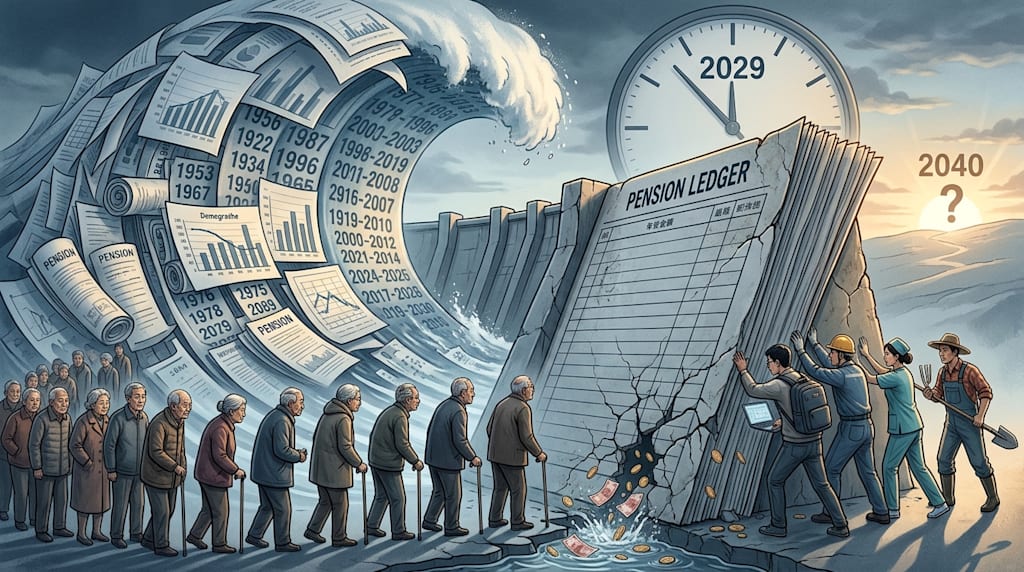
The tide is still rising. The embankment is being raised. Safety will depend on concrete choices, not on how high the wall looks.
About the Creator
Jin
Writer of reamstories
https://reamstories.com/jin
Enjoyed the story? Support the Creator.
Subscribe for free to receive all their stories in your feed. You could also become a paid subscriber, letting them know you appreciate their work.
Comments
There are no comments for this story
Be the first to respond and start the conversation.