
Cesium Chloride Procurement Guide: Purity Grades, Impurity Control and Supplier Qualification
Why Headline Purity Is Only the Starting Point

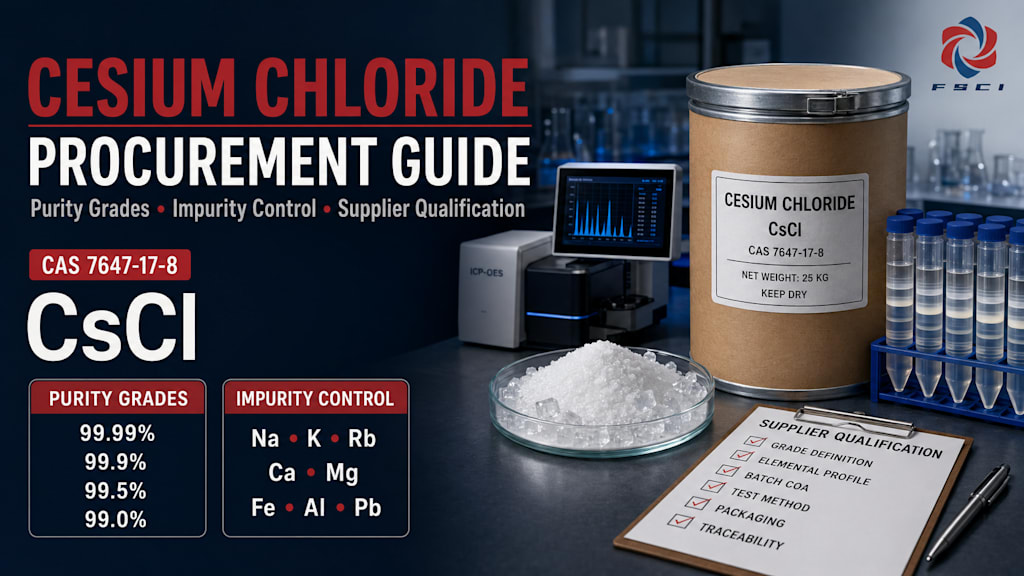
Cesium chloride is used in biochemical separation, density-gradient centrifugation, analytical chemistry, laboratory research, and selected high-purity material applications. Although buyers often begin by comparing assay and price, the headline purity percentage does not provide a complete basis for grade selection.
Two products labeled 99.9% CsCl may contain different levels of sodium, potassium, rubidium, calcium, magnesium, iron, aluminum, or lead. Those differences may matter more than a small change in total assay when the intended process is sensitive to particular elements.
Appearance, solubility, insoluble matter, batch consistency, packaging, documentation, and lot traceability should also be included in the purchasing decision. The right grade is the one that meets the buyer’s actual application and quality requirements—not automatically the highest purity offered.
Confirm the Product Identity
Cesium chloride is also spelled caesium chloride. Its chemical formula is CsCl, and its CAS number is 7647-17-8.
A complete purchasing description should identify:
Cesium chloride or caesium chloride
CsCl
CAS 7647-17-8
Required purity grade
Intended application
Critical impurity requirements
These details should appear consistently on the quotation, product specification, Certificate of Analysis, Safety Data Sheet, package label, packing list, and invoice.
When reviewing available purity grades, elemental impurity specifications, samples, or batch documents for Cesium chloride (CsCl) CAS 7647-17-8, buyers should compare the complete analytical profile rather than relying on the assay alone.
A quotation that states only “high purity cesium chloride” is not sufficiently specific. Procurement teams should request the numerical grade, individual impurity limits, test information, and proposed batch data before approval.
Select the Grade According to the Application
Density-gradient centrifugation and biochemical separation can place particular importance on consistency, solubility, solution clarity, and impurities that may influence the intended laboratory system. The buyer’s technical team should define the necessary grade and acceptance criteria for its validated application.
Analytical chemistry users may focus on elements that could interfere with the target measurement. In this setting, an impurity that appears minor in the total assay may still create an analytical background or affect method sensitivity.
General laboratory users may not require the same impurity controls as a highly sensitive biochemical or analytical process. Purchasing a more expensive grade can add cost without improving the result if the additional controls are unrelated to the application.
High-purity material and specialty industrial users may prioritize metallic impurity profiles, stable batch composition, packaging cleanliness, and long-term supply consistency. The importance of each element depends on the downstream material or process.
The intended use should therefore be communicated before requesting a quotation. Buyers should also state the expected volume, required documentation, packaging preference, impurity concerns, and validation plan.
Compare the Main CsCl Purity Grades
Cesium chloride may be offered in grades such as 99.0%, 99.5%, 99.9%, and 99.99%. These percentages describe total assay, but they do not create universal performance categories.
99.0% grade: This may be considered for general laboratory, industrial, or material uses where the process can tolerate a broader impurity profile. Buyers should still review the individual elemental limits and confirm that the grade fits the intended application.
99.5% grade: This provides a higher total assay and may be positioned for applications requiring tighter overall control. Its value depends on which impurities account for the remaining fraction and how consistently those impurities are managed.
99.9% grade: This grade may be evaluated for more sensitive analytical, biochemical, or specialty material work. Buyers should request detailed elemental data because the same 99.9% assay can be achieved with different impurity distributions.
99.99% grade: This represents a tighter total-purity target and may be relevant where very low impurity levels are required. It should not be treated as automatically necessary or superior for every use. The buyer must confirm that the critical individual elements, test methods, and batch data meet the actual process requirements.
For every grade, documentation expectations should reflect application sensitivity. A high-purity grade without complete batch data may provide less procurement confidence than a properly characterized grade with transparent impurity reporting and reliable traceability.
Do Not Evaluate Purity in Isolation
Total assay expresses how much of the tested sample is reported as cesium chloride under the applicable method. It does not explain the complete composition of the remaining material.
For example, two batches can both meet a 99.9% assay while containing different relative amounts of sodium, potassium, rubidium, moisture, or other impurities. One may fit a specific analytical application while the other does not.
Procurement teams should evaluate total purity together with individual impurity limits. The specification should identify the elements that matter, the units used, the test methods or method references where relevant, and the acceptance criteria.
The batch-specific COA should report actual results for the proposed lot whenever possible. A document that only repeats maximum specification limits provides less information about normal batch variation.
Review Critical Elemental Impurities
Sodium and potassium are alkali metals that may require close control in analytical or high-purity material applications. Their acceptable levels depend on the sensitivity of the buyer’s process.
Rubidium deserves separate attention because it is chemically related to cesium. A total assay may not adequately show whether rubidium is controlled to the level required by the application.
Calcium and magnesium are alkaline-earth metals. They may affect solution behavior, analytical background, or downstream material properties in processes where ionic composition is important.
Iron and aluminum may be relevant to analytical methods, optical or specialty materials, and processes sensitive to metallic contamination. Even when total concentrations are low, buyers should determine whether these elements require individual reporting.
Lead is commonly reviewed as a heavy-metal impurity. Its acceptable limit should be established through the buyer’s internal standards and application requirements rather than a universal assumption.
Other elements may also matter. Technical and quality teams should identify the complete impurity list needed for their process before evaluating a cesium chloride supplier.
Verify Appearance and Solubility
Cesium chloride is commonly described as a colorless crystalline material or white powder. Appearance can serve as an incoming quality-control check when compared with the agreed specification and an approved reference.
Receiving personnel should note unexpected color, visible particles, contamination, caking, or packaging damage. However, visual consistency alone cannot confirm purity or suitability.
Solubility and solution clarity may also support incoming evaluation. Buyers should agree with the supplier on the relevant test conditions, expected behavior, and reporting criteria.
If insoluble matter is important, it should be included in the purchasing specification with an appropriate test method. Descriptions such as “freely soluble” or “clear solution” are more useful when the supplier and buyer apply the same conditions.
A simple dissolution check cannot replace elemental analysis, assay testing, or COA review. It should be treated as one part of a broader quality-control program.
Request Samples and Representative Batch Data
A representative sample allows the buyer to assess application fit before purchasing a larger quantity. The sample should carry a lot number and be accompanied by the relevant specification and COA.
Buyers should also request recent COAs from several production batches. This helps reveal normal variation in assay and elemental impurities rather than showing only one selected result.
Useful supporting information may include:
Current product specification
Batch-specific COA
Elemental impurity data
Analytical methods or method references
Lot number
Production or retest information where applicable
Packaging description
Storage instructions
A small trial order can extend the evaluation to packaging integrity, label accuracy, delivery performance, documentation quality, and supplier response.
Sample approval should not automatically authorize every future batch. Repeat purchasing still requires batch review and an appropriate incoming inspection program.
Audit the Batch Certificate of Analysis
A practical COA review should verify:
Product name and CsCl formula
CAS 7647-17-8
Purity grade
Batch or lot number
Actual assay result
Sodium
Potassium
Rubidium
Calcium
Magnesium
Iron
Aluminum
Lead
Appearance
Solubility, clarity, or insoluble matter where specified
Test methods or method references where relevant
Release status
Authorized quality approval
The lot number on the COA should match the package labels and shipment documents. Units and reporting conventions should also be consistent.
If a critical impurity is missing from the COA, buyers should determine whether it was tested separately, reported on another document, or not included in routine batch release.
Evaluate Packaging, Labeling and Storage
Packaging should be selected according to order size, purity grade, consumption rate, destination, and contamination-control requirements. No single package size is appropriate for every buyer.
The inner package should be sealed and provide protection from moisture and external contamination. The outer container should remain intact during the expected transportation and storage period.
Labels should clearly display the product identity, purity grade, lot number, net weight, and required handling information. Sample packages should provide the same level of traceability as commercial containers.
Buyers should obtain current storage instructions and any available retest or shelf-life information before delivery. Export and transportation documents should be reviewed for accuracy and consistency with the shipment.
Customized packaging may be possible, but material compatibility, cleanliness, minimum quantity, lead time, and additional documentation should be confirmed in advance.
Assess Batch-to-Batch Consistency
A single ideal COA does not demonstrate long-term supply performance. Buyers should compare multiple batches to evaluate:
Assay variation
Elemental impurity trends
Appearance consistency
Solubility or clarity results
Packaging quality
Documentation accuracy
Delivery performance
Trend data can help identify gradual changes that remain within broad specification limits but may still matter to a sensitive application.
Incoming results should be connected with supplier batch numbers. This creates a useful history for supplier reviews, quality investigations, and future purchasing decisions.
Complete Supplier Qualification
Supplier evaluation should cover both the product and the quality system supporting it. Important factors include grade availability, testing capability, sample support, traceability, change control, deviation handling, complaint response, lead time, and export experience.
Buyers should ask how specification changes are communicated and whether critical analytical methods can change without customer notification. They should also identify the technical and quality contacts responsible for resolving questions.
For recurring demand, long-term production capacity and raw-material consistency may be as important as the initial quotation. A supplier should be able to explain how future lots will remain within the agreed specification.
Cesium Chloride Supplier Qualification Checklist
Before approval, confirm that:
Chemical identity and CAS 7647-17-8 are verified.
The intended application has been communicated.
The required purity grade is clearly defined.
Individual impurity limits are documented.
Assay and Na, K, Rb, Ca, and Mg are reviewed.
Fe, Al, and Pb requirements are confirmed.
Appearance criteria are specified.
Solubility or clarity expectations are defined.
A representative sample is available.
Recent batch-specific COAs can be provided.
A current SDS is available.
Packaging and labels are appropriate.
Storage requirements are documented.
Lot numbers provide complete traceability.
Lead time and supply capacity meet demand.
Change-control and complaint procedures are established.
Technical and quality contacts respond clearly.
Questions to Ask Before Buying Cesium Chloride
Procurement teams can ask prospective suppliers:
Which purity grades are currently available?
Which grade is recommended for our intended application, and what data supports that recommendation?
Are individual elemental impurities reported on every batch COA?
What limits apply to Na, K, Rb, Ca, Mg, Fe, Al, and Pb?
How are appearance, solubility, clarity, or insoluble matter evaluated?
Can you provide a representative sample and recent COAs from several production batches?
What packaging and contamination-control options are available?
How are lot traceability, specification changes, deviations, and quality complaints managed?
Written responses allow procurement, laboratory, and quality teams to compare suppliers on a consistent basis.
Conclusion
Successful cesium chloride procurement depends on selecting a grade that matches the intended application. A 99.99% product is not automatically more appropriate than a lower grade if its additional controls do not address the buyer’s actual requirements.
Total assay, individual elemental impurities, appearance, solubility, representative samples, packaging, and batch documentation should be evaluated together. Reliable COAs, multi-batch consistency, and complete lot traceability then provide the foundation for more confident repeat purchasing.
About the Creator
Enjoyed the story? Support the Creator.
Subscribe for free to receive all their stories in your feed.
Comments
There are no comments for this story
Be the first to respond and start the conversation.