
Central Asian glaciers are melting more quickly than before.
Central Asia is affected by ice loss

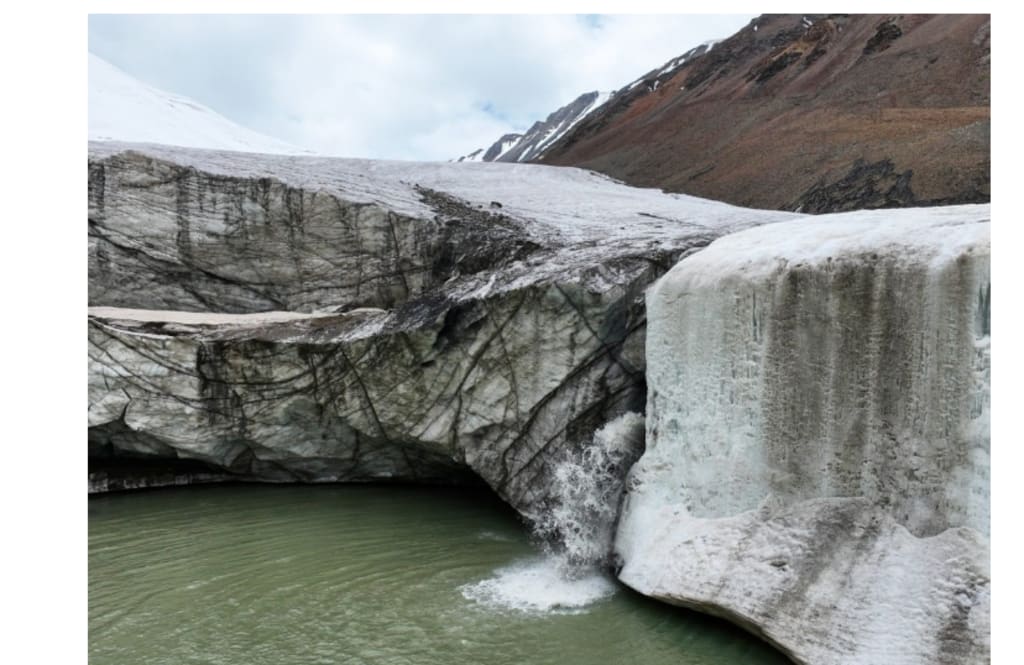
Patches of glaciers typically lose ice. The records fill in one area at a time, with some mountain ranges suffering while others remain stable. In 2025, that pattern broke. Ice loss in Central Asia reached previously unheard-of levels, causing devastation to almost all mountain ranges simultaneously.
Central Asia is affected by ice loss
Using both direct measurements and regional modelling, field teams observed 16 glaciers in two mountain ranges. Nine experienced their worst year ever, and a number of others came dangerously close to the bottom of their own records.
The international team responsible for the analysis was headed by Dr. Lander Van Tricht, a glaciologist at ETH Zürich and the Free University of Brussels (VUB). Nearly 30,000 glaciers in the Pamir and Tien Shan were included in the study.
These two enormous mountain ranges, which span Tajikistan, Kyrgyzstan, and surrounding nations, are located in the center of Central Asia. According to Van Tricht, "2025 stands out as an exceptional year because the extreme losses occurred almost everywhere across Central Asia simultaneously." It is not uncommon to have a horrible year in one valley. The simultaneous failure of both systems is
Calculating the harm
Over the course of the year, glaciers in the area lose about 7 cubic miles (30 cubic kilometres) of ice. In only a single year, that equates to almost 2% of all the ice that was frozen in these mountains. To put things in perspective, the volume is about 30% of what is left in the entire European Alps.
According to regional modelling, 64% of the glaciers in Central Asia saw their worst year since at least 1991. In the western Pamir and western Tien Shan, where several glaciers lost between 2% and 4% of their volume in 2025, losses were most severe. Although at slower rates, eastern regions also lost ice.
Why did the ice disappear?
The losses were not caused by a single record heatwave. Snowfall during the melt season drastically decreased, and unusually warm weather developed from spring and continued into late summer.
At the surface, such a combination had a noticeable impact. Darker glacier ice was exposed to direct sunshine for much longer than usual since seasonal snow, which typically lasts until August, vanished weeks in advance.
Melt picks up speed as soon as the dazzling snow cover is gone. This phenomenon, which scientists refer to as the albedo feedback, occurs when sunlight is absorbed by bare ice and reflected back into the sky by fresh snow.
This feedback loop may be responsible for up to 80% of additional melt from even little temperature increases, according to earlier research on a Himalayan glacier.
A portion of a larger pattern
The incident in 2025 is one of a series of regional records that have been accumulating for years. The Pyrenees and the European Alps set new records in 2022. In 2023, Western North America came next, and in 2024, Svalbard broke the record.
All of these occurrences are linked by climate-driven heat, however the mechanisms vary by location. According to Van Tricht, "short but intense heatwaves are often linked to extreme glacier melt in the Alps." The converse was true in Central Asia, where there was no snowfall over the whole melt window and warmth increased from spring to late summer.
Water downstream at risk
These mountains' runoff does not remain in the highlands. Tens of millions of people rely on streams from the Tien Shan and Pamir for drinking water, electricity, agriculture, and ecosystems.
In the short term, faster melt may force more water into rivers. The problem arises later, during the dry months when lowland rivers most depend on the underlying ice, when it has decreased too much to meet summer demand.
According to a research done earlier this year, the Tien Shan's glacier-fed summer flows will rise until 2050 before drastically declining by the end of the century. An already tense system of agreements over shared rivers and irrigation rights throughout the region is made more difficult by that track.
Prospects for the area
In records dating back to 1991, no single year had pushed Central Asia's glaciers this hard, this widely, all at once. In both mountain systems, field teams and regional models produced identical results.
This has direct implications for water authorities around the region. It is not possible to plan around a condition that is considered an outlier. Future hydropower projections and irrigation budgets must include years like 2025 as part of the baseline rather than as exceptions to it.
The researchers caution that if global warming continues, what was extraordinary in 2025 will probably become unremarkable in a few decades. For the populations downstream whose water supply depends on what occurs on the ice above, continuous monitoring across these mountain ranges has evolved from beneficial to crucial.
About the Creator
Enjoyed the story? Support the Creator.
Subscribe for free to receive all their stories in your feed.
Comments
There are no comments for this story
Be the first to respond and start the conversation.