
“Block the Far Right” — How Digital Activism Is Becoming a Tool of Political Resistance in France
“Block the Far Right” — How Digital Activism Is Becoming a Tool of Political Resistance in France

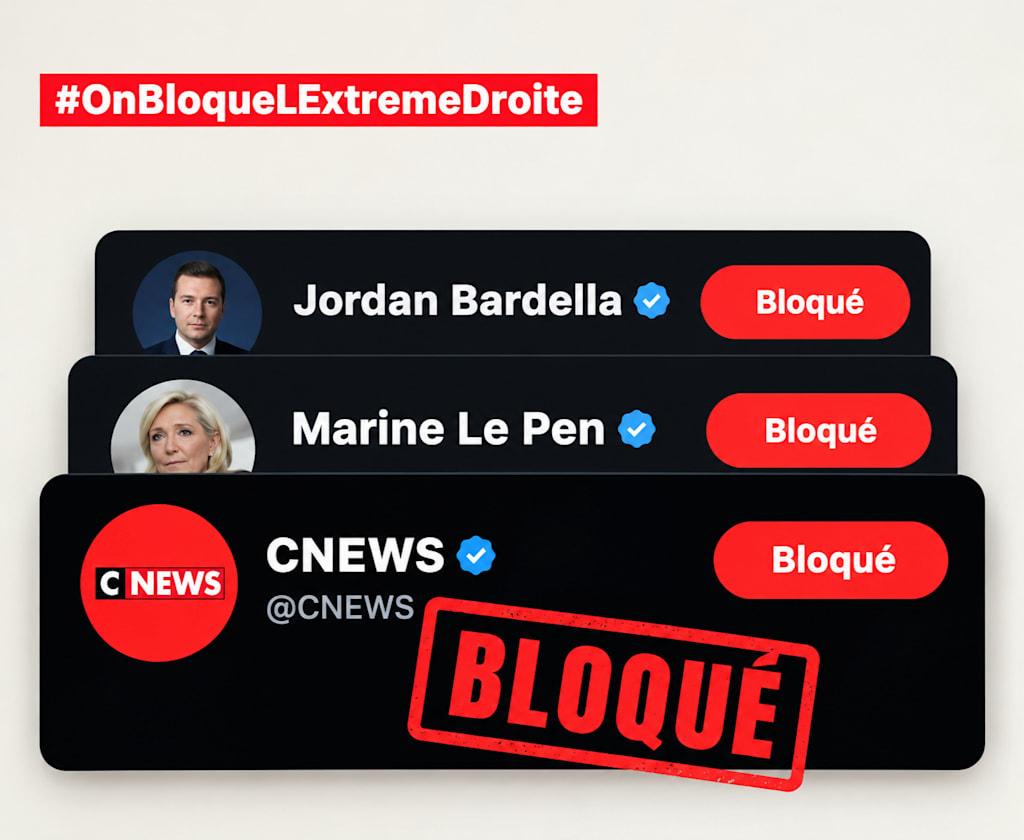
A growing digital campaign in France is urging social media users to block accounts associated with the far right and stop amplifying their posts. Known as “On bloque l’extrême droite,” or “Block the Far Right,” the initiative reflects a broader debate about how online engagement shapes political visibility ahead of France’s 2027 presidential election. Rather than responding to every controversial statement, supporters argue that users can challenge the influence of far-right voices by withdrawing the attention that helps their content circulate.
From Brazil to France — Taking the Political Battle to Social Media Algorithms
The campaign gained attention in France in the final days of October 2026, spreading across platforms including X, TikTok and Instagram. Its approach draws inspiration from digital mobilisation strategies associated with Brazil, where political activists have sought to organise supporters online and counter the visibility of far-right political figures.
Brazilian congressman André Janones has been associated with online mobilisation strategies supporting President Luiz Inácio Lula da Silva. The approach has attracted attention among French activists seeking ways to challenge the digital influence of the far right. However, adopting elements of a political strategy from another country does not guarantee the same results. Political institutions, electoral dynamics and online audiences differ considerably between Brazil and France.
Reports published in France on October 28 and 29, 2026, described an initiative encouraging users to block targeted accounts rather than engage with their posts. Online lists have also been used to help participants identify accounts they are encouraged to block.
The underlying idea is straightforward: political confrontation on social media can sometimes increase the visibility of the very content that critics want to challenge.
Why Angry Comments Can Become Free Publicity
Social media platforms use multiple signals to determine how content is ranked, recommended and distributed. Depending on the platform, these signals can include likes, comments, shares, viewing behaviour and other measures of user interest.
When a political figure publishes a provocative statement, opponents may rush to criticise it, quote it or share it with their own audiences. Although their intention may be to expose misinformation or challenge an extreme political position, their reactions can also bring additional attention to the original post.
This creates a potential amplification effect. A controversial statement attracts criticism, the criticism generates further discussion, and that discussion can expose the content to people who would otherwise never have encountered it.
Supporters of the French campaign argue that users should avoid contributing to this cycle. Instead of repeatedly sharing controversial posts to condemn them, they encourage people to withhold engagement and direct their attention towards alternative sources of information.
However, the relationship between engagement and visibility is not universal. Platforms use different recommendation systems, and a comment does not automatically guarantee greater distribution. Nor does ignoring a post necessarily cause it to disappear from public view. The campaign's underlying argument is plausible, but its overall effectiveness requires independent measurement.
Blocking or Ignoring — Two Different Strategies
The campaign has also raised questions about the difference between blocking an account and simply refusing to engage with its content.
Blocking is a direct way for individual users to limit unwanted interactions and reduce their exposure to selected accounts. Ignoring content, by contrast, means deliberately avoiding likes, comments, reposts and other forms of engagement that might contribute to its circulation.
These approaches are not necessarily interchangeable.
Brazilian congressman André Janones, whose online mobilisation strategies inspired discussion around the French initiative, has reportedly distinguished between avoiding engagement with political opponents and systematically blocking their accounts. As reported by French media on October 29, the distinction has become part of the debate surrounding the campaign.
The central issue is that an individual block primarily changes the experience of the person who blocks an account. It does not automatically remove the targeted account from the platform or prevent its posts from reaching other users.
Even when thousands of people participate, targeted content may continue circulating through followers, reposts, screenshots, alternative accounts and other platforms. Consequently, the number of blocks alone cannot establish whether a campaign has meaningfully reduced an account's overall reach or political influence.
When Political Activism Becomes a Question of Media Freedom
The initiative extends beyond elected politicians to include media personalities, influencers and media organisations identified by campaign participants as associated with the far right.
This broader scope raises an important question: where should the line be drawn between opposing political rhetoric and attempting to isolate particular voices from public debate?
Every user has the right to decide which accounts to follow and which content to exclude from their personal feed. People can also choose to avoid material they consider racist, discriminatory, misleading or harmful. But placing different accounts on a single list does not establish that they all publish the same type of content or bear the same responsibility.
Political affiliation alone does not demonstrate that an account routinely spreads false information or publishes unlawful material. For that reason, the credibility of a digital campaign depends partly on transparent criteria and a clear distinction between political disagreement, demonstrably false claims and content that incites hatred or violence.
Without such distinctions, an initiative intended to challenge political extremism risks contributing to the broader polarisation it seeks to resist.
Could the Campaign Influence France's 2027 Presidential Election?
The timing gives the initiative particular political significance. France is approaching the 2027 presidential election, and social media platforms have become important spaces for political communication, campaigning and the formation of public opinion.
Campaign supporters hope that reducing engagement with far-right accounts could weaken their visibility while encouraging users to promote alternative political perspectives.
Nevertheless, online visibility and electoral success are not the same thing. Voting decisions are shaped by a combination of economic concerns, public services, immigration, security, social identity, political leadership and individual experience. Exposure to social media content is only one element of this wider process.
Even if a campaign succeeds in reducing the visibility of certain accounts among its participants, that would not automatically demonstrate a change in national opinion or voting intentions.
A meaningful assessment would require independent evidence showing changes in audience reach, content distribution, user behaviour and the campaign's ability to sustain participation. Without such evidence, claims that the initiative will significantly alter the outcome of the 2027 election remain speculative.
The Real Battle Is Over Attention
The “Block the Far Right” campaign reflects a broader change in the way political resistance is understood online. Rather than responding to every provocative statement, its supporters are attempting to influence the environment in which political messages circulate.
The strategy treats attention as a limited resource. Every user makes choices about what to watch, share, comment on and recommend to others. Collectively, these decisions can shape the online environment, although their precise effects depend on platform design and user behaviour.
Still, disengagement cannot replace journalism, fact-checking or public scrutiny. When false claims have significant consequences, documenting and correcting them may be more valuable than simply ignoring them. Building an alternative digital presence also requires credible reporting, compelling arguments and sustained participation.
Ultimately, the significance of the French initiative lies not only in how many accounts users choose to block, but also in the question it raises about political communication in the digital age: does every interaction serve the public debate, or can it sometimes amplify the very messages that users oppose?
The answer depends on the circumstances. What is clear is that understanding platform algorithms, distinguishing political mobilisation from measurable results, and protecting the quality of public debate have become essential to understanding contemporary political competition.
About the Creator
Sahby Mehalla
Marketing Consultant | Independent Journalist | Writing on Medium
Pure intention transforms sound into a message. 🇩🇿
Enjoyed the story? Support the Creator.
Subscribe for free to receive all their stories in your feed.
Comments
There are no comments for this story
Be the first to respond and start the conversation.