
Big Tech Wants to Feel Human. It Doesn’t Want to Be Human.
Inside the same building, a product team edits a comforting notification while HR prepares a structural optimization.
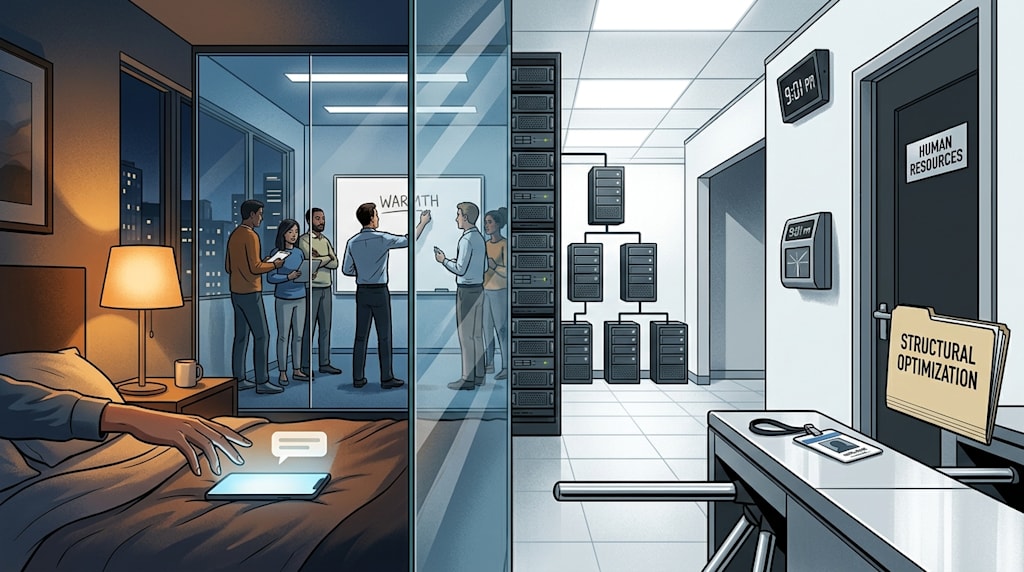
At 9:01 p.m., the time clock blinked.
The system logged one minute late. Clock-out moved back one minute. You stand at the turnstile. The screen flips to 21:01. People behind you look at their phones. No one speaks. The elevator doors close. A poster inside says: Tech for Good. Here for Every Lonely You.
On the third floor, the product review is still running. The whiteboard says warmth, companionship, emotional value. Growth wants a reminder feature. Content rewrites the copy. “You have been using the app for three hours straight” becomes “It’s late. Remember to rest.” By the seventh draft, someone signs off. That one. Like something a friend would say.
When the meeting breaks, Admin posts in the group chat. Starting this month, overtime meal allowances must be submitted through the system. No more automatic payout after hours.
Two things happened in the same building. Outward human warmth. Inward human calculation. They do not contradict each other. They use the same skill: see emotion, touch emotion, lower resistance, prompt behavior. Used on users, it is called user experience. Used on employees, it is called organizational communication.
When HR talks to you, the tone is as soft as product copy. First they ask how you have been. Then they acknowledge your contributions. Then they present the plan: structural optimization. N+1, non-compete, option clawback, last working day. The script is complete. The rhythm is steady. It sounds like a post-launch review. You cannot find a rude sentence. The politeness is designed. Reduce negative emotion. Protect the employer brand. Keep the people who stay from panicking too much. These goals sit in HR’s OKRs next to DAU, retention, and conversion.
Big Tech does not fail to understand human nature. It understands it too well. It can package firing as graduation, layoffs as optimization, overtime as flexibility. It knows loneliness can be traded for time spent, guilt for renewals, belonging for lower attrition. It hires psychologists, behavioral economists, interaction designers. It breaks human nature into variables, draws curves, writes models. Loneliness gets people in the door. Guilt keeps them paying. Belonging keeps them from leaving. Once built, this skill can be reused in any setting: hiring, layoffs, product, PR. Minimum cost. Emotional buy-in.
People mix up two things: understanding human nature and having humanity. Capital never said it had humanity. It only said it understood human nature. A company is not a person. It has no conscience and no malice. It is a system built to maximize efficiency. You are loyal to it. It calculates your productivity. You treat it like family. It treats you as headcount. This is not betrayal. This is how the system works.
What the product looks like often mirrors how the organization works.
Why can’t a feature be cut? Because it is some faction’s KPI. Why is the experience fragmented? Because unification means someone gives up power. Why does a button go through eight revisions? Because the PM believes this version is friendlier. Why is the customer service process cold? Because the cost center is only judged on response time. The mishmash you see is departments at war, reporting lines fighting for territory, ownership no one can calculate. Frontline employees are cannon fodder and consumables. Those unrelated features are the org chart made visible.
That does not mean everyone in Big Tech is an actor.
The PM building the late-night companionship feature may also be scrolling at midnight looking for an emotional outlet. The operations person writing tender copy may also want people to go to bed earlier. When HR says “You deserve a better future,” they may hope things go well for you. Individuals have goodwill. Organizations do not. Organizations have KPIs. Individuals can still have empathy. Two systems run at once. Mixing the abstraction of Big Tech with the concrete people inside it makes you easy to be moved and easy to misread.
Hypocrisy is the wrong frame. We should not treat a company as a person. Hypocrisy requires deliberate deception and moral judgment. Big Tech is more like a machine. A machine does not hate you. It does not love you. It executes parameters. The parameters are profit, growth, and efficiency. Inside the parameters, you are both cost and resource. It displays warmth outward because warmth brings retention. It calculates human nature inward because efficiency brings profit. The same skill, used on different battlefields.
The dangerous part is when someone calls systemic coldness “capitalist honesty.”
Capital is not honest. It simply has no obligation to care about employees’ feelings. Power is unequal, so it can gently inform you that you are leaving. Explaining system logic is not the same as excusing disgusting layoffs. A system will not grow a conscience on its own. What can make it restrain itself is labor law, regulation, public opinion, arbitration, unions, and employee bargaining. Not a boss who suddenly decides to be a human being one day.
So don’t ask whether Big Tech has humanity. Ask: Who defines human nature, whom does it serve, and who gets the costs and benefits? When warmth only serves retention, and efficiency only serves profit margin, the split will always be there.
You can enjoy the product without making it sacred. You can be moved by a push notification and still know there is an A/B test behind it. You can work hard without treating the company as an emotional community. You can believe in specific people without believing the system will be good to you for no reason.
Save money. Learn skills. Keep relationships outside work. Read labor law. Keep your options open. These are more reliable than hoping for a company’s conscience.
At ten p.m., you turn off the late-night companionship push. Set your alarm for seven tomorrow morning. Put your badge on the desk, face down. Lights are still on outside the window.
Tomorrow you still have to clock in.
About the Creator
Jin
Writer of reamstories
https://reamstories.com/jin
Enjoyed the story? Support the Creator.
Subscribe for free to receive all their stories in your feed. You could also become a paid subscriber, letting them know you appreciate their work.
Comments
There are no comments for this story
Be the first to respond and start the conversation.