
Benzil Procurement Guide: Purity, Melting Point, Color, Storage and Supplier Selection
Why Benzil Purchasing Requires More Than a Price Comparison

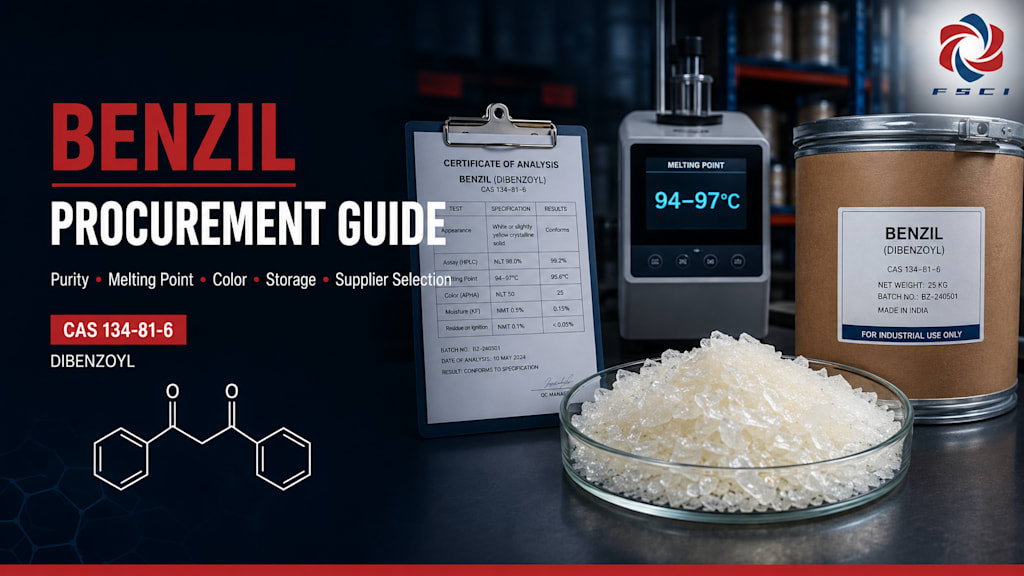
Benzil is used in several areas of industrial chemistry, including UV-curing materials, coatings, dye and pigment intermediates, fine chemical manufacturing, and organic synthesis. The requirements for these applications can differ, so purchasing decisions should not be based on price and stated purity alone.
A practical sourcing review should begin with product identity and continue through measurable quality indicators, packaging, storage, documentation, and supplier performance. Even when two quotations list the same assay, differences in melting point, color, ignition residue, batch consistency, or storage history may affect their suitability for a particular process.
Procurement teams should therefore define their acceptance criteria before contacting suppliers. This creates a consistent basis for comparing quotations, evaluating samples, inspecting incoming material, and managing repeat orders.
Confirm Product Identity: Benzil, Dibenzoyl and CAS 134-81-6
Chemical names and synonyms can create confusion during international sourcing. Benzil may also be listed as Dibenzoyl, and suppliers or distributors may use either term in quotations, catalogs, or shipping documents.
Buyers should confirm five identity elements:
Product name: Benzil
Recognized synonym: Dibenzoyl
CAS number: 134-81-6
Current product specification
Intended industrial application
The CAS number is especially useful because it provides a more precise identifier than a commercial name alone. A quotation for “Dibenzoyl” should still be checked against the CAS number, specification sheet, and other identifying information.
When reviewing specifications, packaging information, or batch documentation for Benzil CAS 134-81-6, buyers should verify that the chemical name, synonym, CAS number, and quality criteria remain consistent across the supplier’s documents.
Identity should also be checked on the product label, COA, SDS, packing list, and invoice. Any mismatch should be resolved before shipment. This simple review reduces the risk of requesting, approving, or receiving the wrong chemical.
Define the Intended Application
The appropriate Benzil specification depends partly on how the material will be used. A grade considered acceptable for one industrial process may not meet the quality or performance requirements of another.
Manufacturers of UV-curing materials may focus on assay, color, dissolution behavior, optical properties, and consistency between lots. Suitability must be confirmed within the complete formulation because Benzil should not automatically be assumed compatible with every resin, coating, light source, or curing system.
Coatings companies may pay particular attention to color and impurities that could influence appearance, stability, or downstream performance. Their acceptance criteria may also depend on whether the material is used in a clear, lightly colored, pigmented, or specialty coating.
Dye and pigment manufacturers may evaluate Benzil as an intermediate. In these processes, impurity control and batch consistency can matter because variations may carry into later manufacturing stages.
Fine chemical producers and organic synthesis teams may prioritize assay, melting point, ignition residue, traceability, and process-specific impurity limits. These buyers should communicate the general application, required volume, acceptance criteria, and documentation needs without disclosing confidential process details.
Before requesting a quotation, procurement teams should ask internal technical and quality personnel which attributes are critical. This prevents the purchasing department from selecting a product based on an incomplete specification.
Inspect the Critical Quality Indicators
A minimum assay of 99.5% can serve as a purchasing benchmark, provided that it matches the buyer’s application requirements. It should be verified against the supplier’s current specification and the batch-specific Certificate of Analysis rather than treated as a universal requirement for every source or process.
Appearance is another useful checkpoint. White or slightly yellow crystals may be an agreed acceptance description. Incoming material should be compared with the documented specification and an approved reference where appropriate.
Color variation can indicate differences in the material, storage conditions, or impurity profile, but visual inspection alone cannot determine the cause. It should trigger further review rather than an immediate conclusion about product quality.
A melting point range of 94–97°C can also be used as a purchasing and inspection benchmark. Buyers should confirm the supplier’s stated range, test method, and actual batch result. A melting point result outside the agreed range may justify further investigation, but an in-range result does not prove complete purity or application suitability by itself.
Ignition residue refers to the nonvolatile material remaining after a controlled analytical test. It can provide information about inorganic or noncombustible residue. The acceptable limit and test method should be agreed upon with the supplier and reviewed on the applicable specification or COA.
Batch-to-batch consistency connects all these indicators. Procurement teams should compare assay, appearance, melting point, and ignition residue across multiple lots when establishing a repeat supply arrangement.
Use Melting Point and Color as Practical Receiving Checks
Melting point and color are useful because receiving or quality-control teams can compare them with clearly defined acceptance criteria. They can help identify an unusual shipment before the material enters production.
However, both checks must be controlled. Melting point results can be influenced by the analytical method, equipment, sample preparation, and interpretation. Buyers should avoid comparing results from different methods as if they were directly equivalent.
Color assessment can also vary according to lighting, sample quantity, container, and the observer. An internal inspection procedure should define how appearance is evaluated and when additional testing is required.
Neither color nor melting point replaces assay testing, impurity review, COA verification, or application validation. The strongest receiving program uses several indicators together.
Evaluate Packaging and Storage Requirements
Packaging protects the material from contamination, moisture, light, damage, and loss of identification during storage and transportation. Procurement teams should confirm the package size, container construction, inner seal, label format, pallet configuration, and lot marking before ordering.
A 25 kg fiber-drum format may be available, but it should be confirmed for the specific order. Buyers should also verify the type of inner packaging or liner and whether the closure provides appropriate protection during the planned transportation and storage period.
The selected package size should match the facility’s consumption rate and handling capability. A package that is too large may remain open for an extended period, while a package that is too small may create unnecessary handling and inventory complexity.
Containers should arrive sealed, intact, dry, and clearly labeled. Receiving teams should check for dents, punctures, water exposure, broken seals, missing labels, or other visible damage before accepting the shipment.
Benzil should be stored sealed and protected from light under the temperature conditions recommended by the supplier. Buyers should obtain current storage instructions from the specification, SDS, or technical documentation and confirm that their warehouse can maintain the required conditions.
Lot numbers must remain readable throughout delivery and storage. Clear lot identification connects each container to its COA and supports inventory control, sample retention, investigation, and recall procedures if needed.
Require Batch Documentation and Pre-Purchase Samples
A supplier qualification file should include more than a general sales specification. Buyers should request:
A current product specification sheet
A batch-specific COA
A current Safety Data Sheet
A representative pre-purchase sample
The sample’s batch number
Relevant test methods or method references
Packaging and sealing information
Recommended storage conditions
The COA should identify the tested lot and report results for the agreed quality parameters. A generic or typical analysis may help during early evaluation, but it should not replace the COA for the lot being purchased.
A representative sample allows the buyer to establish internal inspection results before ordering commercial volume. The sample should be connected to a known batch and accompanied by relevant documentation.
A small commercial order can provide additional information about packaging condition, delivery reliability, labeling, document accuracy, and supplier response. Buyers should confirm whether the approved sample represents the commercial material that will be supplied.
Establish an Incoming Inspection Plan
A receiving framework helps ensure that each shipment is evaluated consistently. The plan may include the following steps:
Verify that the product is Benzil, also known as Dibenzoyl.
Confirm CAS 134-81-6 on the label and documents.
Inspect the outer package, inner seal, and container condition.
Compare labels, lot numbers, quantities, and documents.
Check the crystalline appearance and color.
Confirm assay against the agreed specification and internal procedures.
Verify melting point using the approved method where required.
Review the reported ignition residue.
Compare internal findings with the batch COA.
Retain a labeled sample according to company procedures.
Document and report any nonconformance before use.
The scope of incoming testing may vary according to the application, supplier history, order size, and internal quality system. New suppliers may receive more extensive verification until consistent performance has been established.
Compare Benzil Suppliers on More Than Unit Price
A competitive price has limited value if the supplier cannot provide consistent material, correct documents, or dependable delivery. Supplier comparison should include both product quality and service performance.
Buyers should evaluate production and delivery capacity, sample availability, lead time, packaging flexibility, export-document readiness, and lot traceability. Documentation should be complete, accurate, and delivered early enough for review.
Communication is another measurable factor. A qualified Benzil or Dibenzoyl supplier should respond clearly to questions about specifications, test methods, packaging, storage, and deviations. Response speed becomes particularly important when a shipment is delayed or a quality concern is identified.
Procurement teams can use a scorecard to track on-time delivery, COA accuracy, packaging condition, batch consistency, complaint handling, and corrective-action responses across repeat orders.
Benzil Supplier Checklist
Before approving a Benzil supplier, confirm that:
The product name, Dibenzoyl synonym, and CAS number match.
The intended application has been communicated.
The current specification is available.
A minimum 99.5% assay can be confirmed if required.
The agreed appearance is white or slightly yellow crystals.
The applicable melting point range is confirmed.
Ignition residue is included in the quality review.
A representative sample is available.
A batch-specific COA can be supplied.
A current SDS is available.
Packaging size, liner, seal, and labels are confirmed.
A 25 kg fiber-drum option is verified if requested.
Storage and temperature instructions are documented.
Lot numbers provide shipment traceability.
Production and delivery lead times are realistic.
Export documents can be prepared for the destination.
Quality complaints and nonconforming material are handled through a documented process.
Questions to Ask Before Buying Benzil
Procurement teams can send these questions before placing an order:
Can you confirm that the product is Benzil, also known as Dibenzoyl, under CAS 134-81-6?
Does the current specification list a minimum assay of 99.5%, and can the result be reported on the batch COA?
What appearance and melting point limits apply to the offered material?
Is ignition residue tested and reported for each commercial batch?
Can you provide a representative sample with its batch number and COA?
Is 25 kg fiber-drum packaging available, and what inner sealing system is used?
What storage, light-protection, and temperature conditions do you recommend?
How are lot traceability, specification changes, quality complaints, and replacement requests managed?
The responses should be reviewed by procurement, quality, and technical personnel before supplier approval.
Conclusion
Reliable Benzil procurement begins with accurate identity verification and application-specific acceptance criteria. Confirming the Benzil or Dibenzoyl name together with CAS 134-81-6 helps prevent confusion at the quotation and documentation stages.
Assay, appearance, melting point, ignition residue, packaging, storage, and batch records provide a measurable framework for supplier evaluation. When these controls are supported by representative samples, incoming inspection, traceable lots, and responsive communication, buyers can make better-informed purchasing decisions and manage repeat supply more consistently.
About the Creator
Enjoyed the story? Support the Creator.
Subscribe for free to receive all their stories in your feed.
Comments
There are no comments for this story
Be the first to respond and start the conversation.