
AI Can Write Your PRD. It Still Can’t Make the Call.
Why product managers are moving from execution to judgment, and what that shift demands.
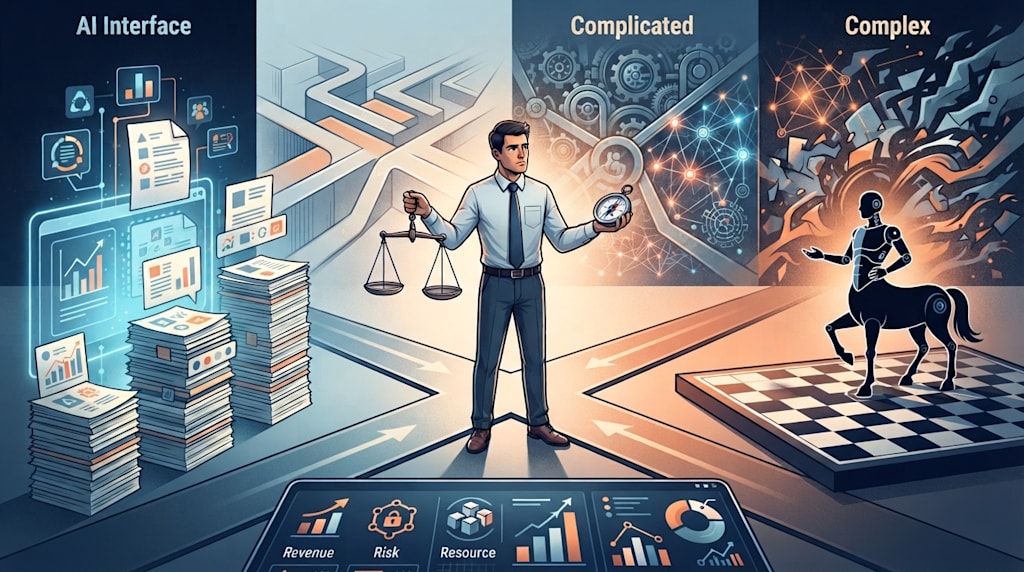
Last Monday, 9 a.m., I had thirty-seven unread messages. AI had already generated a PRD draft, broken user stories down to the third level, filled a competitor matrix in a shared doc, and drafted test cases. I held a coffee, stared at the priority column, and hovered over Send. I did not click.
Three years ago, that draft would have taken me two days. Now it took thirty seconds. My coffee went cold while I read it. The cursor blinked. A colleague pinged me: “Is it ready?” I typed, “I don’t know yet.” That was the most honest thing I said all morning.
The execution bottleneck is gone. A new bottleneck has surfaced: judgment.
The Bottleneck Moved
Economics has a classic theory of constraints. The throughput of a pipeline is determined by its slowest core step. Optimizing non-bottleneck steps does not materially increase output. Only clearing the core bottleneck produces a leap in efficiency.
My workflow used to be simple: understand the need, design the solution, write the document, align in review, accept delivery. Before AI tools became common, the core bottleneck sat in execution. PRDs, competitor research, requirement breakdowns, and flowcharts were repetitive and slow. Most of my energy went into turning logic in my head into standard documents. Whoever could write a clear PRD faster, break down requirements more completely, and push reviews and delivery more efficiently gained an edge.
AI changed that pipeline.
Enter a basic requirement description, and in thirty seconds you get a structurally complete PRD draft. Import user interview notes, and in five minutes you get requirement clustering and a preliminary priority recommendation. Upload competitor materials in bulk, and you get a competitor comparison matrix automatically. A 2025 Productboard survey found that product managers save an average of about four hours per task with AI tools.
Execution efficiency is no longer the main contradiction.
The bottleneck moved. AI can generate a PRD quickly. It cannot judge whether the content is reasonable, whether it fits the business, or whether it is worth shipping. AI can cluster user feedback. It cannot separate valid needs from noise. AI can produce multiple solution options. It cannot select the best one by combining company resources, organizational constraints, and strategic direction.
In the past, execution took more than 80% of my time. The value of judgment was buried under repetitive work. Even a strong judge would see output capped by execution speed. An average practitioner could complete basic work with standard methodology. Strong judgment was a bonus.
Now execution time has been compressed to about 20% of the work. Judgment carries more weight. The core value has shifted from shipping execution to accurate judgment. The quality of requirement trade-offs, direction decisions, and solution selection determines the value of the output. Judgment is no longer a bonus. It is the baseline for holding the role.
A product manager without judgment cannot tell good AI output from bad. Their value keeps getting compressed. A product manager with strong judgment can use AI to amplify results and multiply value.
What the Centaur Taught Me
In 2005, world chess champion Garry Kasparov launched a freestyle chess tournament. Any combination could enter: pure human, pure machine, or human-machine team. Before the event, most people expected a top grandmaster plus a high-end supercomputer to win easily. The winners were two amateur players working with three ordinary commercial computers.
In his later review, Kasparov argued that weaker humans paired with ordinary machines, using an efficient human-machine process, can beat stronger humans paired with high-end machines using an inefficient process. The core competitiveness of human-machine collaboration is not the absolute ability of the human or the machine. It is the quality of the collaboration fit.
This is the Centaur Model.
Applied to product roles, the capability tiers can be redrawn. A product manager with only judgment but little skill in using AI may be less competitive than a practitioner with average judgment who can wield AI well. A centaur product manager with both strong judgment and efficient AI collaboration gains a core advantage.
The Centaur Model turns on accurate control of the human-machine boundary. The amateur chess players won not because they were the strongest players or had the strongest computers. They understood the machine’s limits: which scenarios could be left to the machine, which required human intervention, where the machine was strong, and where its systemic weaknesses were.
Human-machine collaboration for product roles has at least three layers.
First, precise delegation. For structured, patterned, purely data-driven routine work, hand it to AI and let its execution speed work.
Second, timely intervention. For complex scenarios involving organizational collaboration, hidden business context, value trade-offs, and interest balancing, AI output has natural weaknesses. A human must lead and correct the decision.
Third, precise questioning. Using deep understanding of the business problem, turn a vague need into an instruction AI can recognize and act on, improving output quality at the source.
All three layers depend on the product manager’s tacit judgment. Experienced product managers accumulate project experience and hidden business knowledge. They can judge AI’s capability boundary and spot output gaps more accurately. A newcomer cannot quickly replicate that advantage.
The higher-order gap lies in perspective. An average practitioner uses an executor’s lens to judge whether a task can be shipped. A stronger practitioner uses an operator’s lens to judge actual value, return, and cost. That lifts product judgment from project execution to business decision-making.
Where AI Stops and Human Judgment Starts
Dave Snowden’s Cynefin framework divides work scenarios into four categories: clear, complicated, complex, and chaotic. Each has different causal logic and response strategies.
Applied to product work, the framework can distinguish where AI is effective from where human judgment carries core value.
In the clear domain, causality is obvious and best practices are repeatable. AI can cover most of it. Examples include standardized document generation, data cleanup, and process mapping.
In the complicated domain, problems need expert analysis, but causality can still be derived. AI can provide efficient assistance. Examples include competitor analysis, requirement clustering, and test case generation.
In the complex domain, causality can only be understood after the fact. It cannot be fully predicted in advance. AI plays a limited role. Examples include cross-functional collaboration, organizational games, shifts in user behavior, and market trend judgment.
In the chaotic domain, causality has broken down. Fast action and stabilization are needed. AI is largely unfit. Examples include project crises, PR incidents, strategic shocks, and organizational upheaval.
AI’s capability boundary keeps expanding. Complicated work that once required manual sorting is turning into standardized clear tasks. Competitor analysis moved from manual comparison to AI-generated comparison matrices. More standardized work becomes replaceable by AI. What remains for humans shrinks toward the complex and chaotic domains.
Those two domains hold the densest concentration of product judgment and tacit knowledge.
The product manager’s core competitiveness is not fluency in standard methodology. AI has already democratized that. It is long-term immersion in complex and chaotic business scenarios, accumulating tacit pattern recognition. Practitioners who have lived through cross-functional conflict, project crises, and directional bets can predict collaboration risks, control the rhythm of chaotic situations, and spot hidden business dangers. That kind of cognition is embedded in practice. It is hard to encode and hard for AI to acquire quickly.
More importantly, judgment in the complex and chaotic domains goes beyond project management. It sits closer to business management. Product direction determines where company resources go. Cross-functional conflict is essentially organizational interest distribution. Decisions in chaos directly affect business and organizational direction. These are core tasks for business operators.
Three Layers of Judgment
After AI takes over most execution work, the product manager’s judgment work does not disappear. It reorganizes into a system: execution judgment, collaborative judgment, and meta-judgment.
Execution judgment is where AI leads and the human verifies. This layer centers on AI output. The product manager approves, verifies, and corrects. AI can batch-produce multiple PRD drafts, user flow options, test cases, and other standardized outputs. The product manager quickly screens for usability, filters reasonable options, and fixes gaps.
The standards are relatively clear: structural completeness, logical consistency, format compliance, and scenario coverage. AI has a clear advantage here. It produces standardized output efficiently. Human judgment is frequent, but the density of each judgment is low.
Typical scenario: after AI generates a PRD draft, the product manager checks whether feature descriptions are complete, exception branches are covered, data sources are clear, and approval flows are closed-loop.
Collaborative judgment is where human and machine judge together, and the human leads the decision. This is the core human-machine collaboration layer. AI provides data support and solution references. The product manager combines hidden business context to make the final call.
Using historical data and standardized patterns, AI can rank requirement priorities, assess project risks, and compare solution options. The product manager adjusts AI’s conclusions using organizational relationships, resource constraints, strategic goals, and stakeholder demands that AI cannot see.
This layer fuses AI’s broad data advantage with the product manager’s deep business cognition. Judgment quality directly affects project progress and business value. Judgment density and core value are both above average.
Typical scenario: AI ranks a feature as highest priority based on user mention frequency. The product manager looks at the business and finds that a lower-frequency requirement is tied to a core customer renewal and carries higher commercial value. The priority is adjusted. AI’s data analysis is reasonable. The product manager’s adjustment is a higher-order judgment based on commercial relationships and business value beyond the data.
Meta-judgment is where the human leads, verifying AI decisions. Meta-judgment is a new product capability born in the AI era. Its core is judging the reasonableness and validity of AI conclusions.
This point is easy to miss. AI output often looks structurally complete and logically smooth, but it can contain hidden gaps: missing non-public business information, relying on outdated industry patterns, or ignoring special business constraints. AI cannot identify its own blind spots. The product manager must use industry experience and business knowledge to verify, correct, or reject AI output.
This layer depends heavily on long-term industry accumulation. It is a core expression of tacit knowledge. Judgment density is high, and it is important for controlling business risk.
Typical scenario: AI generates a competitor analysis report covering only competitors with public materials. It misses players with no public documents but real competitive strength. A senior product manager spots the gap quickly, fills the blind spot, and avoids a biased decision.
These three layers form the foundational capability system for product managers in the AI era. Execution judgment catches detail gaps in standardized AI output and protects delivery quality. Collaborative judgment fuses human and machine strengths and improves decision quality. Meta-judgment guards the business baseline and avoids decision risks caused by AI blind spots.
From “How to Ship It” to “Is It Worth Shipping?”
The first three layers still revolve around project delivery. Their core question is how to ship. Business judgment revolves around commercial value. It asks whether something is worth shipping, weighing ROI, strategic fit, and long-term organizational value.
This is the higher-order capability that fits the core needs of a company. It is also the core domain AI cannot cover.
Business judgment shows up in three dimensions.
First, value. Judge the value of a requirement not only by user demand and technical feasibility, but by whether it creates business value: revenue growth, cost reduction, or differentiated competitive barriers. AI can verify functional completeness. It cannot judge commercial value. That decision depends on market insight, human nature, and competitive judgment.
Second, resources. Resource allocation should not passively respond to every stakeholder request or sort by urgency. It should follow ROI and long-term value, tilting limited resources toward high-value, high-growth business directions, and actively building long-term business capability. This is core work for a business operator.
Third, risk. Risk judgment is not limited to compliance and delays. It focuses on long-term interest and brand reputation. Some requirements can ship and produce short-term gain, but damage user trust, overdraw the brand, or harm the industry. Short-term benefit with long-term harm should be avoided. That trade-off depends on commercial cognition and industry perspective.
These three types of judgment cannot be derived from data crunching or logical analysis alone. They are value trade-offs, human insight, and business decisions. They sit in a domain AI struggles to reach.
AI can generate options. It cannot bear consequences. The essence of judgment is making trade-offs when information is incomplete, resources are limited, and consequences are real. A product practitioner who consistently produces this kind of judgment has moved beyond the traditional project executor role. They become a business operator using product as the core vehicle.
The Moat Changes Shape
The industry often says judgment is the product manager’s moat. In the AI era, that phrase has new meaning. The shape of the moat has changed.
Before AI became widespread, the product manager’s core competitiveness was breadth: a full stack of standardized methodology. Write PRDs, draw prototypes, run data analysis, coordinate project flows. The more complete the standardized skill set and the higher the execution efficiency, the stronger the competitive position.
After AI became widespread, all standardized, encodable, replicable breadth capabilities were gradually flattened. Competition no longer centers on basic execution. The moat shifts from broad to deep.
The remaining core advantage concentrates in tacit knowledge and higher-order judgment that are hard to encode and hard for AI to acquire. Pattern recognition from years of scenarios, risk prediction experience, insight into users and market psychology, and the instinct to build order in chaos break free from repetitive execution work and become core differentiation.
The product role is being revalued. That is an opportunity, not a crisis.
The depth of the moat comes from accumulated tacit knowledge. The height depends on the product manager’s perspective and operator mindset. This is the key difference among senior product people.
An operator mindset is a perspective upgrade. Job titles do not grant it. An average product practitioner thinks like an executor: “How do I get this done well?” and focuses on delivery. A product practitioner with an owner’s mindset thinks like an operator: “Should this be done at all? What is the value? Who bears the risk and cost?” and focuses on business success and long-term development.
Two perspectives produce different decision heights and different role value.
How I Practice
An operator mindset and industry perspective are not innate. They are not granted by title. They come from deliberate practice and accumulation. Three paths matter.
First, upgrade the lens. Review daily work with an operator’s mindset. Step out of the product role’s default view. Think like the CEO or business owner when examining each requirement and decision. Over time, the thinking upgrades and the executor’s limits loosen.
Second, widen cognition. Accumulate cross-domain knowledge. Perspective depends on vision. Vision depends on diverse information. Product knowledge alone keeps decisions at the shipping level. Combine business, organizational management, human nature, and industry knowledge to make product decisions fit the nature of the business.
Third, stay in the field. Temper capability through conflict and trade-offs. Perspective cannot be formed through theory alone. It is polished in real business scenarios. Resource fights, interest balancing, risk choices, and requirement trade-offs are all training grounds. Every decision accumulates judgment and perspective.
A few practical methods I use: I keep a decision log. I record assumptions, AI recommendations, final choice, outcome, and deviation causes. I red-team AI output by asking about data sources, timeliness, missing actors, counterexamples, and opportunity cost. I map every requirement to a business metric: revenue, cost, renewal, risk, strategic barrier, or organizational capability. I draw a stakeholder map because AI cannot see organizational relationships, resource constraints, or hidden interests. I allocate resources with a portfolio view. I do not sort by who shouts loudest. I sort by ROI, long-term value, and strategic necessity. I practice counterfactual reasoning: if this decision is wrong, where is it most likely wrong? What is the cost? Is it reversible? I run regular business reviews. I look beyond on-time delivery to business results, resource efficiency, and long-term capability building.
What I Do Now
Tomorrow at 9 a.m., AI will generate another PRD. I will not click Send yet.
I will open the decision log. I will write three questions: What is the business value? If this is wrong, who bears the cost? Is there a reversible small experiment?
Then I will send.
The product manager of the future competes on judgment, not efficiency. The contest is who can make better trade-offs when information is incomplete, resources are limited, and consequences are real.
That ability lives in my daily choices. It lives in yours too.
About the Creator
Jin
Writer of reamstories
https://reamstories.com/jin
Enjoyed the story? Support the Creator.
Subscribe for free to receive all their stories in your feed. You could also become a paid subscriber, letting them know you appreciate their work.
Comments
There are no comments for this story
Be the first to respond and start the conversation.