
A Jewelry Empire Sat on 1.5 Billion Yuan in Gold. Then Its Owners Vanished.
Employees say they have not been paid. The online stores are empty. And no one can find the couple who ran Qianye Jewelry.
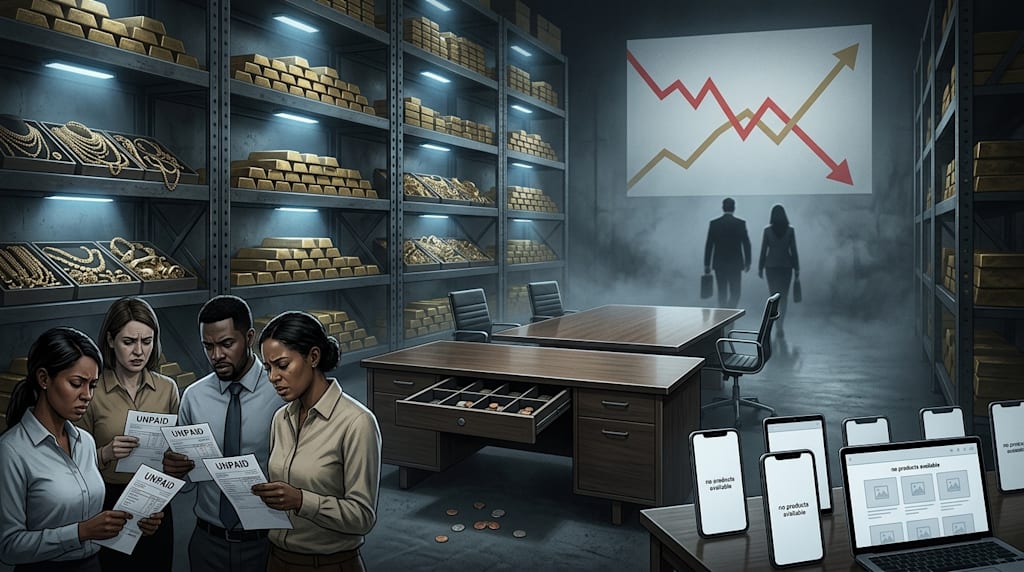
93,000 Yuan in Cash, 1.5 Billion Yuan in Inventory: How Qianye Jewelry Reached the Point of Its Controller’s Disappearance
As of September 12, 2026, the public record on Qianye Jewelry is clear. The company’s actual controllers are unreachable. Employees say they have not been paid. Its online storefronts have been emptied.
On September 11, shares of Qianye Jewelry (833585.NQ) fell 49.41%.
The night before, lead broker Northeast Securities issued a risk warning. It said it had tried WeChat groups, phone calls, emails, and visits to the company’s office. None worked. It could not reach actual controllers Lin Mingjie and his wife, Gao Xiaosong. It did not know why. Other directors, supervisors, and on-site staff also said they could not reach the two. The broker cannot find the boss. Neither can people inside the company.
I
Employees noticed first.
A former senior jewelry design manager posted a timeline. Joined in May. Left in August. Four months on the job. Received only May’s salary in mid-July. Three months of pay missing.
Some employees say they are owed eight months. Some say a year and a half. Former employees say the rights-protection group has about 80 people. Most have filed collective labor arbitration.
One detail matters. Some employment contracts list “Beijing Kufen Culture Technology Co., Ltd.” as the employer, not Qianye Jewelry. The relationship between the two companies now has to be proved in arbitration. For unpaid workers, that makes an already difficult path longer.
Around September 10, employees went to the company’s office. Lin Mingjie and Gao Xiaosong were not there. Other staff on site said they could not reach them either.
II
The online channels halted almost simultaneously.
The JD flagship store cleared all products. Tmall kept only a membership shopping-credit recharge link. All products were delisted. The WeChat mini store had no products on sale. Xiaohongshu marked every item as “sold out.”
One consumer ordered on September 8. On September 9, the product was delisted. Customer service replied: “system failure, data error, product out of stock, cannot ship.” Three reasons, all technical. None said the company was in trouble. But the company was in trouble.
III
On August 24, Qianye disclosed its 2026 half-year report.
Revenue was 213 million yuan. Net profit attributable to shareholders was 14.4791 million yuan. Operating cash flow was 28.44 million yuan, an improvement from a year earlier. Net assets attributable to shareholders of the listed company were 1.296 billion yuan. The income statement did not look ugly. The balance sheet did.
As of June 30, monetary funds stood at 933,700 yuan. That was down 74.58% from the end of 2025. Short-term borrowings were 133 million yuan. Other payables were 98.62 million yuan. Total liabilities were 290 million yuan. A jewelry brand that has operated in Beijing for twenty-five years did not have enough cash on hand to cover one month’s rent.
The money was in inventory. 1.535 billion yuan. That was 96.56% of total assets. Total assets were 1.589 billion yuan. Raw materials were 574 million yuan. Finished goods were 939 million yuan. Gold, platinum, diamonds, jade. In warehouses, in counters, on the books.
IV
Over the past two years, international gold prices rose sharply. In the first half of 2026, London spot gold averaged $4,688.62 an ounce, up about 52% year on year.
A company hoarding 1.5 billion yuan in gold inventory should have been winning. Inventory turnover says otherwise. In 2025, Qianye’s inventory turnover was 0.23 times. Turnover days exceeded 1,500. Lao Feng Xiang, Chow Tai Seng, and CHJ did better on the same measure. 1,500 days is more than four years. From buying raw materials to final sale, the average was more than four years.
During those four years, wages had to be paid. Rent had to be paid. Loans had to be repaid. Gold inventory solves none of that.
The composition of the inventory made it worse. Analysis suggests nearly half was more than three years old. Jewelry inventory older than three years is usually cleared at a discount. Discounting means writing down book value. As gold rose, unsold goods became more awkward. You watch gold climb. Your goods do not move. You cannot cash out. The book numbers look good. Cash shrinks.
On August 24, the National Equities Exchange and Quotations sent an inquiry to Qianye on “inventory and liquidity.” It asked the company to explain whether inventory was slow-moving or accumulated. It asked for a quantified impact of inventory-occupied funds on liquidity. It was the second consecutive year that regulators had issued an inquiry into the company’s financials. That inquiry will probably never receive a reply.
V
Qianye’s board has only three members: Lin Mingjie, Gao Xiaosong, and Lin Huixian. Lin Mingjie and Gao Xiaosong are husband and wife. Lin Huixian is Lin Mingjie’s sister. As of the end of June 2026, the three directly held 52.37% of the company. Lin Mingjie alone held three positions: chairman, president, and board secretary.
This structure is not rare in private companies. Its advantage is speed. The boss decides, and no one has to be consulted. Its cost is that when the boss’s judgment goes wrong, no one can stop it. No one can say a true word at the key moment.
Lin Mingjie’s equity pledges confirmed that risk. Before losing contact, he had frequently pledged shares. The number of shares with restricted rights exceeded half of his holdings. The boss treats the company as his wallet. When the company lacks cash, he pledges equity to borrow. The borrowed money fills the hole. When the hole cannot be filled, he pledges more.
In July, Qianye was executed for more than 990,000 yuan by the Chongqing Fuling District People’s Court. Bankers did show up. A rumor circulated that Lin and his wife may have left the country and were seen in Thailand days earlier. The claim has not been officially confirmed.
VI
Qianye had its moment.
In 2001, Lin Mingjie founded the company in Beijing. In 2015, it listed on the New Third Board. That same year, it signed Anne Hathaway as a brand ambassador. For a few years, it was a recognizable name in the Beijing market.
Its business model swung twice. It began as an asset-heavy, direct-operated business. At one point, 90% of its stores were direct-operated. By the end of 2024, only one direct-operated store remained. The rest were franchises. The shift itself was not wrong. The timing was too late. E-commerce was shrinking. In the first half of 2026, e-commerce revenue fell 89.75% year on year. The company changed its core model twice within a few years. First from direct operation to franchising. Then online, from livestream volume to contraction. Each shift was forced by circumstance, not chosen in advance.
VII
The industry environment did change. In the first half of 2026, China’s gold jewelry consumption fell 30% year on year to 136 tonnes. Chow Tai Seng net-closed 473 stores. Lao Feng Xiang net-closed 439. Zhou Liu Fu net-closed 226. Together, those three leading companies net-closed more than 1,000 stores in half a year.
Not every brand was struggling. Gold jewelry consumption volume fell, while total spending rose 5% year on year to 143.7 billion yuan. The share of self-wear demand rose from 27% in 2024 to 44% in 2026. Consumers were shifting from “buying gold” to “buying design, emotion, and status.” Brands that could differentiate in design and brand were still growing. Qianye’s problem was not the industry downturn. It did not follow the change in consumer logic. Its product line, channel strategy, and brand positioning did not adjust fast enough during the two years of soaring gold prices.
VIII
Franchise stores diverged. Beijing CapitaMall Wangjing closed half a month ago. Shanghai Printemps Baoshan was marked “closed.” Wuhan Shopping Mall was marked “suspended.” Some stores put up “closing sale” promotions. At the same time, several franchise stores in Beijing were still open. One staff member said: “We are a franchise store. We have our own boss. We get goods directly from the factory. Currently, it does not affect customers buying or picking up goods.”
The legal and financial ties between franchisees and the brand are relatively loose. That creates a firewall of sorts. But the collapse of brand reputation is a loss of value for franchisees. A consumer walks into a Qianye Jewelry franchise store and sees the Qianye sign, not the franchisee’s name. When the sign has a problem, the business will eventually feel it.
IX
For employees, the urgent task is to complete labor arbitration and apply for property preservation. Wages have a certain priority in law. The precondition is that there are assets to auction and convert into cash.
Qianye has 1.535 billion yuan in inventory on the books. Nearly half is more than three years old and slow-moving. In a liquidation, the discount would be steep. Whoever acts first protects their rights first.
For consumers, products already purchased have passed quality inspections. Normal wear is not a problem. Brand credibility has been severely damaged. After-sales service, repairs, and trade-ins depend on the brand continuing to operate. Whether those promises can be honored is now uncertain.
Franchisees should expect a long-term decline in brand value. Those who can leave should consider leaving.
X
The Qianye Jewelry story is about cash. Profit, assets, and cash are three different things. A company can have net profit. It can own a great deal of gold and jewelry. But when wages come due, bank loans come due, and supplier payables come due, what it needs is cash it can mobilize in time.
933,700 yuan in cash. 290 million yuan in liabilities. 1.535 billion yuan in inventory. Those three numbers explain the outcome.
The crisis looked sudden from the outside. Inside, low inventory turnover, persistently tight cash flow, family governance without checks, and escalating equity pledges had been flashing as signals for years. No one could stop it. No one said the difficult thing at the key moment.
On September 11, the share price was 0.43 yuan. The market cap was 47.48 million yuan. A company that had operated for twenty-five years lost nearly half its market value in a single day. In its warehouse, there was still 1.5 billion yuan in gold.
About the Creator
Jin
Writer of reamstories
https://reamstories.com/jin
Enjoyed the story? Support the Creator.
Subscribe for free to receive all their stories in your feed. You could also become a paid subscriber, letting them know you appreciate their work.
Comments
There are no comments for this story
Be the first to respond and start the conversation.