halloween
Get into the Halloween spirit; all about trick or treating, spooky costumes, Halloween decorations and haunted houses for October 31st and all year round.
The Salem Witch Trials – Massachusetts. Content Warning.
In the quiet town of Salem, Massachusetts, during the late 17th century, a wave of paranoia and fear transformed a small Puritan community into the site of one of the most infamous events in American history — the Salem Witch Trials. Between February 1692 and May 1693, more than 200 people were accused of practicing witchcraft, and 20 were executed. What began as a few strange incidents among young girls quickly turned into a national symbol of mass hysteria, superstition, and the dangers of false accusation. The Origins of the Witch Hunt The roots of the Salem Witch Trials trace back to the strict religious lifestyle of the Puritans. They believed that the devil was constantly at work to corrupt the faithful. In 1692, when Betty Parris and Abigail Williams, the daughter and niece of Reverend Samuel Parris, began exhibiting bizarre symptoms — screaming fits, convulsions, and trance-like states — the local doctor claimed the girls were victims of witchcraft. Soon, other girls in Salem began to display similar behaviors, and fear spread like wildfire. Pressured to explain their torment, the girls accused several local women of witchcraft — including Tituba, a Caribbean slave; Sarah Good, a homeless beggar; and Sarah Osborne, a woman who rarely attended church. These accusations marked the beginning of the witch hysteria that would soon consume the town. The Trials Begin The colonial legal system in 1692 allowed spectral evidence — testimony that the accused’s spirit or ghost had appeared to the witness — as valid proof. This controversial rule led to the imprisonment of dozens of innocent people. Trials were held in Salem Village and Salem Town, where fear and chaos replaced reason and justice. Tituba’s confession further fueled the hysteria. She admitted to communicating with the devil and described other witches in Salem, confirming the community’s worst fears. As the accusations multiplied, no one felt safe. Prominent members of society, churchgoers, and even children became suspects. The Puritan belief that anyone could fall under Satan’s influence gave the trials terrifying momentum. By the summer of 1692, Governor William Phips had established a special court called the Court of Oyer and Terminer to prosecute the accused witches. The most famous judge, Samuel Sewall, later publicly repented for his role in the trials, calling it a “day of shame.” The Executions and the End of the Trials Nineteen people were hanged on Gallows Hill, and one man, Giles Corey, was pressed to death with heavy stones for refusing to plead. Many others died in jail awaiting trial. Among the victims were Rebecca Nurse and Martha Corey, both respected church members, whose executions shocked the community. By early 1693, skepticism began to grow. Prominent ministers, including Increase Mather, argued that “it were better that ten suspected witches should escape than that one innocent person should be condemned.” Public opinion turned against the trials, and the governor eventually ordered an end to the proceedings. In 1697, the Massachusetts General Court declared a day of fasting and repentance for the tragedy. Later, the court annulled the guilty verdicts and offered compensation to the victims’ families — but the scars of hysteria and injustice remained. Legacy and Modern Interpretations Today, the Salem Witch Trials are remembered as a powerful cautionary tale about fear, intolerance, and the consequences of mass panic. Historians continue to debate the causes — some suggest religious extremism, others point to social tensions, greed, or even ergot poisoning (a fungus that can cause hallucinations). The trials have become deeply embedded in American culture, inspiring countless books, films, and plays — most notably Arthur Miller’s The Crucible (1953), which used Salem as a metaphor for the anti-Communist “witch hunts” of the 1950s. Modern Salem has embraced its haunted reputation. Visitors can explore the Salem Witch Museum, Old Burying Point Cemetery, and the Witch House, once home to Judge Jonathan Corwin. Every October, during the Haunted Happenings Festival, thousands flock to Salem to experience the eerie blend of history and legend that still lingers in its cobblestone streets. The Enduring Symbol of Salem The Salem Witch Trials stand as a reminder that fear can destroy reason, and that justice requires courage and truth. In Salem’s haunting story, we see how a community’s obsession with purity and its terror of the unknown led to one of history’s darkest moral failures. More than three centuries later, Salem continues to fascinate the world — not only as a place of tragedy but as a testament to human fallibility and the eternal struggle between truth and fear.
By Haunted Secrets11 months ago in Horror
The Curse of the Hope Diamond
Few gems in the world have inspired as much fascination, fear, and intrigue as the Hope Diamond, also known as the Blue Diamond of Misfortune. This magnificent jewel, weighing 45.52 carats, dazzles with an otherworldly blue brilliance—but behind its beauty lies a chilling legend. Over centuries, the Hope Diamond has been blamed for bringing death, disaster, and ruin to nearly everyone who owned it. From India to France to America, its story remains one of the most mysterious and cursed tales in history. The Origins – A Jewel Born in Mystery The Hope Diamond’s origins trace back to India in the 1600s. It was said to have been discovered in the Kollur Mine near the River Krishna and originally belonged to a Hindu temple idol. According to legend, the diamond’s first curse began when it was stolen from the idol’s eye by a French merchant named Jean-Baptiste Tavernier. The priests of the temple allegedly cursed the thief, dooming anyone who possessed the gem to misfortune and tragedy. Whether myth or truth, the curse’s legend began here—and the dark fate of the Hope Diamond was set in motion. The French Connection – Wealth, Glamour, and Death Tavernier sold the diamond to King Louis XIV of France in 1668, where it was cut and renamed the French Blue. For decades, the dazzling gem became a symbol of royal power and luxury. Yet soon, tragedy struck nearly everyone connected to it. Jean-Baptiste Tavernier, the merchant who first stole the diamond, reportedly died of a fever after being mauled by wild dogs. King Louis XIV and his descendants suffered misfortune; his great-grandson Louis XVI and Marie Antoinette were executed during the French Revolution. The royal jeweler who cut the gem, Nicolas Fouquet, was later imprisoned for life. In 1792, during the chaos of the Revolution, the French Blue was stolen along with other crown jewels. It vanished for decades, leaving behind whispers of its deadly curse. Rebirth as the Hope Diamond The gem resurfaced in London in 1839, recut into a smaller but equally stunning blue diamond. It came into the possession of Henry Philip Hope, a wealthy British banker—hence its modern name, the Hope Diamond. But the curse seemed to follow. Hope’s descendants faced financial ruin, selling off the diamond to pay debts. Over the next century, it passed through several owners—each suffering misfortune, scandal, or death. Among them were: Jacques Colot, a Parisian jeweler, who went insane and committed suicide. Prince Ivan Kanitovski, said to have gifted the gem to his lover, an actress who was later murdered. The prince himself was shot shortly afterward. Simon Maoncharides, a Greek merchant who bought the diamond and was killed in a car crash with his wife and child. Each tragedy deepened the legend: the Hope Diamond was not merely cursed—it was hungry for sorrow. Arrival in America – The Smithsonian’s Mysterious Gem In 1911, the diamond was purchased by Evalyn Walsh McLean, a wealthy American socialite. She believed the curse was nonsense and wore the diamond frequently to parties. But her life soon unraveled. Her son died in a car accident, her daughter died of a drug overdose, and her husband left her for another woman before going insane. Evalyn herself died nearly penniless in 1947. After her death, the diamond was acquired by famous jeweler Harry Winston, who decided to donate it to the Smithsonian Institution in Washington, D.C., hoping to end the curse’s legacy. In a twist worthy of its legend, Winston sent the world’s most infamous diamond through the U.S. mail—wrapped in brown paper and insured for $145. Today, the Hope Diamond remains one of the Smithsonian’s most popular exhibits, dazzling millions of visitors each year behind its protective glass. The Science Behind the Legend Modern gemologists describe the Hope Diamond as one of the rarest jewels on Earth, due to its deep blue hue caused by trace amounts of boron within the stone. When exposed to ultraviolet light, the diamond glows with an eerie red phosphorescence—a quality that may have contributed to its supernatural reputation. Historians argue that the curse is simply a myth fueled by coincidence, tragedy, and sensational storytelling. Yet others believe that the diamond’s dark energy, born from theft and greed, continues to influence those who come near it. The Eternal Mystery of the Hope Diamond Today, the Hope Diamond sits peacefully in the Smithsonian’s National Museum of Natural History, glittering under controlled light. Visitors marvel at its hypnotic beauty, unaware—or perhaps intrigued—by its haunted past. Whether cursed or not, the Hope Diamond’s story continues to blend fact, legend, and superstition, symbolizing humanity’s timeless obsession with beauty, power, and fate. The truth behind its curse may never be known. But one thing is certain: the Hope Diamond will forever shine as both a masterpiece of nature and a monument to mystery—a reminder that sometimes, the most beautiful things in the world can carry the darkest secrets.
By Haunted Secrets11 months ago in Horror
Creepy Encounters I Had While Cleaning Up After Crime Scenes
A True Horror Story from My Time as a Crime Scene Cleaner I’ve cleaned up blood that’s soaked through old pine floors. I’ve scraped bits of brain tissue off tile, and carried mattresses that sloshed when you moved them. Working in crime scene cleanup isn’t for those with weak stomachs but honestly, it’s not the gore that sticks with you. It’s everything that comes after. The quiet. The strange little moments you can’t explain. People ask me about creepy encounters I’ve had on the job, and over the years, there’ve been plenty. But three of them still keep me awake sometimes. They weren’t the most gruesome scenes, not the worst I’ve seen by a long shot but they were the ones that made me feel something watching from the dark corners. Something that never really left.
By Loud Scary11 months ago in Horror
The Mysterious Disappearance of Malaysia Airlines. Content Warning.
Few mysteries in modern aviation history have captivated the world like the disappearance of Malaysia Airlines Flight MH370. On March 8, 2014, a Boeing 777 carrying 239 passengers and crew vanished without a trace while flying from Kuala Lumpur to Beijing. Despite one of the largest search operations in history, the fate of MH370 remains one of aviation’s most baffling unsolved mysteries. The Flight That Vanished At 12:41 a.m., Flight MH370 took off from Kuala Lumpur International Airport. Everything appeared normal as it climbed to cruising altitude. But less than an hour later, at 1:19 a.m., the final words were heard from the cockpit: “Good night, Malaysian three-seven-zero.” Minutes later, the plane’s transponder—which communicates with air traffic control—was mysteriously turned off. From that moment, MH370 disappeared from radar, beginning a global mystery that still sparks speculation today. A Vanishing Act Over the Indian Ocean Military radar data later revealed that after communication was lost, the plane changed direction, veering sharply west across the Malay Peninsula before heading south over the Indian Ocean. This deviation from its planned route has led to countless theories, ranging from technical malfunction to pilot involvement or even hijacking. For weeks, rescue teams from more than 20 countries scoured the seas and skies, focusing initially on the South China Sea, where the aircraft was last detected. When evidence surfaced suggesting the plane had flown for hours beyond its last contact, the search area shifted to the remote southern Indian Ocean—one of the most difficult and desolate regions on Earth. The Search That Changed Aviation Forever The search for MH370 became the most expensive in aviation history, covering nearly 120,000 square kilometers of ocean floor. Sophisticated underwater drones and sonar mapping technology were deployed to find any trace of wreckage. After two years of intensive searching, investigators found no definitive debris at the primary search site. However, pieces later washed ashore on the coasts of Reunion Island, Madagascar, and Mozambique, confirming the plane’s tragic end somewhere in the southern Indian Ocean. Despite these discoveries, the main wreckage and black boxes—the key to understanding what happened—have never been found. Unanswered Questions and Theories The mystery of Flight MH370 has fueled numerous theories and endless debate. Mechanical failure: Some experts suggest a sudden fire or decompression event rendered the crew unconscious, allowing the plane to fly on autopilot until fuel exhaustion. Pilot suicide: Another theory speculates that Captain Zaharie Ahmad Shah deliberately diverted the aircraft in a planned act of murder-suicide. Hijacking or cyberattack: Others believe the plane was hijacked, or its systems remotely controlled. Government cover-ups: Some conspiracy theories even claim hidden military involvement or secret knowledge withheld from the public. Despite years of investigation, no theory has been conclusively proven. The truth remains locked beneath the waves, leaving families and the world desperate for closure. The Emotional Toll For the families of the 239 souls on board, the disappearance of MH370 is not just a mystery—it’s a living nightmare. With no remains, no wreckage, and no concrete answers, their grief remains suspended in time. Each new discovery brings a flicker of hope, followed by renewed heartbreak when the truth remains elusive. Vigils and memorials continue to be held, especially in Malaysia, China, and Australia, where most of the victims’ families reside. The words “Remember MH370” have become a symbol of resilience and the relentless pursuit of truth. Legacy and Lasting Impact The tragedy of MH370 changed the aviation industry forever. In its aftermath, international aviation authorities introduced new rules requiring aircraft to automatically report their positions more frequently, even over remote oceans. Satellite tracking systems have also been improved to prevent another disappearance of this scale. Still, the loss of MH370 serves as a haunting reminder of the limits of modern technology and the vast, untamed nature of our planet. Even in the age of satellites, GPS, and instant communication, an airliner carrying hundreds of people can still vanish without a trace. The Enduring Mystery Over a decade later, Flight MH370 remains a chilling symbol of the unknown. Its story continues to inspire documentaries, books, and investigations, all seeking to answer the same question: How does a modern aircraft simply disappear? Until the wreckage is found and the black boxes are recovered, MH370 will remain an enduring enigma of the skies, a mystery that haunts the oceans and continues to capture the world’s imagination.
By Haunted Secrets11 months ago in Horror
The House That Woke on Halloween Night. AI-Generated.
It was the last evening of October, a calm but strangely quiet Halloween in a small town called Willow Grove. The sun had already gone down, and the cold autumn wind tapped gently on windows, as if reminding everyone that darkness had arrived. Children wore colorful costumes and walked from house to house with buckets full of candy. Laughter echoed down the streets. But at the end of Maple Street stood a house that had no lights, no decorations, no pumpkins — just darkness. Everyone in town knew the house. Everyone avoided the house. And everyone taught their children to forget it existed. Except one. Emma, a seventeen-year-old girl, had moved into Willow Grove only three weeks ago. She didn’t know the stories. She only knew the house looked old, abandoned, and lonely — like it had been waiting for someone. “What’s inside?” she asked her new friends earlier that day. They all froze. “You don’t go near it,” said Lucas, his voice suddenly serious. “People say the house wakes up on Halloween.” Emma laughed. “A house wakes up? Come on. Houses don't breathe.” But the others didn’t laugh. “It breathes,” whispered another girl, eyes wide. “And it remembers.” Emma thought they were just trying to scare her for Halloween. But curiosity is a powerful thing — especially when someone says don’t. That night, while the town celebrated, Emma slipped away from the group and walked toward Maple Street alone. The wind grew colder. The rest of the street had lights, carved pumpkins, and friendly porches — but the abandoned house seemed to swallow darkness around it. Its windows were black, like blind eyes. Its paint peeled like decaying skin. The front gate creaked open on its own. Emma’s heart beat faster, but she stepped forward. The air felt heavier now. The porch boards groaned under her feet, as if the house was reacting to her presence. She reached the door — and before she touched it — it opened. Slowly. Silently. As if the house had been waiting for her. Inside smelled of dust and forgotten years. But something felt… alive. The walls seemed to pulse faintly. There were no cobwebs. No broken furniture. Everything looked too untouched, too preserved — like time avoided this place. Emma whispered, “Hello?” Something whispered back — but not with sound. Welcome. She gasped and turned around — but no one was there. The floorboards began to vibrate, soft at first, then stronger — like a heartbeat. The house was breathing. She walked deeper, drawn by something she couldn’t explain. She saw family portraits on the wall — but each face was scratched out. Only the eyes remained — wide, staring, desperate. A chill crawled up her spine. Suddenly, a whisper filled the air: “Don’t leave me again.” Emma’s breathing quickened. “Who’s there?!” The hallway lights flickered on. At the end of the hall stood a little girl, her dress white, her hair tangled, her face pale as moonlight. But her eyes — her eyes were endless and hollow. The girl stepped closer. “You came back,” she whispered, reaching out. Emma trembled. “I… I don’t know you.” The girl stopped. Her expression slowly twisted into confusion… then anger. “You forgot me.” The lights shattered. The walls groaned like something massive was waking behind them. Emma ran. The house shook violently now. Doors slammed shut around her. The whispering voices rose to screams. “STAY WITH US.” She sprinted to the front door — but the door sealed as if it were part of a living creature. She pounded on it, crying, “LET ME OUT!” The house exhaled — a long, low breath — and everything fell silent. For a moment, Emma thought she escaped the nightmare. Then the little girl appeared right behind her, whispering into her ear: “Everyone returns to where they belong.” Her hand touched Emma’s shoulder. The house released a deep, echoing sigh — and the door slowly opened. Emma burst out into the cold night, falling onto the porch. She didn’t look back. She ran until her lungs burned. Behind her, the house stood silent again. Sleeping. Waiting. 🌑 The Next Morning Emma told everyone what happened. No one laughed. No one doubted. Lucas put a hand on her shoulder. “That’s why we never wake the house,” he said quietly. “Because it remembers the people who left it.” Emma never walked near Maple Street again. And no one saw the little girl again. But sometimes — on cold nights when the wind blows — residents swear they hear a child whisper outside: “Don’t leave me.” 🧠 Moral of the Story: Curiosity can lead us into places where memories never die — and some doors should remain closed.
By Sajjad Ali11 months ago in Horror
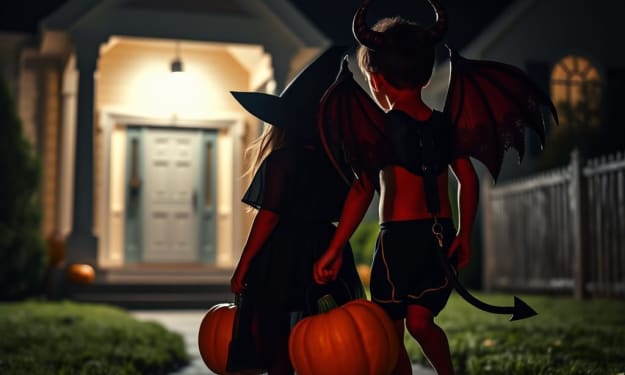
When The Little Witch Goes Trick & Treating
Before her lay a circle of power, and inside stood a powerful demon. Its muscles were bulging, its wings were spread majestically, and its horns curled aggressively. It glared at the witch just outside the circle, just outside its influence. “What would you have of me, woman, so that I may yet again be free?”
By Jamais Jochim11 months ago in Horror
The Disappearance of the Roanoke Colony – America’s Oldest Unsolved Mystery
In the annals of American history, few stories are as haunting and mysterious as the disappearance of the Roanoke Colony. Often called “The Lost Colony,” this 16th-century settlement vanished without a trace, leaving behind only a single cryptic word carved into a tree: “CROATOAN.” Over four centuries later, historians, archaeologists, and mystery lovers still wonder—what really happened to the people of Roanoke? The Dream of a New World In the late 1500s, England sought to expand its power and establish a foothold in the New World. Under the reign of Queen Elizabeth I, explorer Sir Walter Raleigh was granted permission to create a colony on the coast of what is now North Carolina. In 1585, the first group of English settlers arrived on Roanoke Island, but harsh conditions, poor supplies, and tense relations with local Native American tribes forced many to return to England. Determined to succeed, Raleigh organized a second expedition in 1587, this time including families who hoped to build permanent homes in the New World. A New Beginning Led by John White, the second Roanoke group consisted of about 115 settlers, including men, women, and children. Among them was White’s daughter, Eleanor Dare, who gave birth to Virginia Dare, the first English child born in the Americas. The colony began with hope and optimism, constructing homes and forming relationships with local tribes. However, their supplies soon dwindled, and conflicts with nearby tribes worsened. As the colony’s governor, John White decided to sail back to England to gather more provisions. He left his family and fellow settlers behind, promising to return within a few months. A Mysterious Silence White’s return was delayed—not by choice, but by history itself. England was at war with Spain, and nearly all ships were seized to defend against the Spanish Armada. By the time White finally returned to Roanoke in **1590—three years later—**the colony was gone. When he stepped onto the island, he found abandoned houses overgrown with weeds and no sign of struggle or violence. The settlers had simply disappeared. The only clue was the word “CROATOAN” carved into a wooden post, and the letters “CRO” etched into a nearby tree. White believed this referred to Croatoan Island (now Hatteras Island), home to friendly Native Americans the settlers knew. However, storms prevented him from searching the island, and he was forced to return to England—never knowing the fate of his family or the lost colony. Theories and Speculations Since that time, countless theories have tried to explain the mystery of the Lost Colony of Roanoke. 1. Integration with Native Tribes: The most widely accepted theory is that the settlers assimilated with local tribes, particularly the Croatoan (Hatteras) people. Some later reports from explorers described Native Americans with gray eyes and European features, possibly descendants of the colonists. 2. Mass Relocation or Migration: Another idea suggests the colonists moved inland in search of better resources and were later killed or absorbed by other tribes. 3. Spanish Attack: Some historians speculate the Spanish, who controlled nearby territories, discovered and destroyed the settlement to eliminate English presence. 4. Disease or Starvation: Harsh conditions, lack of food, and unfamiliar diseases could have led to the colony’s demise. 5. Supernatural Explanations: Over the centuries, folklore and legend have transformed the mystery into ghost stories, curses, and tales of haunted forests and vanishing spirits, making Roanoke a staple in American paranormal lore. Archaeological Clues Modern archaeologists continue to search for answers. In recent years, excavations on both Roanoke Island and Hatteras Island have uncovered English artifacts, including pottery fragments and tools that may belong to the lost settlers. However, none have provided definitive proof of what happened. In 2015, researchers revealed a hidden symbol on John White’s 1587 map, possibly marking the site of a secret settlement inland. This discovery reignited the debate and inspired further investigations, but the truth remains elusive. The Legacy of the Lost Colony Despite the uncertainty, Roanoke holds a permanent place in American history and culture. It represents the risks and dreams of early colonization, the fragility of human survival, and the enduring power of mystery. The story has inspired books, television shows, and films, including the popular “American Horror Story: Roanoke,” which blends history with horror fiction. Each year, thousands of visitors travel to Roanoke Island Festival Park to experience reenactments of the colony’s history and to stand where one of the world’s greatest mysteries began. An Unanswered Mystery More than 400 years later, the question still lingers: What happened to the Lost Colony of Roanoke? Were they absorbed by local tribes, destroyed by enemies, or lost to the wilderness? The silence of history has preserved their story, leaving behind only whispers and the word “CROATOAN”—a symbol of the unknown. Until definitive evidence is found, the fate of the Roanoke Colony remains an enduring enigma—a story that blends history, legend, and the haunting allure of the unexplained.
By Haunted Secrets11 months ago in Horror