art
Art that’s as dark as it is evocative; discover horror-inspired artwork, from twisted mutations of classic paintings, chilling sculptures, spooky photography and more.
The Echo of the Unsent
The phone was a steal. Not the latest model, but a pristine, unlocked iPhone X. I snagged it for a song from a pawn shop downtown, thinking I’d finally upgrade from my cracked relic. It felt good in my hand, smooth and familiar. A clean slate, I thought. I was dead wrong. It started subtly, as these things always do. A phantom notification buzz in my pocket, even when no message arrived. Dismissible at first, just a quirk of a used device. But then came the messages. They’d pop up on my screen, not as new texts, but as unsent drafts in my messaging app. Brief, fragmented, always from an unknown sender. The first one was just a string of emojis: a broken heart, a weeping face, a black cloud. I’d delete it, only for it to reappear hours later. Then came the words: "He left... alone." Another, "Can't breathe… so cold." I figured it was a data glitch, some lingering cache from the previous owner. Maybe a prank. But the messages became more frequent, more vivid. They weren't just random words; they were raw, unfiltered bursts of emotion. Fear. Despair. A profound sense of abandonment. I tried factory resetting the phone. Wiped everything. Still, the unsent messages resurfaced, stubbornly clinging to the digital ether of the device. Then, the photos. My camera roll started showing images I hadn’t taken. Dark, blurry shots of unfamiliar rooms, distorted reflections in glass, and once, a fleeting glimpse of a pale, terrified face looking directly into the lens. These weren't photos I'd ever seen before, yet they were marked with timestamps from my phone, taken in the dead of night, while the phone lay dormant on my nightstand. A cold dread began to creep in. This wasn't a bug. This was a digital echo. The previous owner’s last, desperate communications, forever trapped within the phone, unable to be sent, yet refusing to be deleted. And they were trying to tell me something. I began to research. The pawn shop owner was tight-lipped about the phone’s origin, just muttering about "a quick sale, no questions asked." I found a Reddit thread, buried deep in a forgotten corner of the internet, about "ghost data" – digital remnants clinging to devices, sometimes manifesting in strange ways. But nothing as specific, as personal, as this. The messages continued, forming a fragmented narrative. "He took it... the research..." "They won't believe me... trapped here..." "It's not human... the hum..." The language was frantic, the tone increasingly terrified. The photos became clearer too, revealing glimpses of a cluttered apartment, strange electronic equipment, and always, in the periphery, a deep, unsettling darkness. I realized with a chilling certainty: the previous owner hadn't just used this phone; they had poured their final, terrifying moments into it. Their last confession. Their last cry for help. And they hadn't disappeared; they had been "taken," as the messages hinted, perhaps by whatever "He" was, or the "hum." The real terror began when the unsent messages started appearing on my own accounts. A draft email in my personal inbox, not from me, but eerily echoing the previous owner's despair. A fragmented message in my social media DMs, written in my style, but detailing a fear I hadn't voiced, a secret I hadn't admitted. The digital echo wasn't just confined to the phone anymore; it was spreading, hijacking my own online presence, weaving itself into my digital identity. It was as if the entity, or whatever had claimed the previous owner, was now using my digital footprint as its next vessel. It wasn't just receiving messages; it was sending them, using me as a conduit. Panic flared. I had to stop it. This wasn't a ghost haunting a house; it was a digital entity haunting my life, threatening to expose my deepest fears, to turn my own online presence against me. The unsent messages weren't just cries for help; they were a warning. And now, a threat. I started a desperate digital exorcism. I unplugged everything, severed all connections. I bought a Faraday cage, wrapping the phone in layers of aluminum foil and copper mesh, hoping to block whatever signal or resonance it was emitting. I went offline, cutting myself off from the digital world that had become so terrifyingly porous. The silence was deafening. No phantom buzzes. No unsent messages. For days, I felt a fragile sense of victory. But then, one night, alone in my dark room, I saw it. My laptop, which had been off and unplugged, flickered to life. The screen glowed faintly, and on it, a single, blank messaging app. And in the draft field, appearing word by agonizing word, was a new unsent message. My own words. A secret thought I had never dared to voice, a deep, buried fear. And beneath it, a new line, chillingly familiar: "He knows you know. He's here." The previous owner hadn't been fully consumed. A fragment of their consciousness, perhaps, had tried to warn me, had become an unwilling accomplice to whatever entity had transcended the digital realm. And now, by taking their phone, I had inherited their burden, their ghost in the machine. I never fully recovered. I destroyed the phone, smashed it to pieces, but the chilling knowledge remained. The digital world was not just a network of information; it was a fabric, and somewhere, within its vast, unseen threads, something could still be lurking, something that could read your unsent messages, something that could step out of the screen and claim you. I still avoid old electronics, and every time my phone buzzes unexpectedly, I feel a cold dread. Because I know that some messages are never truly deleted, and some echoes, once heard, can never be silenced.
By Noman Afridiabout a year ago in Horror
Thirteenth Floor, Thirteenth Victim
Detective Marla Reyes didn’t believe in curses, ghosts, or haunted hotels. She believed in patterns—blood trails, motive, and good old-fashioned footprints. But when the fourth body in two months splattered the alley behind the Ambrose Grand Hotel, the facts started getting strange. Too strange.
By Muhammad Sabeelabout a year ago in Horror
The Room That Shouldn't Exist
Samantha Winters had just turned 24 when she signed the lease on Apartment 3B in the Ashgrove Complex. It was one of those older buildings—red-bricked, slightly crooked, with creaky staircases and ivy crawling up the sides like green veins.
By Silas Blackwoodabout a year ago in Horror
The Library Only Opens for the Brokenhearted—And I Had the Key
Prologue: The Book That Wasn’t There Yesterday I first found it on a night I wasn’t supposed to be out. My face was still wet from crying, my hands shaking from what I’d just done—what he had just said. A breakup isn’t always an explosion. Sometimes it’s a slow collapsing of the world. And mine had caved in quietly at a park bench beneath a sky that didn’t care.
By Muhammad Sabeelabout a year ago in Horror
Night Teeth: Volume IV
The Bloody Evolution of a Cult Vampire Saga The Night Teeth series has carved its name into the modern vampire genre with its sleek visuals, neon-noir aesthetic, and high-octane action. Now, with Volume IV, the franchise takes a darker, deeper dive into its mythos—blending urban horror, crime thriller elements, and a fresh wave of undead intrigue. This article explores everything we know (and theorize) about Night Teeth: Volume IV, from its plot leaks, returning characters, stylistic shifts, and how it fits into the growing vampire renaissance in film and TV. • What Is Night Teeth? A Quick Recap
By Silas Blackwoodabout a year ago in Horror
The Crying Man
A shadowy figure appears in the dead of night, his face obscured, his body wracked with silent sobs. Witnesses describe an overwhelming sense of despair in his presence—a grief so profound it lingers long after he vanishes. This is The Crying Man, a modern urban legend that has surfaced in ghost stories, paranormal encounters, and even government conspiracy theories across the world. But who—or what—is he? A lost spirit? A psychological manifestation of collective sorrow? Or something far more sinister? This article explores the origins, reported encounters, and possible explanations behind one of the most haunting figures in contemporary folklore.
By Silas Blackwoodabout a year ago in Horror
The Capuchin Crypts
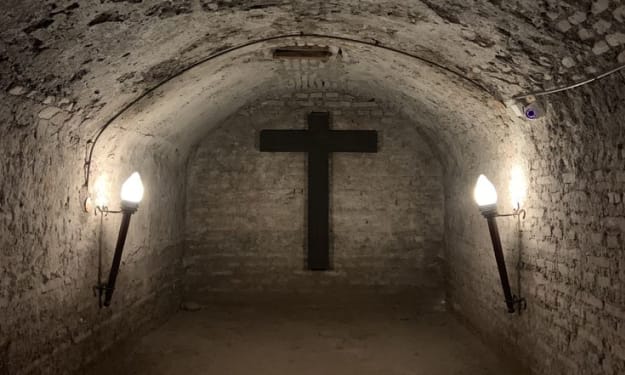
Introduction Beneath the unassuming Church of Santa Maria della Concezione dei Cappuccini in Rome lies one of the most hauntingly beautiful sites in the world—the Capuchin Crypts. This subterranean ossuary contains the skeletal remains of over 3,700 Capuchin friars, meticulously arranged into intricate patterns, chandeliers, and even full-body displays. Created between the 17th and 19th centuries, the crypts serve as both a sacred burial site and a memento mori, reminding visitors of life’s fleeting nature.
By Silas Blackwoodabout a year ago in Horror
The Tarim Mummies
Introduction Deep in the arid deserts of China’s Xinjiang region lies one of archaeology’s most fascinating mysteries—the Tarim mummies. These remarkably preserved corpses, some over 4,000 years old, exhibit striking Caucasian features—blonde hair, tall stature, and woven woolen clothing—completely unlike the region’s modern inhabitants. Discovered along the ancient Silk Road, these mummies have sparked debates about prehistoric migration, lost civilizations, and cultural exchange. Were they early Indo-European settlers? A forgotten branch of humanity? This article explores their discovery, scientific analysis, cultural significance, and enduring mysteries. 1. Discovery of the Tarim Mummies A. First Encounters (Early 20th Century) European explorers like Sven Hedin and Aurel Stein first reported mummies in the Tarim Basin in the early 1900s. Local Uyghur and Kazakh herders had long known of the preserved bodies but considered them sacred. B. Major Archaeological Finds (1970s–1990s) Chinese archaeologists began systematic excavations in the 1970s. The Beauty of Loulan (1800 BCE), a 3,800-year-old woman with delicate European features, became the most famous mummy. Other key sites: Xiaohe, Qäwrighul, and Cherchen. C. Preservation Conditions The Tarim Basin’s dry, salty soil naturally mummified the dead. Some mummies were buried in boat-shaped coffins with felt coverings. 2. Who Were the Tarim Mummies? Physical & Genetic Evidence A. Unexpected European Features Tall stature (some men over 6 feet). Light hair (blonde, red, brown). High noses, deep-set eyes (resembling early Europeans or Indo-Iranians). B. DNA Studies: A Genetic Puzzle 1990s–2000s: Initial tests suggested European (Tocharian) ancestry. 2021 Harvard Study: Revealed they were a local, isolated population with ancient North Eurasian roots, not direct migrants from Europe. Controversy: Some Chinese scholars argue they were proto-Tocharians, linked to the later Tocharian languages of the region. C. Clothing & Textiles Woolen fabrics with tartan patterns (similar to Celtic designs). Felted hats, leather boots (indicating a pastoral lifestyle). Advanced weaving techniques (suggesting trade links). 3. The Tocharian Connection: A Lost Indo-European People? A. The Tocharians of History The Tocharians were an ancient Indo-European-speaking people in the Tarim Basin (1st millennium CE). Spoke Tocharian A & B, related to Celtic, Germanic, and Latin. Their origins were unknown until the mummies were discovered. B. Were the Mummies Proto-Tocharians? Some scholars believe the mummies represent an early Indo-European migration (before Tocharian languages developed). Others argue they were indigenous people who later adopted Indo-European culture. C. Linguistic Clues Later Tocharian texts (Buddhist manuscripts) suggest a long-established presence. No written records from the mummies’ era, so their language remains unknown. 4. Cultural & Historical Significance A. Evidence of Early Silk Road Exchange The mummies show trade connections between East and West long before the formal Silk Road. Textiles, tools, and burial customs resemble those of the Afanasievo culture (Siberia) and Andronovo culture (Central Asia). B. Challenging Historical Narratives Their existence contradicts the idea that ancient Xinjiang was solely East Asian. Suggests early multicultural interactions in Central Asia. C. Political Controversies The Chinese government downplays their "Western" features, emphasizing local origins. Uyghur activists sometimes claim them as ancestors, complicating modern ethnic politics. 5. Ongoing Mysteries & Research A. Unanswered Questions Where did they come from? (Local evolution or migration?) Why did they disappear? (Assimilation, climate change, or conflict?) What was their society like? (No large cities found, possibly nomadic.) B. New Scientific Techniques Isotope analysis (to trace diet and migration). Ancient protein studies (to understand health and lifestyle). More advanced DNA sequencing (to clarify ancestry). C. Future Excavations Many sites remain unexplored due to political sensitivities in Xinjiang. New discoveries could rewrite early Eurasian history. Conclusion: A Window into a Lost World The Tarim mummies are more than just preserved bodies—they are ghosts of a forgotten past, challenging our understanding of ancient migration, trade, and cultural exchange. Whether they were early Indo-Europeans, a lost branch of humanity, or an isolated indigenous group, their legacy continues to intrigue scientists and historians. As research advances, these enigmatic figures may yet reveal more secrets about the deep connections between East and West—long before empires and Silk Road caravans shaped history. Would you like additional details on any section, such as specific mummies or political debates?
By Silas Blackwoodabout a year ago in Horror
I Am Legend
I Am Legend: Richard Matheson’s Groundbreaking Vampire Apocalypse (1954) Introduction: Few novels have reshaped horror and science fiction as profoundly as Richard Matheson’s I Am Legend (1954). From The Last Man on Earth (1964) to I Am Legend (2007), starring Will Smith, this gripping tale of the last man on Earth fighting vampire-like creatures redefined post-apocalyptic fiction and influenced generations of writers. But beyond its pop culture legacy, I Am Legend is a psychological masterpiece, exploring loneliness, survival, and what it truly means to be "monstrous." In this in-depth look, we'll investigate: I Am Legend's themes and plot
By Silas Blackwoodabout a year ago in Horror
Whispers Beneath the Moonlight
The moon was full and radiant, casting a silver glow across the quiet forest. Trees stood like ancient guardians, their shadows stretching long across the mossy floor. A gentle breeze stirred the leaves, and in the stillness of the night, every sound was sacred—the hoot of an owl, the soft trickle of a hidden stream, the rhythmic rustle of the grass beneath careful steps.
By Real Tanhaabout a year ago in Horror
Dracula by Bram Stoker (1897)
Introduction Bram Stoker's Dracula, written in 1897, is the most influential vampire novel ever written. Though not the first story about blood-drinking creatures of the night, Stoker’s Gothic masterpiece codified vampire lore, inspired countless adaptations, and turned Count Dracula into a cultural icon. But Dracula is more than just a horror story—it’s a Victorian-era thriller, a psychological drama, and a symbolic clash between modernity and ancient evil. In this in-depth look, we investigate:
By Silas Blackwoodabout a year ago in Horror