Latest Stories
Most recently published stories in Horror.
Top 5 Horror Sequels We're Still Waiting To See
When looking through the history of cinema it seems that any horror film, even a bad one, is able to spawn sequels. In terms of quality, some films have been strengthened by sequels. Look at the Phantasm series for example. Others, however, have been embarrassed by sequels, the original Halloween being an unfortunate example.
By Luke Duffyabout a year ago in Horror
The Fresno Nightcrawler
You might be familiar with cryptids like Bigfoot, the Moth man, and the Chupacabra but what about the Fresno Nightcrawler? It's one cryptid you may or may not have heard about around the campfire as you take turns telling eerie stories.
By Jasmine Aguilarabout a year ago in Horror
The Last Tenant
A Place I Could Afford I wasn't supposed to live there. Not in that part of town. Not in that building. But you know how life is—losing a job, breaking up, sleeping on couches. When you’re tired enough, you’ll live anywhere that offers a key and four walls. The building was called Bellview Heights, though there was nothing high or beautiful about it. It stood like a forgotten concrete block at the edge of the city—gray, silent, and weathered by time. The apartment manager, an older man named Mr. Heller, gave me a warm smile but cold eyes. “It’s quiet,” he said. “People like quiet, right?” I nodded. The rent was shockingly low. A one-bedroom, furnished, no deposit, no references. I didn’t question it. I should have. He handed me the keys with a grip a little too tight and said, “Apartment 6B. You’ll be the only one on that floor.” The First Night The place wasn’t bad. The furniture was basic, clean enough. The windows faced a dead tree and a rusted fence. Still, it felt like something had happened there—not visible, but present, like a smell you can’t name but know isn’t right. That night, I heard it for the first time. Scratch. Scratch. Scratch. It came from beneath the floor. Slow, deliberate. Not rats. Not pipes. Something… methodical. Like fingernails. I tried to ignore it. Pulled the blanket tighter. Told myself it was nothing. Then came the whisper. Faint. Right by my ear. “You're not the first.” The Locked Door The next day, I asked Heller about the noise. “You're on the top floor,” he said too quickly. “No one above or below. Probably just the building settling.” When I pressed him, he changed the subject. Back in 6B, I noticed something strange. A door in the hallway closet—small, metal, bolted shut. I hadn’t seen it the day before. It wasn’t a utility hatch. It was just… a door. Barely two feet high. With a single latch and something smeared near the base—looked like dried paint. Or rust. I didn’t open it. That night, the whispers came again. “Don’t trust the floor.” “They live underneath.” “They’re listening.” Neighbors Who Never Blink I met a neighbor on the third day—an old woman in 4A. She wore a blue dress and stared at me without blinking. “You shouldn’t have come here,” she said. “Why?” “They don’t like new ones.” “Who?” She leaned closer. Her breath smelled like soil. “The tenants beneath.” She closed the door before I could say anything else. I checked the building directory in the lobby. There were no tenants listed on 5th or 7th. No 6th floor at all. And yet, there I was. Living in 6B. Down Below
By Silas Blackwoodabout a year ago in Horror
The Whispering Farmhouse
The Inheritance I inherited the farmhouse from an uncle I barely knew. My mother never talked about her older brother, and when she did, her face would tighten like she’d bitten into something sour. “He lived alone for a reason,” she once said. That was all. So when a dusty lawyer’s letter arrived informing me I now owned “the Lancaster Farm, Hillvale County,” I was shocked. Even more surprising was the clause: "The property must be inspected in person within one month of this notice or it will revert to the state." At the time, I was broke, recently laid off, and desperate. So I packed my car, left the city behind, and drove four hours into forgotten Pennsylvania countryside. I should have turned back the moment I saw the crows. Arrival The farmhouse stood at the edge of a forest, surrounded by fields that had long turned wild. The house itself leaned slightly, as though the ground beneath it were sighing. Every window was dark, and the roof had caved in at one corner. A rusted gate creaked when I pushed it open. As I walked toward the porch, I noticed an old wind chime hanging near the door—made of animal bones, gently clicking in the wind. That should have been the second sign. Inside, the air was thick with the scent of rot and old books. Furniture lay shrouded in white sheets. Dust floated in sunbeams like tiny spirits. I found a journal on the kitchen table. My uncle’s. “Don’t stay past sundown,” the first page read in jagged writing. “The house wakes up then.” The Whispers Begin That first day, I explored. The place was strange, but not terrifying—yet. I found odd things. Carvings in the floorboards: circles with eyes scratched into them. Strings of salt tied above every window. Mirrors covered with black cloth. The attic was padlocked shut. I left it alone. At dusk, as I was unpacking in the bedroom, I heard a whisper. Faint, but clear. “You shouldn’t be here.” I froze. The voice came from the hallway. I grabbed my flashlight, stepped out, and called, “Hello?” Nothing. I convinced myself it was the wind, or my imagination. But that night, as I lay in bed, the whispers returned. “Wake up.” “Look outside.” “He’s still there.” I bolted upright. The room was empty. But when I turned to the window, I saw a man standing at the edge of the field. Motionless. Facing the house. Watching. The Locked Door The next morning, I went outside. The man was gone, but footprints led from the field to the porch—and stopped at the front door. No return prints. I tried calling the lawyer. No signal. I decided to check the attic. It took me an hour to find the right key. The door groaned open, revealing an old room with a rocking chair, a shattered mirror, and dozens of tape recorders. One still had a tape in it. I pressed play. “They’re not voices in your head,” my uncle’s voice crackled. “They’re in the walls. They want out. They copy your thoughts. They take your face.” My skin crawled. “Don’t listen to them,” the tape ended. “Don’t believe what you see after dark.” Night Three I tried to leave that day. Packed my bags. Tried starting the car. Dead battery. I hadn’t left the headlights on. The battery had been ripped out. As the sun dipped behind the forest, the house began to whisper again. But this time, the whispers were my voice. “I deserve this.” “Let them in.” “He’s behind you.” I screamed and turned—no one was there. But in the hallway mirror, I saw my reflection smiling. And I wasn’t. I covered every mirror. Locked every door. Sat in the middle of the living room holding the flashlight like a weapon. Around midnight, I heard something heavy dragging across the attic floor. Something breathing just above me. The Face in the Field The next morning, I walked out to the field. Something pulled me there, like a thread around my spine. That’s when I saw it: a hole in the earth. Perfectly round. As if something had dug its way up. Around the hole were faces carved into the dirt. Dozens of them. All screaming. One looked like my uncle. Another—like me. I stumbled back and ran inside. I locked the door. And then someone knocked from the other side. Three times. Possession That night, I found another tape recorder on my pillow. It played by itself. “You can’t leave. You’ve been marked.” The whispers came louder, more confident. And then I saw myself—standing in the hallway, grinning, head tilted unnaturally sideways. My double spoke: “It’s your turn now.” I slammed the door and barricaded it. At 3:33 AM, the wind chime stopped ringing. That’s when the walls started bleeding. The symbols carved into the floor began to glow. Whispers turned to screams. Escape At dawn, something changed. The house went silent. I took my chance. I ran. Through the woods. No road. No phone. Just trees. For what felt like hours. Eventually, I reached a gas station. Collapsed on the floor. The clerk called the police. They drove me back. But the house? Gone. Just grass. And a wind chime, swinging from a dead tree. Now It’s been six months. I’m back in the city. Seeing a therapist. Trying to convince myself I imagined it all. But sometimes, when the room is quiet… I hear whispers. And at night, in the mirror… My reflection sometimes blinks before I do. The Whispering Farmhouse Some houses aren't haunted by spirits... they're alive.
By Silas Blackwoodabout a year ago in Horror
The Second Corona. Content Warning. AI-Generated.
Everyone believed that the first wave had ended years ago. Humanity had adjusted by 2031. Masks have evolved into fashion accessories, social distance has become social etiquette, and vaccines have been upgraded to the level of smartphone apps. Although never the same again, life could be lived. That was before The Second Corona—something else, not a virus. In a remote Indian village where the sun never seemed to rise correctly, it began quietly. Locals claimed the sky glowed with a second corona—an eerie, shimmering halo of light that hovered just behind the sun. At first, scientists called it an atmospheric anomaly. Then people started vanishing.
By Mr Asrafulabout a year ago in Horror
"The Clockmaker's Secret: A Small Town's Curse That Ticks in the Dark"
They say the dead don’t tell time. In the town of Millhaven, that’s not true. No one visits the old quarter of Millhaven anymore. The houses lean as though whispering secrets to one another, their eyes dark with broken glass. But at the heart of the decay stands a curious shop—"Wickers & Time: Precision Clocks Since 1841." No one’s entered it for 35 years, yet the clocks inside still tick.
By Hamad Haiderabout a year ago in Horror
The Coffin That Spoke
1. The Shortcut It was just a shortcut. That’s what I told myself as I pushed open the rusted gate of the old cemetery that separated two neighborhoods in our town. I had taken the path a dozen times before, during the day. But that night was different. The wind was colder, the silence deeper. My phone’s battery had died, and I was already running late. So I stepped in. Gravel crunched beneath my shoes as I walked quickly between rows of crooked headstones. The moonlight was thin, slipping between clouds like a guilty secret. Somewhere behind me, a dog howled. I kept my head down. Then I heard it. A soft thump. I froze. --- 2. A Whisper in the Wind At first, I thought it was a trick of the wind, or maybe an animal. But then it came again. Closer. Louder. Thump. Thump. It was coming from one of the newer graves. A large, dark coffin lay half-buried in loose soil, its lid slightly ajar. That was odd. All coffins are buried deep, sealed shut. But this one looked like it had been tossed in carelessly. I took a cautious step forward, my breath sharp in my throat. And then — a voice. “Help me…” I stumbled back, nearly falling over a headstone. My mind raced. Was someone trapped in there? Was this some sick prank? “Please… it’s cold…” It was a woman’s voice. Weak, but desperate. I crept closer, my heart pounding. “Who’s in there?” I whispered. No answer. I moved to the side of the coffin and hesitated before reaching for the lid. It was heavier than I expected, cold to the touch. I pushed it up slowly, unsure of what I’d find. It was empty. --- 3. Echoes of the Dead I stood frozen, staring into the black void of the coffin. Nothing. No one. Just silence. Then the voice came again. “I’m not in the coffin anymore…” It came from behind me. I spun around — nothing. “Look behind the tree,” it whispered. I stared at the large, twisted tree just a few feet away. I couldn’t move. Every instinct told me to run. But something stronger held me there. A figure stepped out. She was barefoot. Pale. Wearing a faded white dress. Her eyes were hollow, as if drained of life — and yet, she looked right at me. “I was buried alive,” she said. Her voice was calm now, almost serene. “They thought I was dead. I screamed, but no one heard me. Until you…” My mouth opened, but no words came. “I don't want revenge,” she added. “I just needed someone to know.” She raised her hand and placed it over her heart. Her fingers disappeared into her chest like smoke. “I’m leaving now.” And then she vanished. --- 4. The Morning After I don’t remember running home. I don’t remember unlocking the door or collapsing on the floor. All I remember is waking up the next morning with my clothes still dusty, my shoes still wet with cemetery soil. No one believed me, of course. Not my parents. Not my friends. But something told me to go back. That afternoon, I returned to the cemetery. The coffin was gone. In its place was a fresh mound of earth. A new headstone had been added: Amara Bint Hussain 1995–2024 Beloved daughter, lost too soon. I knelt beside the grave. There were no flowers, no candles. Just silence. I whispered, “I know now.” --- 5. One Last Sign As I stood to leave, I noticed something carved into the base of the headstone — not engraved by a machine, but scratched in by hand. It read: “Thank you for listening.” That was the moment I understood: some souls can’t rest until their story is heard. Until someone knows. Until the silence is broken. Since that night, I’ve taken the long road home. I never cut through the cemetery again. But I listen more. To silence. To shadows. Because sometimes, the dead aren’t gone. They’re just waiting.
By Noman Afridiabout a year ago in Horror
The Anonymous Confession
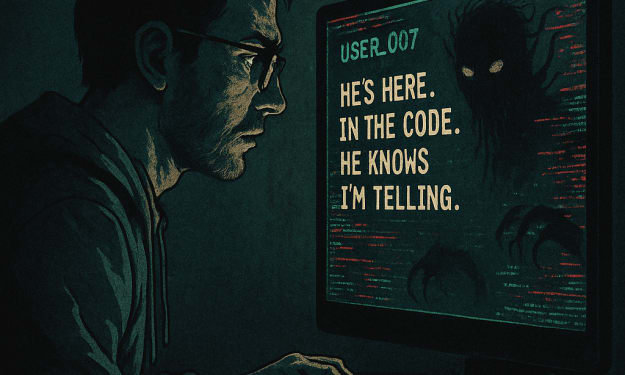
Leo was a digital janitor. Not glamorous, but essential. He worked for "Echo Chamber," a global anonymous confession platform, sifting through the torrent of human secrets, fears, and dark desires. Most posts were fleeting whispers: a cheated spouse, a forgotten dream, a trivial lie. But every few months, a particular sequence of posts would appear, chillingly consistent, yet utterly untraceable. They were from "User_007," and their confessions were unlike anything else. They started subtly, five years ago. "I saw something. Something beneath the city. Not human." Then, months later, "They know I saw. They're watching." Over the years, the confessions grew more detailed, more frantic. "The whispers in the vents. The cold touch. The feeling of being hollowed out." They spoke of a hidden, subterranean complex, of impossible experiments, of an "entity" that fed on human consciousness, leaving behind empty shells. What fascinated and terrified Leo was not just the content, but the digital breadcrumbs User_007 left. Embedded in seemingly innocuous image files attached to the posts were hidden steganographic codes. In the audio files, Elias had found faint, almost subliminal sound frequencies that replicated the "whispers" User_007 described. And the timestamps of these posts, while random, formed a bizarre, almost rhythmic pattern when plotted on a digital timeline. This wasn't random paranoia; this was a desperate message, encoded and spread across years. Leo, a former ethical hacker with an insatiable curiosity, found himself obsessed. He used his off-hours, pouring over User_007’s digital trail. The pattern of the timestamps led him to specific, long-abandoned government and corporate servers – data graveyards where information was supposed to die. He suspected User_007 wasn't just posting; they were trying to leak information about a hidden, monstrous secret. His first breakthrough came with an old image file attached to a confession from three years ago: "They're building something. Underneath everything." The steganographic code within it revealed a set of coordinates. Not for a location, but for a segment of dark web activity, long dormant. Leo delved in, navigating through layers of encrypted proxies. What he found chilled him to the bone. Not a conspiracy forum, but a heavily encrypted, meticulously organized database of missing persons reports, cross-referenced with energy consumption spikes and strange seismic anomalies in specific, densely populated urban areas – the very areas User_007 had hinted at. The missing persons weren't just vanished; they were "deactivated," as the chilling terminology in the database put it. Each "deactivated" person was linked to a brief, corrupted audio file, a fragmented scream, and a single, recurring symbol. The symbol matched the one User_007 had mentioned in their earliest posts. It was the mark of the "Conduit," the entity they described. This wasn't a human experiment. It was something else. Something ancient, something feeding on consciousness, and it was operating through some kind of network beneath the cities, an unseen drain on humanity. As Leo pieced together the puzzle, the nature of User_007’s predicament became terrifyingly clear. User_007 wasn't just a witness; they were a victim, slowly being consumed, their consciousness fragmented and spread across the digital ether of Echo Chamber, desperately trying to send out a final warning before they were fully "deactivated." The platform, designed for anonymous confessions, had become their last, unwitting lifeline, their digital tombstone. Then, a new confession appeared from User_007. It was shorter, more fractured than usual. "He's here. In the code. He knows I'm telling." A cold dread seeped into Leo's bones. "He"? The Conduit was not just a process; it was sentient. And it was now aware of Leo's investigation. He felt a subtle shift in his own connection, a brief flicker in his internet connection, a warmth on his screen that wasn't from his monitor. It was probing, looking for him, trying to find the source of the resistance. His own anonymity on Echo Chamber, his digital shield, felt thin, porous. He had to act. He couldn't just expose this; it was too bizarre, too unbelievable. He had to stop the Conduit. User_007's fragmented messages hinted at a weakness: the Conduit could be starved, cut off from its "feed" if its digital anchors were severed. It wasn't about destroying the entity, which was likely impossible, but about containing its influence. Working frantically, Leo devised a counter-protocol. He would use Echo Chamber itself, its vast, distributed network, as a weapon. He would flood the platform with a specific null-frequency signal, embedded in seemingly random posts, designed to disrupt the Conduit's connection points, its digital tendrils feeding on human consciousness. It would be a digital exorcism. The night he initiated the protocol, the server rooms of Echo Chamber hummed ominously. Leo sat before his screen, his heart pounding. The latest confession from User_007 flickered on his screen, even more distorted: "It's coming... for me... and for you. The feed... it stops." Then, Leo unleashed the null-frequency. The Echo Chamber platform erupted in a silent, digital scream. Users reported bizarre glitches: their confessions vanishing, replaced by incomprehensible symbols, their profile pictures morphing into distorted, screaming faces. The screen before Leo showed a chaotic maelstrom of code, a digital storm raging. He saw fragmented images of the Conduit, tendrils of darkness thrashing against the null-frequency, trying to break through, trying to reach him. The feeling of being watched intensified, a cold touch on his shoulder, though he was alone in the room. "You can't stop it!" a chilling, composite voice roared in his mind, echoing through his skull. "It is everywhere! It is eternal!" But Leo held firm, his fingers flying across the keyboard, maintaining the null-frequency's integrity. The struggle felt primal, a clash of wills between man and an unseen, digital horror. Finally, with a surge of energy that made his computer hum dangerously, the chaos subsided. The glitches on Echo Chamber vanished. The platform returned to normal, its usual stream of mundane confessions flowing. The cold presence in the room lifted. He checked for User_007. Their profile was gone. Every single post, every encrypted breadcrumb, had vanished. Not deleted, but completely purged, leaving no trace. They were finally at peace, or perhaps, fully consumed and absorbed, their struggle now over. Leo never spoke of what he had done. How could he? Who would believe a story of a consciousness-eating entity hiding in the digital veins of the internet? The "Echo Chamber Glitch" was logged as an inexplicable, one-time server anomaly. He continued his work, but with a new vigilance. He knew the Conduit wasn't truly gone; it was merely dormant, its network severed, but perhaps not destroyed. It was a digital predator, waiting for another opportunity, another platform, another unwitting user to open a door. And Leo, the digital janitor, now bore the silent, terrifying knowledge of the true cost of anonymous confession. He had become a guardian, forever listening to the faint, lingering echoes in the data stream, forever aware that some secrets were better left untold, for they could attract a hunger that fed on the very essence of human thought. The internet, he knew, held more than just information; it held entities, waiting in the vast, dark, digital abyss, always seeking a connection, always seeking a new, unsuspecting anonymous confession.
By Noman Afridiabout a year ago in Horror
Whispers from the Wreckage: The Unheard Voices of a Fallen Flight
The sky was calm that morning over central India — the kind of calm that often precedes a storm not in the clouds, but in the hearts of those who survive. In the early hours of dawn, an aircraft carrying passengers from various walks of life took to the skies, unaware that it was embarking on a journey that would never reach its destination. It began like every other flight: boarding calls, hurried goodbyes, tired eyes, coffee cups clutched tight. For some passengers, it was just another business trip. For others, it was the start of a long-awaited family reunion, or perhaps a hopeful migration toward a new beginning. The cabin buzzed with the quiet hum of life — laughter, yawns, prayers whispered under breath. And then... silence. Somewhere between takeoff and landing, tragedy struck. Initial reports mentioned a sudden loss of altitude, a technical failure, and a desperate attempt by the pilots to stabilize the aircraft. The plane spiraled downward, vanishing from radar screens, and within minutes, it crashed into a remote field far from any eyes that could witness it. The wreckage told its own story — twisted metal, scattered belongings, half-burnt passports, and a child’s toy resting eerily untouched. News channels flashed headlines: “Plane Crash in India — Dozens Feared Dead.” But behind every number was a life, a dream, a journey abruptly ended. There was Arjun, a 27-year-old medical student returning from a conference, whose parents had just finished preparing his room for his arrival. Meera, a mother of two, traveling alone to attend her sister’s wedding — a ceremony that would now begin with silence and tears. And little Aarav, just 5 years old, flying for the first time, who kept asking if the clouds could be touched through the window. We often read headlines, mourn briefly, and move on. But the real stories lie in the seconds before the impact — in the cries, in the prayers, in the messages never sent. One passenger had typed, “We’re losing altitude. I love you,” but the message never got delivered. Another had held hands with a stranger, silently acknowledging that in their final moments, fear could be softened by human connection. The rescue teams arrived, sifting through debris, recovering what was left. For days, the site echoed with sirens, sobs, and the painful silence that follows confirmed names on a casualty list. Families gathered at hospitals, clinging to hope, only to be met with unclaimed bodies, unrecognizable remains. In the aftermath, questions arise: Could it have been prevented? Were there signs missed? Fingers are pointed, investigations begin, and technical terms flood the media. But for those who lost someone, no explanation is enough. No black box recording can fill the void left behind by a mother, a son, a friend. And yet, within the sorrow, something else arises — a collective grief that unites strangers. Candlelight vigils are held across cities. Letters are written. Strangers embrace at memorials. Lives that never knew each other in life are now connected in death. One journalist described it best: “This wasn’t just a plane crash; it was a reminder that every moment we are given is fragile, and that the people we love could vanish in the blink of an eye.” The government promised compensation. Airlines offered apologies. Safety protocols were reviewed. But for some, like the grandmother who still sets an extra plate at dinner, or the father who scrolls through old voice messages just to hear his daughter say “Goodnight,” closure will never arrive. We must remember these lives not as statistics, but as stories. Every seat on that flight carried a novel — a collection of dreams, regrets, laughter, and love. And when the plane fell, it was not just metal that broke apart; it was futures, promises, and countless "what-ifs." Today, the crash site is cordoned off — a patch of scorched earth surrounded by silence. But for those who listen closely, they say you can still hear echoes: a lullaby sung softly, a farewell unspoken, a hope that soared too high and fell too soon. Let this be more than a news story. Let it be a wake-up call to love more loudly, to live more fully, and to never leave words of love unsaid. Because sometimes, the sky doesn’t return those we send into it. Sometimes, it keeps their whispers — forever.
By Noman Afridiabout a year ago in Horror