
Year 1928: Fun Facts, Trivia, and History
This quick read presents a mix of fun facts, trivia, and history events from the year 1928.
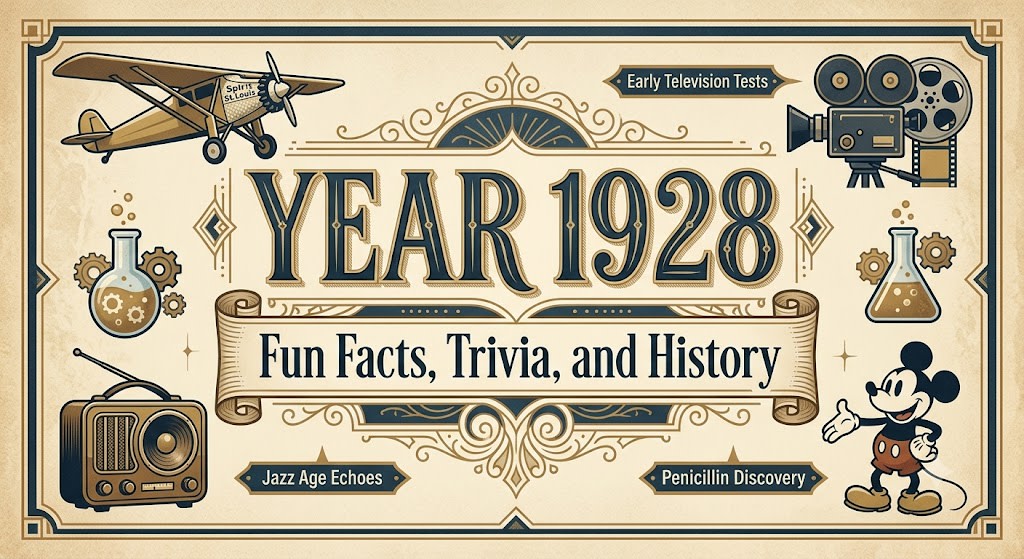
This quick read presents a mix of fun facts, trivia, and history events from the year 1928. Discover the year’s top news stories, most influential people, sports facts, retail prices, entertainment trivia, and much more.
Take a journey through history in just minutes.
President of the United States: Calvin Coolidge (R-Massachusetts)
Vice President: Charles G. Dawes (R-Illinois)
Chief Justice of the Supreme Court: William Howard Taft (Ohio)
Speaker of the House of Representatives: Nicholas Longworth (R-Ohio)
Senate Majority Leader: Charles Curtis (R-Kansas)
U.S. Congress: The 70th U.S. Congress was in session.
United States population: 120,509,000
The most populous states in 1928 were New York, Pennsylvania, Illinois, Ohio, and Texas. The most populated cities were New York, Chicago, Philadelphia, Detroit, and Cleveland.
Federal spending: $2.96 billion
Consumer Price Index: $17.1
Inflation rate: -1.72 percent
Unemployment rate: 4.2 percent
Average price of gold: $20.67 per troy ounce
Average cost of a home: About $6,296.00
Average monthly rent: About $15.00
Average cost of a new car: About $515.00
Average retail price for a gallon of gas: About 23 cents
Cost of a first-class stamp: Two cents
$1.00 in 1928 is equivalent in purchasing power to about $17.84 today.
In January, W2XB, known today as WRGB, became the world's first television station. It aired from Schenectady, New York, to three private homes where experimental television sets had been installed.
January 1: The first air-conditioned office building in the United States opened in San Antonio, Texas.
January 16: President Coolidge attended the opening session of the sixth Pan-American Conference in Havana and became the last sitting U.S. president to visit Cuba until President Barack Obama's historic visit in 2016.
January 16: May Ruth Snyder became the first woman to die in the electric chair. She was executed at New York's Sing Sing Prison for murdering her husband, Albert Snyder.
February 25: The Federal Radio Commission granted Charles Jenkins Laboratories, located in Washington, DC, the first television license.
March 12: Because of design flaws, the St. Francis Dam in northern Los Angeles County "catastrophically failed," killing 400 people.
On March 19, the sitcom, Amos 'N' Andy, premiered on WMAQ radio in Chicago.
March 25: American aviator Charles Lindbergh received the Medal of Honor for his transatlantic flight from New York City to Paris in 1927.
On April 9, actress Mae West made her stage debut in the play Diamond Lil.
April 14: Maddus Airlines began regularly scheduled passenger flights between San Francisco and Los Angeles.
April 25: The iconic Alioto's Restaurant opened on Fisherman's Wharf in San Francisco.
April 16: Clarence DeMar won the 32nd Boston Marathon.
May 7: In the UK, the Equal Fairness Act "granted equal voting rights to women and men. As a result, both men and women could vote at the age of 21."
On May 7, Thornton Wilder, an American playwright and novelist, received the Pulitzer Prize for his novel, The Bridge of San Luis Rey.
May 10: Television programming began in Schenectady, New York, through General Electric's television station, W2XB. (Today, W2XB is known as WRGB.)
May 19: At 4:07 PM, a methane gas and dust explosion ripped through the Mather Mine in western Pennsylvania, killing 195 of the 279 coal miners who were working underground. The Mather Mining disaster was the seventh deadliest mining accident in U.S. history and the second deadliest in Pennsylvania.
May 19: Reigh Count was the winning horse in the 54th Kentucky Derby.
May 30: Louis Meyer won the 16th Indianapolis 500.
June 14: At the Republican National Convention in Kansas City, Herbert Hoover was nominated for president of the United States.
June 17: American aviator Amelia Earhart became the first woman to fly across the Atlantic as a passenger. Her flight originated from the Canadian province of Newfoundland and ended one day later in Burry Point, Wales.
June 17 to July 15: Nicholas Frantz won the 22nd Tour de France.
June 29: At the Democratic National Convention in Houston, New York Governor Alfred E. Smith became the first Roman Catholic "to be nominated by a major political party for U.S. president." He accepted the nomination on August 22.
July 6: A powerful thunderstorm in Potter, Nebraska, produced many giant hailstones, one of which was the size of a grapefruit.
September 1: Richard E. Byrd, an American naval officer and polar explorer, left New York for the Arctic.
On September 11, the world's first television drama, The Queen's Messenger, premiered on W2XB TV in Schenectady, New York. (W2XB is now known as WRGB and is also a CBS affiliate.)
September 16: The Okeechobee Hurricane killed over 4,000 people and was the fourth deadliest hurricane in U.S. history. It ravaged every state from Maine to Florida, as well as the Bahamas, Cape Verde, Eastern Canada, Guadalupe, the Leeward Islands, the Lesser Antilles, Montserrat, Martinique, Puerto Rico, the Virgin Islands, and West Africa. In the United States, the Florida towns of Delray, Jupiter, Lake Worth, Palm Beach, Pompano, and West Palm Beach were the hardest hit by the catastrophic cyclone.
September 17: Actress Katharine Hepburn made her stage debut in the play, Night Hostess.
October 4 to October 9: The New York Yankees won the 25th World Series by defeating the St. Louis Cardinals, 4 games to 0.
October 20: Wien Alaska Airways, Inc. became the first airline in Alaska and one of the first in North America.
November 6: In the 1928 presidential election, Republican candidate Herbert Hoover defeated the Democratic nominee, New York Governor Alfred E. Smith. Hoover received 444 electoral votes and carried 40 states. On the other hand, Smith received 87 electoral votes and carried eight states.
On November 17, Notre Dame lost its first home football game in 23 years. The "Fighting Irish" were defeated by Carnegie Tech of Pittsburgh, 27-7.
On November 18, Walt Disney's Steamboat Willie became the first Mickey Mouse sound cartoon.
On December 13, George Gershwin's "jazz-influenced orchestral piece," An American in Paris, was first performed at Carnegie Hall in New York City.
On December 13, the clip-on tie was created in Iowa by an unknown inventor.
On December 20, the Ethel Barrymore Theatre opened at 243 West 47th Street in New York City.
December 21: The Boulder Canyon Project Act paved the way for the construction of the Hoover Dam on the Colorado River.
On December 24, the George Abbott Theater opened in NYC at 152 West 54th Street.
On December 31, Guy Lombardo and His Royal Canadians played the New Year's Eve song, Auld Lang Syne, for the first time.
The Roaring Twenties (1920-29), with its "economic prosperity and carefree living for many," would soon come to a "crashing" end. Throughout his presidency, Calvin Coolidge "demonstrated his determination to preserve the old moral and economic precepts of frugality amid the material prosperity that many Americans were enjoying during the 1920s era."
Back in 1928, what did people do for fun? Well, there were baseball cards, jigsaw puzzles, and roller skating. There were poker games, ping-pong, and pedal cars. Baseball was the national pastime, and many Americans went to baseball games, followed baseball, and played baseball. People also listened to music, read books, danced the Charleston, went to the movies, and took a regular "Sunday drive" in their Model A or Model T Ford.
Popular baby names in 1928 were Robert, John, James, William, Charles, Mary, Dorothy, Betty, Helen, and Margaret.
The average lifespan for men born in 1928 was 55.6 years. For women, it was 58.3 years.
Time magazine's “Man of the Year” was Walter Chrysler, who founded the Chrysler Corporation.
The Future Farmers of America (FFA) was established at Virginia Tech in Blacksburg, Virginia. According to FFA History, "the Future Farmers of America brought together students, teachers, and agribusiness to solidify support for agricultural education."
Ellsworth Milson Statler, the founder of Statler Hotels, passed away. His Statler Hotel in Buffalo, New York, was the first hotel in the United States to have running water and private baths in each guest room.
In 1928, American Home magazine (1928-77), Mechanix Illustrated magazine (1928-2001), and My Weekly Reader (1928-2012) all began publishing.
Did you know that babies have been eating Gerber baby foods since 1928?
The first sliced bread was baked and sold in Chillicothe, Missouri. (Just so you know, Otto Rohwedder of Davenport, Iowa, invented sliced bread.)
Bosco chocolate syrup appeared on grocery store shelves for the first time.
Brylcreem, a British brand of hair styling products, was founded in Birmingham, England. The company's first product was a hair cream for men.
The Chrysler Corporation launched the Plymouth car brand to compete with the "low-priced" auto market that was dominated at the time by Chevrolet and Ford. The Plymouth was a "high-volume seller" for Chrysler until the late 1990s and was discontinued on June 29, 2001.
The chaise lounge, Grand Confort armchair, and recliner were also invented in 1928.
The Hoberg Paper Company, based in Green Bay, Wisconsin, created the Charmin (bath tissue) name.
Ettore Boiardi, an Italian immigrant, launched the Chef Boyardee brand of canned pasta products. For years, Chef Boyardee was a major importer of Parmesan cheese from Italy.
Walter Diemer of Philadelphia invented Dubble Bubble bubble gum—a fruit-flavored and pink-colored bubble gum.
Kellogg's released their ready-to-eat Rice Krispies breakfast cereal to the public.
Le Corbusier, a classic French furniture line, was founded in Paris.
The F. Hoffman & Co.—located in Chicago—launched Milk Duds chocolate-coated caramel candies.
Harry Burnett Reese, an American inventor and businessman who founded the H. B. Reese Candy Company, created Reese's Peanut Butter Cups.
Natale Olivieri of Garfield, New Jersey, invented Yoo-hoo, a chocolate-flavored drink.
Daily newspaper: Two cents
Hudson car (Roadster, Super Six): $1,295.00
Men's union suit: 87 cents apiece
Radio (Majestic brand): $85.00 to $163.00
Refrigerator (Frigidaire): $210.00 to $270.00
In 1828 as well, the words “butter lettuce,” “codependent,” “concertgoer,” “cupcake,” “eggbeater,” “fashion plate,” “forty winks,” “homeopathic medicine,” “municipal court,” “passbook,” “road racing,” “runway,” “splurge,” “stampede,” and “trade union” all appeared in print for the first time.
References:
https://www.foodreference.com/html/html/food-timeline-1825.html
https://babel.hathitrust.org/cgi/pt?id=mdp.39015035798035&seq=21
Disclaimer: In writing and editing this article, Gregory DeVictor has made every effort to ensure historical accuracy and not to mislead his audience. In addition, the contents of this article, including text, graphics, and captions, are for general informational purposes only.
© 2026 Gregory DeVictor
About the Creator
Gregory DeVictor
Gregory DeVictor is a trivia enthusiast who likes to write articles about American history and nostalgia. Each of his articles presents a mix of fun facts, trivia, and historic events about a specific calendar year, decade, or century.
Enjoyed the story? Support the Creator.
Subscribe for free to receive all their stories in your feed.
Comments