
Year 1910: Fun Facts, Trivia, and History
This quick read presents a mix of fun facts, trivia, and history events from the year 1910.
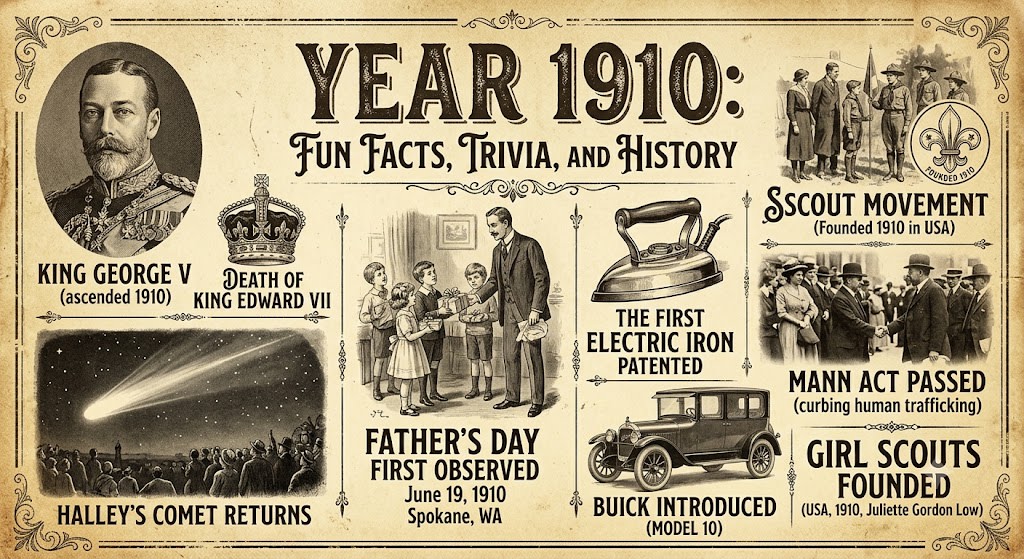
This quick read presents a mix of fun facts, trivia, and history events from the year 1910. Discover the year’s top news stories, most influential people, sports facts, retail prices, entertainment trivia, and much more.
Take a journey through history in just minutes.
President of the United States: William Howard Taft (R-Ohio)
Vice President: James S. Sherman (R-New York)
Chief Justice of the Supreme Court: Melville Fuller (Illinois) was the chief justice until July 4, 1910. On December 19, 1910, Edward Douglass White (Louisiana) became the chief justice of the U.S. Supreme Court.
Speaker of the House of Representatives: Joseph Gurney Cannon (R-Illinois)
The 61st U.S. Congress was in session.
United States population: 92,407,000
Federal spending: $0.69 billion
Inflation rate: 4.40%
Unemployment rate: 5.9%
Average price of gold: $20.67
Average retail price for a gallon of gas: 12 cents
Cost of a first-class postage stamp: Two cents
The average wage in the United States was 22 cents an hour, and the average U.S. worker earned $200-$400 annually.
On the other hand, a skilled accountant could earn as much as $2,000 per year, an established dentist could earn as much as $2,500 annually, and an experienced mechanical engineer could earn as much as $5,000 per year.
During 1910-11, there was a minor economic depression in the United States known as the Panic of 1910-11. The downturn "followed the enforcement of the Sherman Antitrust Act," which "banned businesses from colluding or merging to form a monopoly."
January 2: The first middle school in America opened in Berkeley, California.
January 10: Joyce Hall founded Hallmark Cards in Kansas City, Missouri.
January 10: The Lunt-Fontanne Theatre opened at 205 West 46th Street in New York City.
January 16: David McCampbell, a U.S. Navy captain, fighter pilot, and Medal of Honor recipient, was born in Bessemer, Alabama.
January 17: Edith Green, a member of the U.S. House of Representatives from 1955 to 1974, was born in Trent, South Dakota.
January 30: Granville Woods, an African American inventor who held more than 50 parents, passed away in New York City.
February 1910: After a 75-year absence, Halley's Comet was streaking toward Earth. French astronomer Camille Flammarion predicted that cyanogen gas from the comet's tail would "snuff out" all life on planet Earth. Widespread public anxiety about the "end of the world" persisted for months. For example, some people believed that the comet caused the death of Britain's King Edward VII. In France, people blamed the comet for the flooding that occurred on the Seine River. Other people looked at the comet as "an omen of a German invasion."
February 8: The Boy Scouts of America was incorporated.
February 13: William Shockley, an American physicist who invented the bipolar transistor, was born in London.
February 16-18: Ohio was crippled by a major snowstorm. The majority of the state received an estimated 10 to 20 inches of snow from the storm, but some cities got even more than that. For example, Dayton received 31 inches of snow, Columbus received 29 inches, Urbana received 25 inches, and Canton received 22 inches. Street sweepers were unable to keep up with the snow accumulation, and the USPS was forced to temporarily cancel mail deliveries.
February 27: Joan Bennett, an American actress, was born in Palisades, New Jersey.
March 1: David Niven, a British actor, was born in London.
March 9: The 17-month Westmoreland County coal strike of 1910-11 began in western Pennsylvania. At its peak, the work stoppage would involve 15,000 coal miners who were represented by the United Mine Workers across 65 mines.
March 10: The Pittsburgh Courier, a newspaper geared toward the African American community, began publishing.
March 24: The thermometer soared to 83°F in Cleveland, which was the highest temperature ever recorded there in March.
March 26: Congress amended the Immigration Act of 1907 and prohibited "criminals, anarchists, the poor, and people carrying infectious diseases from entering the United States.”
May 1910: Halley's Comet passed "between the earth and the sun without causing any atmospheric disturbances."
May 10: Donau was the winning horse at the 36th Kentucky Derby.
May 11: Glacier National Park in Montana was created.
May 12: Dorothy Mary Crowfoot Hodgkin, a Nobel-Prize-winning English chemist, was born in Cairo, Egypt.
May 16: Congress established the U.S. Bureau of Mines.
May 22: Johnny Olson, an American radio personality and television host (The Price Is Right), was born in Windom, Minnesota.
May 31: Elizabeth Blackwell, an Anglo-American physician who was the first woman to graduate from an American medical school, passed away in the United Kingdom.
June 11: Jacques Cousteau, a French naval officer, ocean explorer, filmmaker, and author, was born. He is best known for co-inventing the aqualung, which was "the first fully automatic compressed-air underwater breathing apparatus."
June 19: The first Father's Day in the United States was observed in Spokane, Washington.
June 20: Congress authorized the New Mexico Territory and the Arizona Territory “to form state governments and apply for statehood.”
June 25: Congress passed the Publicity Act, which required members of Congress to report campaign contributions.
June 25: The U.S. Parole Commission was created, "making it possible . . . for persons convicted of a federal crime to be paroled before the end of their sentences."
June 25: Congress passed the Mann Act, which prohibited "the transportation of women across state lines for 'immoral purposes.'"
June 25: The Pickett Act became law, which gave the president the authority "to withdraw government-owned land from public use, as necessary, for government projects."
June 25: The United States Postal Savings System was established, which enabled people "to deposit up to $2,500 into an interest-bearing (2%) account at their local post office." The system continued to operate until 1985.
July 4: African American boxer Jack Johnson defeated white boxer James J. Jeffries "in a heavyweight boxing match, sparking race riots across the United States."
July 14: William Hanna, an American animator and the founder of the Hanna-Barbera studio, was born in New Mexico.
August 20-21: The Great Fire of 1910 was the largest forest fire in U.S. history. It burned about three million acres of land in "northeast Washington, northern Idaho, and western Montana," which is equivalent in size to the state of Connecticut. An estimated 86 people were killed, including 78 firefighters.
August 26: Mother Teresa, an Albanian-born Indian nun who won the Nobel Peace Prize in 1979, was born.
October 1: A bomb exploded at the Los Angeles Times building, killing 21 people. James and John Joseph McNamara were later arrested and sentenced accordingly for the crime.
October 1: Bonnie Parker, the American outlaw of "Bonnie and Clyde" fame, was born in Rowena, Texas.
October 23: The Philadelphia Athletics won their first World Series by defeating the Chicago Cubs, 4 games to 1.
November 7: The first air flight that delivered commercial freight was made between Dayton, Ohio, and Columbus, Ohio, by the Wright Brothers.
November 11: William Schreiber, an American physicist who helped to develop the first atomic bomb, was born in Oregon.
December 19: Edward Douglass White was sworn in as the 9th chief justice of the United States Supreme Court.
November 27: New York's Penn Station opened and became the world's largest railway station.
December 31: According to the U.S. tobacco industry, nine billion cigarettes were produced in America during 1910.
In 1910, Angel Island, located in San Francisco Bay, became the immigration center for Asians who were entering the United States.
Back in 1910, there were no smartphones, televisions, or GPS systems. There were no fast food restaurants, DVDs, or convenience foods. However, there were coloring books, marbles, and ping-pong. There were baseball cards, jigsaw puzzles, and roller skating. There were card games, singing games, and seesaws. There were also dance halls, amusement parks, vaudeville, and something called reading.
In 1910, "traditional family values" prevailed throughout the United States. OurEverydayLife.com explains that "most husbands and wives related to each other as members of the traditional family unit. This meant that husbands were the breadwinners and leaders of the household, usually working outside the home. Wives stayed home to attend to domestic matters, such as cleaning, cooking, and raising children. The traditional view was that wives were helpers for their husbands. This stable, predictable union was the cornerstone for the community."
In 1910, popular baby names were John, James, William, Robert, George, Mary, Helen, Margaret, Dorothy, and Ruth.
The average life expectancy for men born in 1910 was 48.4 years. For women, it was 51.8 years.
There were 107.9 males to every 100 females in the United States.
You could buy five pounds of bacon, 20 bottles of Coke, or 30 loaves of bread for $1.00.
The Eiffel Tower in Paris was still the tallest structure in the world.
The speed limit in most U.S. cities was 12 mph, and about 500,000 motor vehicles were "cruising" the streets of America. While car ownership was rapidly increasing throughout the United States, the majority of Americans still traveled by horse and carriage.
By 1910, roughly 75% of American children were attending school, and many states had "compulsory schooling laws," including Massachusetts and Illinois.
Nearly 20% of the U.S. population didn't know how to read or write, and only 14% of Americans had a high school diploma.
Less than 3% of adults in the U.S. had a bachelor's degree, and about 5.1% of young adults (18 to 20 years old) were attending college. Nearly 40% of all undergraduate students were women.
In 1910, 2,331,542 people lived on the island of Manhattan. This was at the height of European immigration to New York City.
With 416,912 residents, San Francisco was California's most populated city. About one-third of SF's population at the time was foreign born. In neighborhoods like North Beach, you would find people from countries like Canada, France, Germany, Great Britain, Greece, Ireland, Italy, Russia, and Sweden. By 1920, however, North Beach became known as San Francisco's "Little Italy." (Just so you know, Los Angeles' population did not surpass San Francisco's until 1920.)
The average American ate five pounds of cheese a year.
The electric vacuum cleaner and the electric refrigerator were both invented.
Seven million telephones were in use throughout the United States.
There were over 10,000 movie theaters across the U.S.
Consumer goods that were introduced during 1910 include binder clips, Gauloises French cigarettes, Gitanes French cigarettes, the milkshake machine, and Murphy oil soap.
American companies and brands that were launched in 1910 include Black+Decker, the Blair Corporation, FTD Florists, Hallmark Cards, Hamilton Beach Brands, Harry & David, Jantzen, Penn Racquet Sports, and Sunbeam Products.
In Paris, Georges Claude created neon lighting.
Jeanette Rankin became the first woman to be elected to the U.S. Congress, and John D. Rockefeller became America's first billionaire.
Alice Stebbins Wells was sworn in as the first female police officer in the United States. She was hired as an LAPD officer.
References:
https://blog.genealogybank.com/1910s-facts-interesting-historic-u-s-events.html
https://goldstandardsonglist.com/Pages_Sort_4b/Sort_4b_1910-1919.htm
https://www.foodreference.com/html/html/food-timeline-1906.html
https://www.alphadictionary.com/slang/?term=&beginEra=1910&endEra=1919&clean=true&submitsend=Search
https://popculturemadness.com/1910-trivia-history-and-fun-facts/
https://discover.hubpages.com/education/year-1910-fun-facts-trivia-and-history-events
Disclaimer: In writing and editing this article, Gregory DeVictor has made every effort to ensure historical accuracy and not to mislead his audience. In addition, the contents of this article, including text, graphics, and captions, are for general informational purposes only.
© 2026 Gregory DeVictor
About the Creator
Gregory DeVictor
Gregory DeVictor is a trivia enthusiast who likes to write articles about American history and nostalgia. Each of his articles presents a mix of fun facts, trivia, and historic events about a specific calendar year, decade, or century.
Enjoyed the story? Support the Creator.
Subscribe for free to receive all their stories in your feed.
Comments