
Year 1881: Fun Facts, Trivia, and History
This quick read presents a mix of fun facts, trivia, and history events from the year 1881.

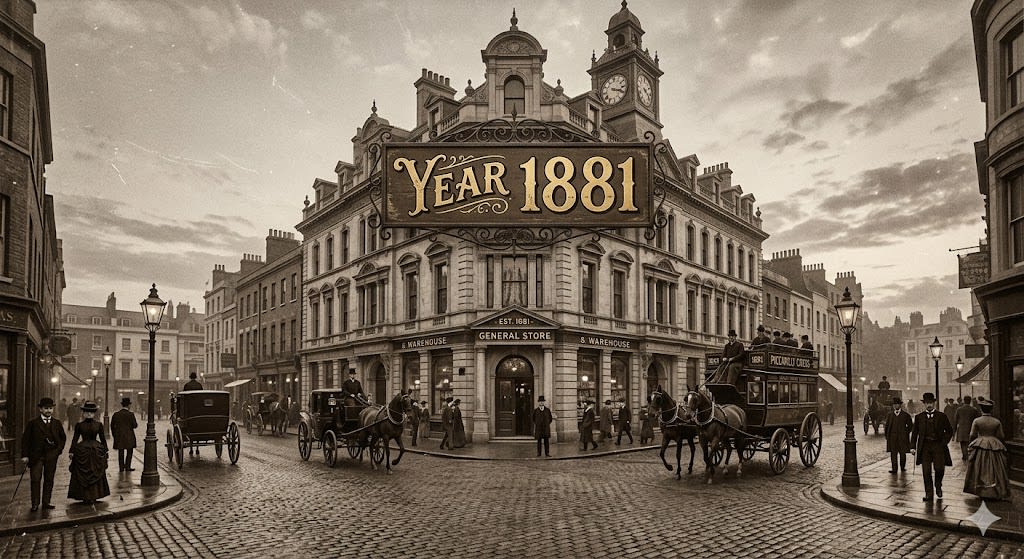
This quick read presents a mix of fun facts, trivia, and history events from the year 1881. Discover the year’s top news stories, most influential people, historic firsts, sports facts, retail prices, entertainment trivia, and much more.
Take a journey through history in just minutes.
- President of the United States: Rutherford B. Hayes (R-Ohio)—Until March 4
- President of the United States: James A. Garfield (R-Ohio)—From March 4 to September 19, when he passed away after being shot on July 2 by lawyer Charles J. Guiteau at the Baltimore and Potomac Railroad Station in Washington, DC.
- President of the United States: Chester A. Arthur (R-New York)—Beginning on September 19
- Vice President: William A. Wheeler (R-New York)—Until March 4
- Vice President: Chester A. Arthur (R-New York)—From March 4 to September 19
- Vice President: Vacant—Beginning on September 19
- Chief Justice of the Supreme Court: Morrison Waite (Ohio)
- In 1881, the 46th U.S. Congress was in session until March 4. On that date, the 47th U.S. Congress convened. The House had a Republican majority, but the Senate was evenly divided for the first time in history, “with no vice president to break ties for most of this term.”
- Unemployment rate: Between 4% and 4.6% (During the 1880s, no state or federal agencies compiled “accurate tallies” of America’s unemployment rate. Only “rough estimates” of the U.S. jobless rate were available.)
- Inflation rate: 0.00%
- $100.00 in 1881 is equivalent in purchasing power to about $3,264.90 today. The U.S. dollar had “an average inflation rate of 2.43% per year” between 1881 and 2026, “producing a cumulative price increase of 3,164.90%.” In other words, a U.S. dollar today buys about 3.063% of what it could purchase back in 1881.
- It’s worth noting that the U.S. dollar has lost 97% of its value since 1881.
- $1.00 in 1881 is equivalent in purchasing power to about $32.65 today.
- $10.00 in 1881 is equivalent in purchasing power to about $326.49 today.
- As mentioned above, $100.00 in 1881 is equivalent in purchasing power to about $3,264.90 today.
- Consumer price index (CPI): 10.200
- The cost of a first-class stamp was three cents.
- American companies and brands established in 1881 included A. Schilling & Company (a San Francisco-based food processing business); Bowater (a paper and pulp company); C. C. Lang & Son (a pickle and sauerkraut manufacturing firm); Diamond Match Company (a manufacturer of matches and toothpicks); Filene’s (a Boston-based department store chain); Hudson’s (an upscale department store chain based in Detroit); May Company California (a department store chain); and Shea Homes (a homebuilding company).
- In 1881, the average life expectancy at birth in the U.S. was around 42 to 45 years because of a high infant mortality rate. Americans who survived childhood often lived into their 50s, 60s, and even 70s.
- On April 5, Edwing Houston and Elihu Thomson received a U.S. patent for a centrifugal separator, which could be used to separate cream from milk.
- On May 1, Kansas became the first U.S. state to prohibit the manufacture and sale of all alcoholic beverages.
- On May 21, Clara Barton founded the American Red Cross in Washington, DC.
- On May 21, the United States National Lawn Tennis Association was founded at the Fifth Avenue Hotel in New York City. Representatives from 33 tennis clubs “convened to establish a unified national governing body, harmonize the diverse rules of play nationwide, and promote the sport's development.”
- On July 2, President Garfield was shot by disgruntled lawyer Charles J. Guiteau at the Baltimore and Potomac Railroad Station in Washington, DC. He died of his injuries on September 19.
- On July 8, Edward Berner, the owner of a soda fountain in Two Rivers, Wisconsin, invented the ice cream sundae. According to AuthenticWisconsin.com, Berners' customer George Hallauer “requested that Berners serve him a dish of ice cream topped with the syrup used for sodas. Berner liked the dish and added it to his regular menu, charging a nickel.”
- On July 20, five years after Lieutenant Colonel George A. Custer’s defeat at the Battle of the Little Bighorn, “Sitting Bull, leader of the Hunkpapa Teton Sioux, surrendered to the U.S. Army, which offered amnesty to him and his followers after they had fled to Canada following their uprising in 1876.”
- On August 6, Scottish bacteriologist Alexander Fleming was born. In 1928, he discovered penicillin while working at St. Mary's Hospital in London.
- On August 9, American grocer Clarence Saunders was born in Amherst County, Virginia. In 1916, he founded the Piggly Wiggly grocery store chain in Memphis, Tennessee, which was the world’s “the first true self-service grocery store.”
- On September 20, Chester Arthur was inaugurated as the U.S. president, becoming the third person to serve as president of the United States during 1881.
- On November 15, the Federation of Organized Trades and Labor Unions of the United States and Canada (FOTLU) was established at Turner Hall in Pittsburgh, Pennsylvania. On December 8, 1886, FOTLU changed its name to the American Federation of Labor (AFL).
- On December 8, a fire at the Ring Theater in Vienna, Austria, killed an estimated 620 people and injured hundreds more. The Ring was a luxurious and ornate theater that presented the most popular performances of the day.
- In 1881, Canada conducted its second census. The country’s population was 4,324,810, of which 498,715 were farmers.
- Key fiction books published in 1881 included Henry James’ The Portrait of a Lady, Thomas Hardy’s A Laodicean, and Wilkie Collins’ The Black Robe.
- A noteworthy non-fiction work published during 1881 was Jefferson Davis’ The Rise and Fall of the Confederate Government.
- Famous people born in 1881 were Alexander Fleming (biologist), Guccio Gucci (fashion designer), Harry Warner (entrepreneur), Pablo Picasso (painter), and William Boeing (entrepreneur).
- Famous people who died in 1881 included David Alter (an American inventor), Fyodor Dostoevsky (a Russian novelist), James A. Garfield (a U.S. president), James Starley (a British entrepreneur), and Lewis Morgan (an American anthropologist).
- In 1881 as well, the words “big daddy,” “blood sugar,” “Broadway,” “cliché,” “condescending,” “enzyme,” “fundraiser,” “general anesthesia,” “high-quality,” “knickers,” “live wire,” “motion sickness,” “newspaperwoman,” “pasteurize,” “pencil pusher,” “punch card,” “raggedy,” “sauna,” “symphony orchestra,” “tap water,” “tilefish,” and “walkout” all appeared in print for the first time.
- Beans: 13 cents a quart
- Brown sugar: 10 cents a pound
- Butter: 35 cents a pound
- Cheese: 18 cents a pound
- Coal: $7.84 a ton
- Corned beef: 10 cents a pound
- Cornmeal: Four cents a pound
- Cotton flannel: 16 cents a yard
- Eggs: 40 cents a dozen
- Fresh pork: 13 cents a pound
- Granulated sugar: 11 cents a pound
- Lard: 15 cents a pound
- Men’s heavy boots: $3.19 a pair
- Milk: Six cents a quart
- Mutton chops: 18 cents a pound
- New Orleans molasses: 67 cents a gallon
- Potatoes: $1.26 a bushel
- Puerto Rico molasses: 63 cents a gallon
- Rice: 10 cents a pound
- Roasted coffee: 29 cents a pound
- Roasting beef: 17 cents a pound
- Rye flour: Five cents a pound
- Salted pork: 13 cents a pound
- Smoked ham: 15 cents a pound
- Soup beef: Six cents a pound
- Starch: Nine cents a pound
- Syrup: 77 cents a gallon
- Wheat flour: $8.57 a barrel
References:
- https://en.wikipedia.org/wiki/1881_in_the_United_States
- https://www.officialdata.org/us/inflation/1881
- https://en.wikipedia.org/wiki/Category:American_companies_established_in_1881
- https://en.wikipedia.org/wiki/1881_in_literature
- https://www.famousbirthdays.com/year/1881.html
- https://www.famousbirthdays.com/deceased/1881.html
- https://www.merriam-webster.com/time-traveler/1881
- https://www.foodreference.com/html/html/food-history-1880.html
- https://www.history.com/a-year-in-history/1881
- https://www.onthisday.com/events/date/1881
Disclaimer: In writing and editing this article, Gregory DeVictor has made every effort to ensure historical accuracy and not to mislead his audience. In addition, the contents of this article, including text, graphics, and captions, are for general informational purposes only.
© 2026 Gregory DeVictor
About the Creator
Gregory DeVictor
Gregory DeVictor is a trivia enthusiast who likes to write articles about American history and nostalgia. Each of his articles presents a mix of fun facts, trivia, and historic events about a specific calendar year, decade, or century.
Enjoyed the story? Support the Creator.
Subscribe for free to receive all their stories in your feed.
Comments