
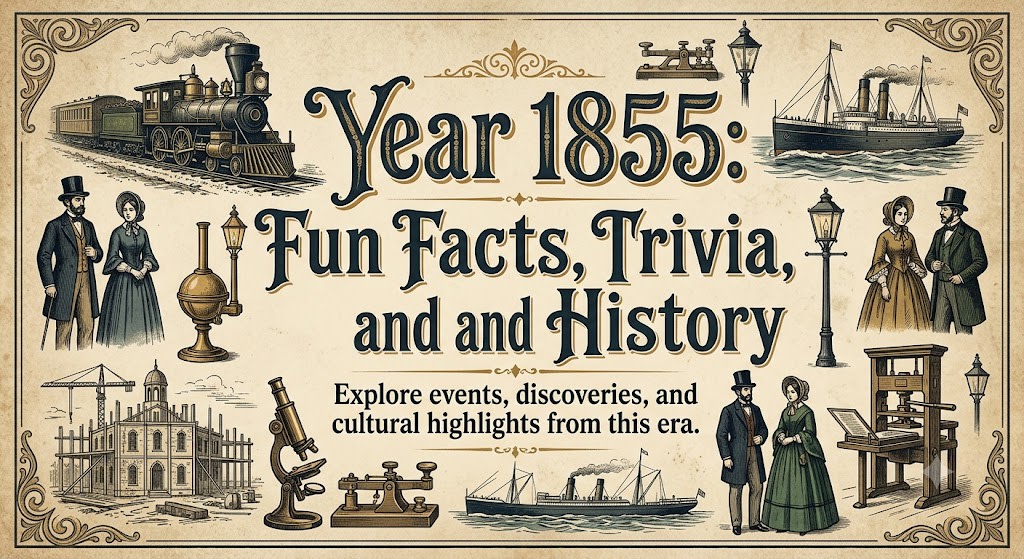
Year 1855: Fun Facts, Trivia, and History
This quick read presents a mix of fun facts, trivia, and history events from the year 1855.
This quick read presents a mix of fun facts, trivia, and history events from the year 1855. Discover the year’s top news stories, most influential people, historic firsts, sports facts, famous birthdays and deaths, retail prices, entertainment trivia, and much more.
Take a journey through history in just minutes.
President of the United States: Franklin Pierce (Democrat-Massachusetts)
Vice President: Vacant
Chief Justice of the Supreme Court: Roger B. Taney (Maryland)
Speaker of the House of Representatives: Linn Boyd (Democrat-Kentucky)
The 33rd U.S. Congress was in session until March 4, when the 34th U.S. Congress convened. The Senate “had a Democratic majority, and the House was controlled by a coalition of representatives led by Nathaniel P. Banks, a member of the American Party.”
Inflation rate: 3.57%
Consumer price index (CPI): 8.700
$100.00 in 1855 is equivalent in purchasing power to about $3,838.53 today. The U.S. dollar had “an average inflation rate of 2.16% per year” between 1855 and 2026, “producing a cumulative price increase of $3,738.53.” In other words, a U.S. dollar today buys about 2.605% of what it could purchase back in 1855.
American companies and brands founded in 1855 included The Collins Companies (a forest products company); Elmer Chocolate (a confectionary company); Hillerich & Bradsby (a manufacturer of sporting goods); the Miller Brewing Company (a Milwaukee-based brewer); the NP Dodge Company (America’s oldest real estate firm); Sears Seating (a manufacturer of harnesses, saddles, and other leather and canvas goods); and Swift & Company (a meat processing company).
American railways established in 1855 were the Atlantic, Tennessee, and Ohio Railroad, the Carolina Central Railroad, and the Chicago, Burlington, and Quincy Railroad.
In 1855, there were 31 U.S. states. In order of admission to the Union, they were Delaware (1787), Pennsylvania (1787), New Jersey (1787), Georgia (1788), Connecticut (1788), Massachusetts (1788), Maryland (1788), South Carolina (1788), New Hampshire (1788), Virginia (1788), New York (1788), North Carolina (1789), Rhode Island (1790), Vermont (1791), Kentucky (1792), Tennessee (1796), Ohio (1803), Louisiana (1837), Indiana (1816), Mississippi (1817), Illinois (1818), Alabama (1819), Maine (1820), Missouri (1821), Arkansas (1836), Michigan (1837), Florida (1845), Texas (1845), Iowa (1846), Wisconsin (1848), and California (1851). It’s worth noting that no new states joined the Union until May 11, 1858, when Minnesota became the 32nd U.S. state. Minnesota entered the Union as a free state that banned slavery.
In 1855, there were 16 free states, including California, Connecticut, Illinois, Indiana, Iowa, Maine, Massachusetts, Michigan, New Hampshire, New Jersey, New York, Ohio, Pennsylvania, Rhode Island, Vermont, and Wisconsin.
There were also 15 slave states, including Alabama, Arkansas, Delaware, Florida, Georgia, Kentucky, Louisiana, Maryland, Mississippi, Missouri, North Carolina, South Carolina, Tennessee, Texas, and Virginia.
On January 23, the Father Louis Hennepin Bridge, the first bridge to span the entire Mississippi River, opened to traffic. It connected Minneapolis to Nicollet Island and Saint Anthony in the Minnesota Territory.
On January 23, John Moses Browning, sometimes referred to as the “father of modern firearms,” was born in Ogden, Utah. History.com tells us that “Many of the guns manufactured by companies whose names evoke the history of the American West—Winchester, Colt, Remington, and Savage—were actually based on John Browning’s designs.”
On January 27, Henry Parsons Crowell, who founded the Quaker Oats Company in 1901, was born in Cleveland, Ohio.
On January 28, the first locomotive ran across the 47-mile Panama Canal Railway from the Atlantic Ocean to the Pacific Ocean and “marked the completion of the world's first interoceanic railroad.”
On February 10, U.S. citizenship laws were amended, and all children of U.S. parents born in foreign countries were granted permanent United States citizenship.
In March, Congress approved $30,000 to fund the U.S. Army Camel Corps, “a military experiment championed by Secretary of War Jefferson Davis to test camels and dromedaries as pack animals across the arid American Southwest.”
On March 3, Congress authorized registered mail as a new security option for the U.S. Post Office Department.
On March 27, Canadian geologist Abraham Gesner received a patent for kerosene.
On April 28, America’s first veterinary college was incorporated in Boston.
In June, Manhattan’s three established baseball clubs—the Knickerbockers, Gothams, and Eagles—played three matches “round robin.”
On July 4, American poet Walt Whitman published the first edition of Leaves of Grass, a collection of 12 poems, in Brooklyn, New York.
On June 5, the American Party, also known as the Know-Nothing Party, “held a pivotal national convention in Philadelphia.” During the meeting, “the nativist organization officially adopted a controversial pro-slavery platform compromise.”
On August 4, John Bartlett, an American bookseller from Cambridge, Massachusetts, published the first edition of Familiar Quotations, a 258-page list of memorable quotes from the Bible, William Shakespeare, and the great English poets. It’s also worth noting that the 19th edition of Familiar Quotations was published in 2022 and has over 1,500 pages and “more than 20,000 quotes from roughly 4,000 contributors.”
On August 6, an “infamous election-day riot” known as "Bloody Monday" erupted in Louisville, Kentucky, when “anti-immigrant and nativist ‘Know-Nothing’ mobs attacked German and Irish Catholic neighborhoods, resulting in at least 22 deaths, widespread arson, and severe property destruction.”
On August 14, the Atlantic Base Ball Club was established in Brooklyn’s Bedford neighborhood. The club was named after Atlantic Avenue, one of Brooklyn’s major thoroughfares.
On October 9, Isaac Merritt Singer received the first U.S. patent for a sewing machine motor.
On October 9, Joshua Stoddard of Worcester, Massachusetts, received a U.S. patent for the calliope, “a steam-powered musical instrument.”
In 1855, the Smithsonian Institution Building, also known as "The Castle," was completed.
Popular baby names for boys in 1855 were John, William, James, Charles, George, and Thomas. Popular baby names for girls were Mary, Anna, Emma, Elizabeth, Margaret, and Minnie.
In 1855, the United States was “overwhelmingly” Protestant, and the largest denominations included Methodists, Baptists, Presbyterians, Episcopalians, Congregationalists, and Lutherans. America’s Roman Catholic population was around one million, which comprised about 5% of the total U.S. population.
Famous people born in 1855 were Edwin Hall (an American physicist), John Browning (an American inventor), and King C. Gillette (an American entrepreneur).
Notable people who died in 1855 included Carl Friedrich Gauss (a German mathematician), Charlotte Brontë (a British novelist and poet), and Soren Kierkegaard (a Danish philosopher).
In 1855 as well, the words “backstabbing,” “beer and skittles,” “carbon paper,” “Chippendale,” “cold cuts,” “euro,” “exchange rate,” “excited,” “fire truck,” “foul ball,” “garbageman,” “gumball,” “hallway,” “heart-to-heart,” “herbalism,” “jelly roll,” “jet propulsion,” “mortality rate,” “parlor trick,” “penny ante,” “Prince Charming,” “progressivism,” “stream of consciousness,” “tartar sauce,” “time stamp,” “tongue twister,” “unbeatable,” and “world power” all appeared in print for the first time.
In 1855, aluminum was a “rare and expensive” metal and sold for roughly $545 a pound. It was “so rare and unique” that small bars of the metal “were exhibited along with the crown jewels of France at the Paris Exhibition.”
Ax: About $2.00
Bacon: Around six cents a pound
Boots: About $2.50 per pair
Bowls: Around 25 cents each
Broom: About 19 cents
Cheese: Around 15 cents a pound
Cigars: About 25 cents a dozen or $7.00 a box
Eggs: Around 10 cents a dozen
Ginger: About 24 cents a pound
Lemons: Around 12 for $1.00
Marbles: About 12.5 cents a dozen
Molasses: Around 16 cents a quart
Nails: About 10 cents a pound
Olive oil: Around 62 cents a bottle
Pepper: About 25 cents a pound
Pickles: Around 75 cents a jar
Raisins: About 25 cents a pound
Rice: Around 10 cents a pound
Shoes: About $1.25 a pair
Storage trunk: Around $5.00
Tobacco: About 56 cents a plug
Toothbrush: Around 25 cents
Wine: About $1.00 per bottle
References:
https://en.wikipedia.org/wiki/Category:American_companies_established_in_1855
https://www.foodreference.com/html/html/food-history-1855.html
https://www.nps.gov/common/uploads/teachers/lessonplans/Sutler%20Store%20prices_508.pdf
Disclaimer: In writing and editing this article, Gregory DeVictor has made every effort to ensure historical accuracy and not to mislead his audience. In addition, the contents of this article, including text, graphics, and captions, are for general informational purposes only.
© 2026 Gregory DeVictor
About the Creator
Gregory DeVictor
Gregory DeVictor is a trivia enthusiast who likes to write articles about American history and nostalgia. Each of his articles presents a mix of fun facts, trivia, and historic events about a specific calendar year, decade, or century.
Enjoyed the story? Support the Creator.
Subscribe for free to receive all their stories in your feed.
Comments