
Year 1854: Fun Facts, Trivia, and History
This quick read presents a mix of fun facts, trivia, and history events from the year 1854.
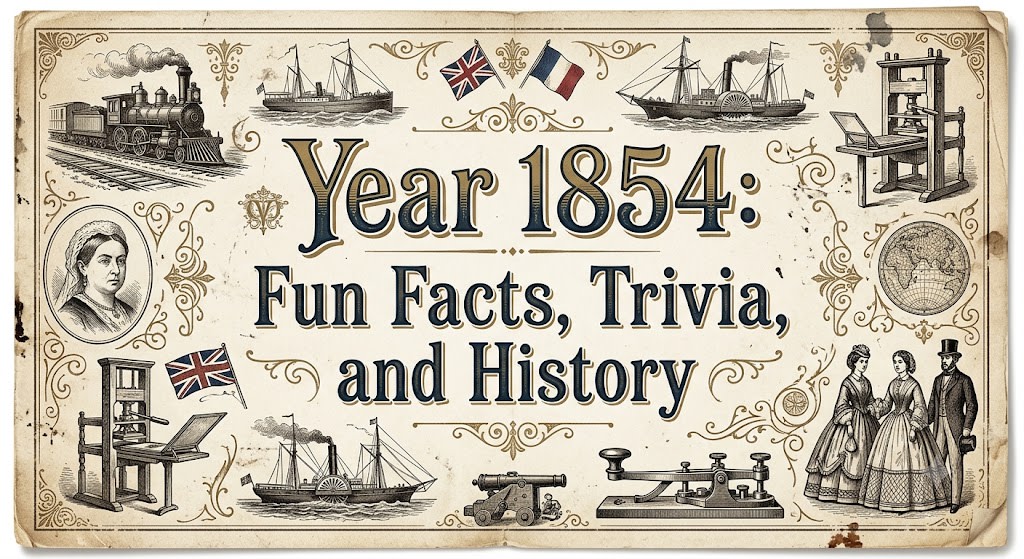
This quick read presents a mix of fun facts, trivia, and history events from the year 1854. Discover the year’s top news stories, most influential people, historic firsts, sports facts, famous birthdays and deaths, retail prices, entertainment trivia, and much more.
Take a journey through history in just minutes.
President of the United States: Franklin Pierce (Democrat-Massachusetts)
Vice President: Vacant
Chief Justice of the Supreme Court: Roger B. Taney (Maryland)
Speaker of the House of Representatives: Linn Boyd (Democrat-Kentucky)
The 33rd U.S. Congress was in session, and both chambers had a Democratic majority.
Inflation rate: 9.09%
Consumer price index (CPI): 8.400
$100.00 in 1854 is equivalent in purchasing power to about $3,975.62 today. The U.S. dollar had “an average inflation rate of 2.16% per year” between 1854 and 2026, “producing a cumulative price increase of $3,875.62.” In other words, a U.S. dollar today buys about 2.515% of what it could purchase back in 1854.
American companies founded in 1854 included the Atlantic and Pacific Telegraph Company, Bloch Publishing Company, California Steam Navigation Company, Dierbergs Markets (a supermarket chain), Ellis Coffee Company, Forrest & Maples (a slave-trading company), Hilliard Lyons (a financial services company), and Ticknor and Fields (a publishing company).
American railways established in 1854 were the Atlantic and North Carolina Railroad, the Grand Rapids and Indiana Railroad, and the Philadelphia and Baltimore Central Railroad.
In 1854, there were 31 U.S. states. In order of admission to the Union, they were Delaware (1787), Pennsylvania (1787), New Jersey (1787), Georgia (1788), Connecticut (1788), Massachusetts (1788), Maryland (1788), South Carolina (1788), New Hampshire (1788), Virginia (1788), New York (1788), North Carolina (1789), Rhode Island (1790), Vermont (1791), Kentucky (1792), Tennessee (1796), Ohio (1803), Louisiana (1837), Indiana (1816), Mississippi (1817), Illinois (1818), Alabama (1819), Maine (1820), Missouri (1821), Arkansas (1836), Michigan (1837), Florida (1845), Texas (1845), Iowa (1846), Wisconsin (1848), and California (1851).
In 1854, there were 16 free states, including California, Connecticut, Illinois, Indiana, Iowa, Maine, Massachusetts, Michigan, New Hampshire, New Jersey, New York, Ohio, Pennsylvania, Rhode Island, Vermont, and Wisconsin.
There were also 15 slave states, including Alabama, Arkansas, Delaware, Florida, Georgia, Kentucky, Louisiana, Maryland, Mississippi, Missouri, North Carolina, South Carolina, Tennessee, Texas, and Virginia.
On January 9, the Astor Library opened in New York City, which served as a “non-circulating research institution” before merging into the city’s public library system.
According to 1850 U.S. Census data, Philadelphia was America’s fourth-largest city with a population of 121,376. However, 29 municipalities that are now part of the City of Philadelphia were enumerated in 1850 as separate boroughs, districts, and townships. They included Blockley Township, Bridesburg Borough, Byberry Township, Frankford Borough, Germantown Township, the Kensington District, Kingsessing Township, Manayunk Borough, the Moyamensing District, the Northern Liberties District, Passyunk Township, the Richmond District, Roxborough Township, the Southwark District, the Spring Garden District, and West Philadelphia Borough. On February 2, the 1854 Consolidation Act was signed into law by Pennsylvania Governor William Bigler, and all 29 of these municipalities were merged into the “newly expanded” City of Philadelphia, which increased the city’s size from two square miles to approximately 130 square miles.
Here is some Philadelphia trivia: Bigler Street in South Philadelphia is named after Pennsylvania Governor William Bigler, who signed the historic 1854 Consolidation Act. Bigler was Pennsylvania’s 14th governor and served the Commonwealth from 1852 to 1855. Other east-west streets in South Philly named after Pennsylvania governors include Johnston, McKean, Mifflin, Moore, Pattison, Porter, and Ritner.
On February 11, coal gas was used for the first time to light the streets of San Francisco.
On February 14, Texas was officially linked by telegraph to the rest of the United States, when a connection between New Orleans, Louisiana, and Marshall, Texas, was completed.
On March 7, Charles Miller received a U.S. patent for a sewing machine to stitch buttonholes.
On March 11, Philadelphia celebrated the passage of the 1854 Consolidation Act, which merged the city with 29 separate boroughs, districts, and townships and increased the city’s size from two square miles to roughly 130 square miles.
On March 20, a group of anti-slavery activists met at the Little White Schoolhouse in Ripon, Wisconsin, and organized the Republican Party.
On March 20, the Boston Public Library opened to the public.
On April 1, the Knickerbocker Baseball Club, Gotham Baseball Club, and Eagle Baseball Club met at Smith's Tavern in New York City “to adopt unified rules. This conference marked the first known formal standardization of baseball rules across multiple clubs.”
In May, American industrialist Elisha Otis demonstrated his safety elevator at the New York World's Fair. (In 1852, Otis invented the groundbreaking elevator safety brake.)
On May 30, President Pierce signed the Kansas-Nebraska Act, which established the territories of Kansas and Nebraska.
On June 13, Anthony Faas of Philadelphia received a U.S. patent for an accordion that featured improvements to both the keyboard and the sound quality.
On June 14, Townend Glover became the first U.S. federal entomologist, an “expert for collecting statistics and other information on seeds, fruits, and insects of the United States.”
On June 29, English novelist Charlotte Brontë (Jane Eyre) married curate Arthur Bell Nicholls.
On July 6, the Republican Party’s first convention took place in Jackson, Michigan.
On July 8, an anti-Catholic riot in Bath, Maine, destroyed a church that served the Irish Catholic community.
On August 9, Henry David Thoreau published Walden (aka Life in the Woods), a reflection upon his “simple living in natural surroundings.”
On September 22, future American railroad executive Mark Hopkins Jr. married Mary Sherwood. (It’s worth noting that Mark Hopkins Jr. was one of the “key investors” behind civil engineer Theodore D. Judah's plan “to construct a railway across the Sierra Nevada, linking Sacramento, California, to Promontory, Utah.”)
On October 16, in his famous Peoria Speech, future U.S. President Abraham Lincoln expressed opposition “to the expansion of slavery in the United States.”
From October 9 to 11, U.S. diplomats James Buchanan, John Y. Mason, and Pierre Soulé drafted the controversial Ostend Manifesto, which “argued” that the United States should acquire Cuba from Spain by force, if necessary, as slave territory.
On December 15, America’s first street-cleaning machine went into service in Philadelphia.
In 1854, Hugh Rock of Boston, Massachusetts, received the first U.S. patent for a hairbrush.
Popular baby names for boys in 1854 were John, William, James, Charles, George, and Thomas. Popular baby names for girls were Mary, Anna, Emma, Elizabeth, Margaret, and Minnie.
In 1854, the United States was “overwhelmingly” Protestant, and the largest denominations included Methodists, Baptists, Presbyterians, Episcopalians, Congregationalists, and Lutherans. America’s Roman Catholic population was around one million, which comprised about 5% of the total U.S. population.
Famous people born in 1854 were David Dunbar Buick (entrepreneur), John Philip Sousa (composer), and Oscar Wilde (novelist).
Notable people who died in 1854 included Frederick Catherwood (architect), Georg Ohm (physicist), and Peter Skene Ogden (explorer).
In 1854 as well, the words “binge,” “blood pressure,” “board game,” “bohemianism,” “business suit,” “busload,” “cardiovascular,” “carfare,” “catfight,” “climate change,” “crankshaft,” “cream soda,” “everyplace,” “fiasco,” “flagpole,” “houseclean,” “know-nothingism,” “periodontal,” “Phi Beta Kappa,” “self-rising flour,” “short circuit,” “parlor game,” “shepherd’s pie,” “stomping ground,” “sugar cookie,” and “ultraprogressive” all appeared in print for the first time.
In 1854, aluminum was a “rare and expensive” metal and sold for roughly $545 a pound.
Ax: $2.00
Bacon: Six cents a pound
Boots: $2.50 per pair
Bowls: 25 cents each
Broom: 19 cents
Cheese: 15 cents a pound
Cigars: 25 cents a dozen or $7.00 a box
Eggs: 10 cents a dozen
Ginger: 24 cents a pound
Lemons: 12 for $1.00
Marbles: 12.5 cents a dozen
Molasses: 16 cents a quart
Nails: 10 cents a pound
Olive oil: 62 cents a bottle
Pepper: 25 cents a pound
Pickles: 75 cents a jar
Raisins: 25 cents a pound
Rice: 10 cents a pound
Shoes: $1.25 a pair
Storage trunk: $5.00
Tobacco: 56 cents a plug
Toothbrush: 25 cents
Wine: $1.00 per bottle
References:
https://en.wikipedia.org/wiki/Category:American_companies_established_in_1854
https://www.foodreference.com/html/html/food-history-1850.html
https://www.nps.gov/common/uploads/teachers/lessonplans/Sutler%20Store%20prices_508.pdf
Disclaimer: In writing and editing this article, Gregory DeVictor has made every effort to ensure historical accuracy and not to mislead his audience. In addition, the contents of this article, including text, graphics, and captions, are for general informational purposes only.
© 2026 Gregory DeVictor
About the Creator
Gregory DeVictor
Gregory DeVictor is a trivia enthusiast who likes to write articles about American history and nostalgia. Each of his articles presents a mix of fun facts, trivia, and historic events about a specific calendar year, decade, or century.
Enjoyed the story? Support the Creator.
Subscribe for free to receive all their stories in your feed.
Comments