
Year 1853: Fun Facts, Trivia, and History
This quick read presents a mix of fun facts, trivia, and history events from the year 1853.

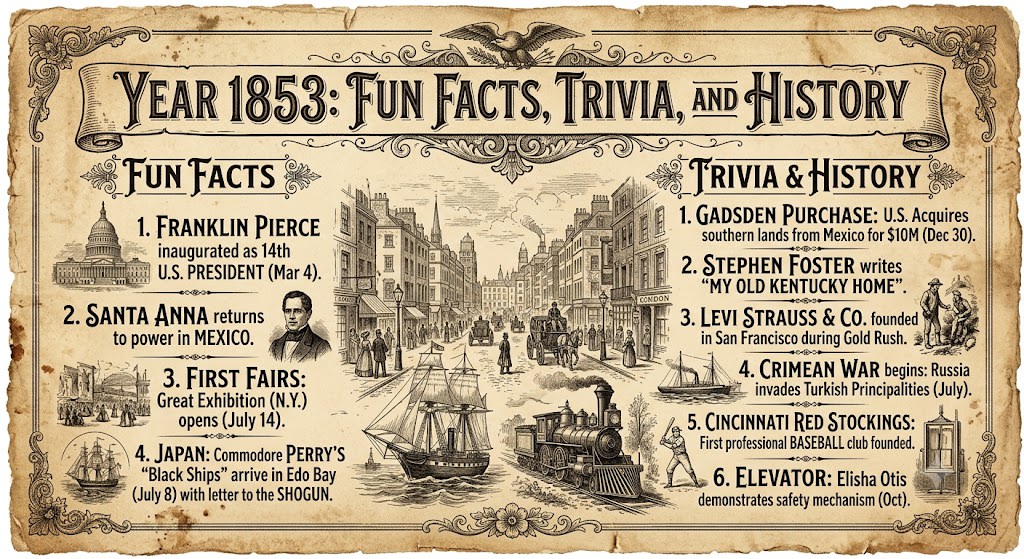
This quick read presents a mix of fun facts, trivia, and history events from the year 1853. Discover the year’s top news stories, most influential people, historic firsts, sports facts, famous birthdays and deaths, retail prices, entertainment trivia, and much more.
Take a journey through history in just minutes.
President of the United States: Millard Fillmore (Whig-New York)—Until March 4
President of the United States: Franklin Pierce (Democrat-Massachusetts)—Beginning on March 4
Vice President: Vacant—Until March 4
Vice President: William R. King (Democrat-Alabama)—From March 4 until April 18, when he died of tuberculosis in Selma, Alabama.
Vice President: Vacant—Beginning on April 18
Chief Justice of the Supreme Court: Roger B. Taney (Maryland)
Speaker of the House of Representatives: Linn Boyd (Democrat-Kentucky)
The 32nd U.S. Congress was in session until March 4, when the 33rd U.S. Congress convened. Both chambers had a Democratic majority.
Inflation rate: 0.00%
Consumer price index (CPI): 7.700
$100.00 in 1853 is equivalent in purchasing power to about $4,337.04 today. The U.S. dollar had “an average inflation rate of 2.20% per year” between 1853 and 2026, “producing a cumulative price increase of $4,237.04.” In other words, a U.S. dollar today buys about 2.306% of what it could purchase back in 1853.
American companies and brands founded in 1853 included the Aetna Life Insurance Company; the Cream City Brewing Company (a Milwaukee-based brewery); the Keebler Company (a cookie and cracker manufacturer); Levi Strauss (a San Francisco-based clothing manufacturer); Steinway & Sons (a New York City piano manufacturer); The Travelers Companies (an insurance firm); and F. Weber & Company, Inc. (a manufacturer of artists’ supplies).
American railways established in 1853 were the Atlantic and Great Western Railroad, the Ligonier Valley Railroad, and the New York Central Railroad.
In 1853, there were 31 U.S. states. In order of admission to the Union, they were Delaware (1787), Pennsylvania (1787), New Jersey (1787), Georgia (1788), Connecticut (1788), Massachusetts (1788), Maryland (1788), South Carolina (1788), New Hampshire (1788), Virginia (1788), New York (1788), North Carolina (1789), Rhode Island (1790), Vermont (1791), Kentucky (1792), Tennessee (1796), Ohio (1803), Louisiana (1837), Indiana (1816), Mississippi (1817), Illinois (1818), Alabama (1819), Maine (1820), Missouri (1821), Arkansas (1836), Michigan (1837), Florida (1845), Texas (1845), Iowa (1846), Wisconsin (1848), and California (1851).
In 1853, there were 16 free states, including California, Connecticut, Illinois, Indiana, Iowa, Maine, Massachusetts, Michigan, New Hampshire, New Jersey, New York, Ohio, Pennsylvania, Rhode Island, Vermont, and Wisconsin.
There were also 15 slave states, including Alabama, Arkansas, Delaware, Florida, Georgia, Kentucky, Louisiana, Maryland, Mississippi, Missouri, North Carolina, South Carolina, Tennessee, Texas, and Virginia.
On January 1, the first “practical” horse-drawn fire engine went into service in Cincinnati, Ohio.
On January 4, with the help of New York Governor Washington Hunt, Solomon Northup was freed from twelve years of slavery. Later in the year, Northup published his famous memoir, Twelve Years a Slave. The narrative “details the true story of Northup, a free-born African American and professional musician from New York, who was drugged and kidnapped in Washington, D.C., in 1841 and sold into slavery in Louisiana.”
On March 5, Heinrich Steinweg (later known as Henry Steinway) founded the iconic piano company Steinway & Sons in New York City.
On April 1, Cincinnati, Ohio, became the first American city to employ fulltime professional firefighters.
On May 14, American newspaper inventor Gail Borden received a U.S. patent for condensed milk.
On June 21, Dr. Russell L. Hawes, of Worcester, Massachusetts, received a U.S. patent for an envelope-folding machine.
On June 24, President Pierce signed the Gadsden Purchase, which authorized the purchase of 29,670 square miles from Mexico for $10 million. The area is now southern Arizona and southern New Mexico.
On July 6, abolitionist and former slave William Wells Brown published Clotel, widely recognized as the first novel written by an African American.
On July 14, America’s first World’s Fair, known as the Exhibition of the Industry of All Nations, opened in New York City.
On July 21, the New York State legislature created Central Park, which comprises over 750 acres of land on Manhattan Island.
On August 4, Confederate general Thomas Jackson married Elinor Junkin in Lexington, Kentucky.
In September, William Backhouse Astor Jr., grandson of the American real estate magnate John Jacob Astor, married Dutch-American heiress Caroline Webster Schermerhorn, who is known for establishing "The Four Hundred," a “meticulously curated roster of key figures in American high society.”
On September 15, Antoinette Blackwell, of South Butler, New York, became America’s first ordained minister.
On October 12, John Morrissey was crowned Heavyweight Boxing Champion of America when he defeated "Yankee" Sullivan in the Heavyweight Championship of America at Boston Corners, New York.
On October 19, Hawaii’s first flour mill began operating.
On October 25, members of the Paiute Indian Tribe “attacked the U.S. Army Captain John W. Gunnison and his party of 37 soldiers and railroad surveyors near Sevier Lake, Utah.”
In 1853, German baker Godfrey Keebler introduced his ever-popular Keebler biscuits in his Philadelphia bakeshop.
Popular baby names for boys in 1853 were John, William, James, Charles, George, and Thomas. Popular baby names for girls were Mary, Anna, Emma, Elizabeth, Margaret, and Minnie.
In 1853, the United States was “overwhelmingly” Protestant, and the largest denominations included Methodists, Baptists, Presbyterians, Episcopalians, Congregationalists, and Lutherans. America’s Roman Catholic population was around one million, which comprised about 5% of the total U.S. population.
Famous people born in 1853 were Andre Michelin (a French entrepreneur), Helen Magill White (an American educator), and Vincent van Gogh (a Dutch artist).
Notable people who died in 1853 included Abigail Fillmore (the wife of U.S. President Millard Fillmore); Christian Doppler (an Austrian physicist); Joseph Rene Bellot (a French explorer); William Beaumont (an American physiologist); and William R. King (an American vice president).
In 1853 as well, the words “baby powder,” “Big Dipper,” “boredom,” “braggadocious,” “Braille,” “brain fog,” “brass knuckles,” “condensed milk,” “cornstarch,” “crosswalk,” “davenport,” “derringer,” “forty-niner,” “Hall of Fame,” “hands down,” “linear function,” “lock out,” “lockout,” “matchbox,” “Nebraskan,” “no-nonsense,” “parenthood,” “pay dirt,” “policewoman,” “pushcart,” “reading glasses,” “social studies,” “spiffy,” “waxed paper,” “witch hunt,” and “writer’s cramp” all appeared in print for the first time.
In 1853, aluminum was a “rare and expensive” metal and sold for roughly $545 a pound.
Almonds: 37.5 cents a pound
Ax: $2.00
Bacon: Six cents a pound
Boots: $2.50 per pair
Bowls: 25 cents each
Broom: 19 cents
Cheese: 15 cents a pound
Cigars: 25 cents a dozen or $7.00 a box
Eggs: 10 cents a dozen
Ginger: 24 cents a pound
Lemons: 12 for $1.00
Marbles: 12.5 cents a dozen
Molasses: 16 cents a quart
Nails: 10 cents a pound
Olive oil: 62 cents a bottle
Pepper: 25 cents a pound
Pickles: 75 cents a jar
Raisins: 25 cents a pound
Rice: 10 cents a pound
Shoes: $1.25 a pair
Socks: 37.5 cents a pair
Storage trunk: $5.00
Table salt: 18.25 cents a box
Tobacco: 56 cents a plug
Toothbrush: 25 cents
Wine: $1.00 per bottle
References:
https://en.wikipedia.org/wiki/Category:American_companies_established_in_1853
https://www.foodreference.com/html/html/food-history-1850.html
https://www.nps.gov/common/uploads/teachers/lessonplans/Sutler%20Store%20prices_508.pdf
Disclaimer: In writing and editing this article, Gregory DeVictor has made every effort to ensure historical accuracy and not to mislead his audience. In addition, the contents of this article, including text, graphics, and captions, are for general informational purposes only.
© 2026 Gregory DeVictor
About the Creator
Gregory DeVictor
Gregory DeVictor is a trivia enthusiast who likes to write articles about American history and nostalgia. Each of his articles presents a mix of fun facts, trivia, and historic events about a specific calendar year, decade, or century.
Enjoyed the story? Support the Creator.
Subscribe for free to receive all their stories in your feed.
Comments