
Year 1852: Fun Facts, Trivia, and History
This quick read presents a mix of fun facts, trivia, and history events from the year 1852.
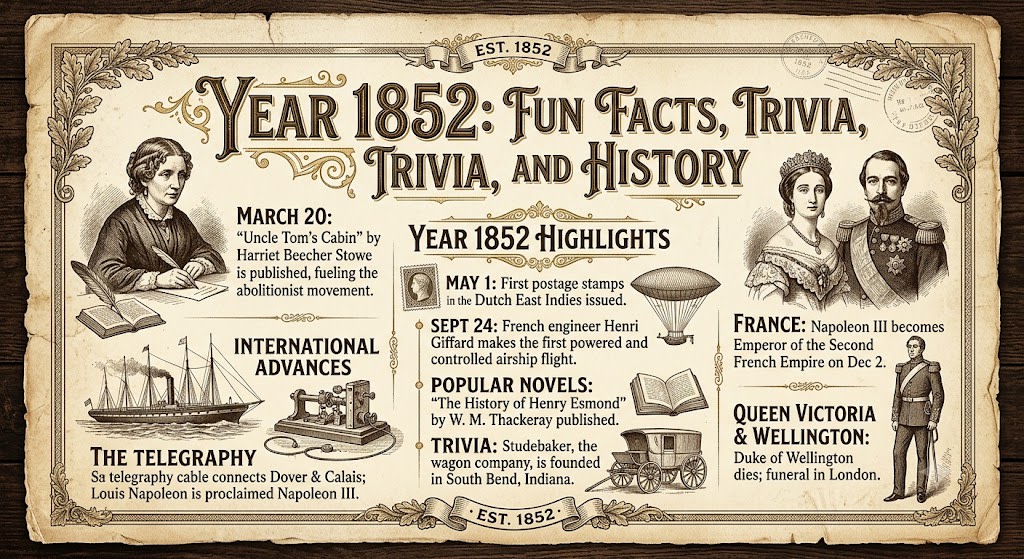
This quick read presents a mix of fun facts, trivia, and history events from the year 1852. Discover the year’s top news stories, most influential people, historic firsts, famous birthdays and deaths, retail prices, entertainment trivia, and much more.
Take a journey through history in just minutes.
President of the United States: Millard Fillmore (Whig-New York)
Vice President: Vacant
Chief Justice of the Supreme Court: Roger B. Taney (Maryland)
Speaker of the House of Representatives: Linn Boyd (Democrat-Kentucky)
The 32nd U.S. Congress was in session, and both chambers had a Democratic majority.
Inflation rate: 0.00%
Consumer price index (CPI): 7.700
$100.00 in 1852 is equivalent in purchasing power to about $4,352.25 today. The U.S. dollar had “an average inflation rate of 2.19% per year” between 1852 and 2026, “producing a cumulative price increase of $4,252.25.” In other words, a U.S. dollar today buys about 2.298% of what it could purchase back in 1852.
American companies and brands founded in 1852 included Anheuser-Busch (a brewing company); the Bradley & Hubbard Manufacturing Company (a manufacturer of brass tables, candlestick holders, clocks, lamps, and other consumer goods); the Jones and Laughlin Steel Company (a Pittsburgh-based steel manufacturer); PNC Financial Services (a Pittsburgh-based bank); Shreve & Co. (a jewelery retailer); Smith & Wesson (a firearms manufacturer); Studebaker (a wagon and future automobile manufacturer); and Wells Fargo (a financial services company).
American railways established in 1852 were the New York and New England Railway, the Lackawanna and Bloomsburg Railway, and the Sacramento Valley Railway.
In 1852, there were 31 U.S. states. In order of admission to the Union, they were Delaware (1787), Pennsylvania (1787), New Jersey (1787), Georgia (1788), Connecticut (1788), Massachusetts (1788), Maryland (1788), South Carolina (1788), New Hampshire (1788), Virginia (1788), New York (1788), North Carolina (1789), Rhode Island (1790), Vermont (1791), Kentucky (1792), Tennessee (1796), Ohio (1803), Louisiana (1837), Indiana (1816), Mississippi (1817), Illinois (1818), Alabama (1819), Maine (1820), Missouri (1821), Arkansas (1836), Michigan (1837), Florida (1845), Texas (1845), Iowa (1846), Wisconsin (1848), and California (1851).
In 1852, there were 16 free states, including California, Connecticut, Illinois, Indiana, Iowa, Maine, Massachusetts, Michigan, New Hampshire, New Jersey, New York, Ohio, Pennsylvania, Rhode Island, Vermont, and Wisconsin.
There were also 15 slave states, including Alabama, Arkansas, Delaware, Florida, Georgia, Kentucky, Louisiana, Maryland, Mississippi, Missouri, North Carolina, South Carolina, Tennessee, Texas, and Virginia.
On January 1, the New York Association for Improving the Condition of the Poor opened the first public bath and wash house on Mott Street in New York City.
On January 3, 195 Chinese immigrants arrived in Hawaii to work on sugarcane plantations.
In March, Charles Dickens' novel Bleak House began its 20-month serialization.
March 18: In New York City, Henry Wells and William G. Fargo “joined with several other investors” to launch their “namesake business,” Wells Fargo, which later became one of the world's largest banks.
On March 18, the New York Lantern published Frank Bellew's political cartoon, Raising the Wind, which marked “the very first illustration of the 'Uncle Sam' persona.”
On March 20, John P. Jewett of Boston published Harriet Beecher Stowe's anti-slavery novel, Uncle Tom's Cabin, in book form. The publication sold an estimated 300,000 copies in just three months and also became the best-selling literary work of the 19th century.
On March 29, Ohio made it illegal for children under 18 and women to work more than 10 hours a day.
In April, Samuel Orchart Beeton launched The Englishwoman's Domestic Magazine, the first British magazine “aimed at a middle-class female readership.”
Between April 5, 1852, and January 20, 1853: The Second Anglo-Burmese War unfolded, which was a “decisive conflict between the British East India Company and the Burmese Konbaung Dynasty.” Ongoing trade disputes and unresolved tensions between the two countries ignited the conflict.
On April 19, the California Historical Society was formed and incorporated in San Francisco.
On April 29, retired British physician Peter Mark Roget published the first edition of Roget's Thesaurus, containing 15,000 words. Since 1852, over 32 million copies of the thesaurus have been sold worldwide, and its overall impact on writing has been “immeasurable.” (Just so you know, a thesaurus “is a reference work that lists the synonyms and sometimes antonyms of words.”)
On May 1, American adventurer and performer Martha Jane Canary (aka “Calamity Jane”) was born in Princeton, Missouri. Known for her sharpshooting skills, storytelling, and adventurous spirit, she is “a legendary and vibrant icon” of the Wild West.
On May 1, brothers Jacob and Wilhelm Grimm published the first volume of their German dictionary, Deutsches Wörterbuch, which would not be completed until 1961.
On May 8, the Boston Olive Branch published The Rival Painters: A Story of Rome, American author Louisa May Alcott’s first known story to appear in print.
On May 18, Massachusetts became the first U.S. state to require that all children between ages 8 and 14 must attend school.
On July 3, Congress passed legislation that designated San Francisco as the site for the second U.S. Mint.
July 5: During an Independence Day celebration at Corinthian Hall in Rochester, New York, abolitionist Frederick Douglass delivered his “keynote” speech, entitled “What to the slave is the Fourth of July?” Historians consider Douglass’ speech one of the “most powerful and enduring political orations in American history.”
On July 23, Private John Brown became the first interment at the Presidio's military post cemetery in San Francisco.
On August 1, the Reverend John Jamison Moore founded the African Methodist Episcopal (A.M.E.) Zion Church in San Francisco, the city’s first Black church.
On August 3, Harvard and Yale competed in the first-ever American intercollegiate athletic competition. In a two-mile rowing contest on Lake Winnipesaukee in Center Harbor, New Hampshire, “Harvard's Oneida boat triumphed over Yale's Shawmut by two lengths.”
On September 27, George Aiken's play Uncle Tom's Cabin, an adaptation of Harriet Beecher Stowe's anti-slavery novel, debuted in Troy, New York.
On November 2, Americans elected Democrat Franklin Pierce as the 14th president of the United States. Running against Whig Party candidate Winfield Scott, Pierce received 254 electoral votes to Scott's 42.
On December 23, the Celestial John, the first theater in the United States catering to a Chinese audience, opened in San Francisco’s Telegraph Hill neighborhood.
On December 29, 17-year-old Emma Snodgrass was arrested in Boston for the “heinous crime” of wearing pants.
In 1852, Bishop John Neumann established Philadelphia's Catholic school system.
The Camden and Atlantic Railroad, which would later connect Philadelphia and Atlantic City, was chartered.
Charles Gilpin was re-elected as Philadelphia’s mayor.
Popular baby names for boys in 1852 were John, William, James, Charles, George, and Thomas. Popular baby names for girls were Mary, Anna, Emma, Elizabeth, Margaret, and Minnie.
In 1852, the United States was “overwhelmingly” Protestant, and the largest denominations included Methodists, Baptists, Presbyterians, Episcopalians, Congregationalists, and Lutherans. America’s Roman Catholic population was around one million, which comprised about 5% of the total U.S. population.
Famous people born in 1852 were Albert Michelson (a German physicist); Calamity Jane (an American explorer); Cap Anson (an American baseball player); Henri Becquerel (a French physicist); and William Ramsay (a Scottish chemist).
Notable people who died in 1852 included Ada Lovelace (a British mathematician who made “a profound impact” on the mechanical engineering field); Fanny Wright (a Scottish civil rights leader); and Louis Braille (the French inventor of Braille, a system of writing for blind people).
In 1852 as well, the words “bathing suit,” “business administration,” “common stock,” “dishpan,” “German shepherd,” “Groundhog Day,” “gyroscope,” “jimjams,” “liverwurst,” “machine tool,” “nightlife,” “nightstand,” “polyglotism,” “poppycock,” “rural route,” “scrapple,” “serialize,” “sheet music,” “shopping list,” “shoreline,” “sugar pill,” “telegram,” “union card,” “Washingtonian,” and “white blood cell” all appeared in print for the first time.
In 1852, aluminum was a “rare and expensive” metal and sold for $545 a pound.
Ax: $2.00
Bacon: Six cents a pound
Boots: $2.50 per pair
Bowls: 25 cents each
Broom: 19 cents
Cheese: 15 cents a pound
Cigars: 25 cents a dozen or $7.00 a box
Eggs: 10 cents a dozen
Ginger: 24 cents a pound
Lemons: 12 for $1.00
Molasses: 16 cents a quart
Nails: 10 cents a pound
Pepper: 25 cents a pound
Pickles: 75 cents a jar
Raisins: 25 cents a pound
Rice: 10 cents a pound
Shoes: $1.25 a pair
Storage trunk: $5.00
Wine: $1.00 per bottle
References:
https://en.wikipedia.org/wiki/Category:American_companies_established_in_1852
https://www.foodreference.com/html/html/food-history-1850.html
https://www.nps.gov/common/uploads/teachers/lessonplans/Sutler%20Store%20prices_508.pdf
Disclaimer: In writing and editing this article, Gregory DeVictor has made every effort to ensure historical accuracy and not to mislead his audience. In addition, the contents of this article, including text, graphics, and captions, are for general informational purposes only.
© 2026 Gregory DeVictor
About the Creator
Gregory DeVictor
Gregory DeVictor is a trivia enthusiast who likes to write articles about American history and nostalgia. Each of his articles presents a mix of fun facts, trivia, and historic events about a specific calendar year, decade, or century.
Enjoyed the story? Support the Creator.
Subscribe for free to receive all their stories in your feed.
Comments