
Year 1850: Fun Facts, Trivia, and History
This quick read presents a mix of fun facts, trivia, and history events from the year 1850.

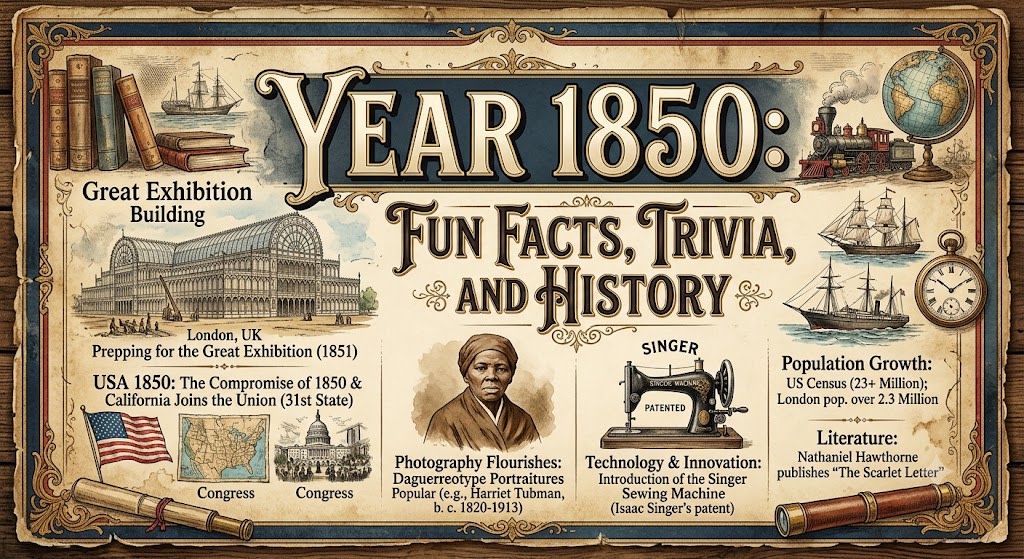
This quick read presents a mix of fun facts, trivia, and history events from the year 1850. Discover the year’s top news stories, most influential people, historic firsts, noteworthy inventions, famous birthdays and deaths, retail prices, entertainment trivia, and much more.
Take a journey through history in just minutes.
President of the United States: Zachary Taylor (Whig-Kentucky)—Until July 9, when he died suddenly from a severe gastrointestinal illness.
President of the United States: Millard Fillmore (Whig-New York)—Beginning on July 9
Vice President: Millard Fillmore (Whig-New York)—Until July 9
Vice President: Vacant—Beginning on July 9
Chief Justice of the Supreme Court: Roger B. Taney (Maryland)
Speaker of the House of Representatives: Howell Cobb (Democrat-Georgia)
The 31st U.S. Congress was in session.
Inflation rate: 1.30%
Consumer price index (CPI): 7.800
$100.00 in 1850 is equivalent in purchasing power to about $4,296.45 today. The U.S. dollar had “an average inflation rate of 2.16% per year” between 1850 and 2026, “producing a cumulative price increase of $4,196.45." In other words, a U.S. dollar today buys about 2.328% of what it could purchase back in 1850.
It’s also worth noting that the U.S. dollar has lost about 98% of its value since 1850.
American companies founded in 1850 included the City of Paris Dry Goods Co. (a San Francisco-based department store); Cullen and Dykman LLP (a law firm headquartered in Uniondale, New York); Hazelton Brothers (a New York City-based piano manufacturer); Lehman Brothers (a financial services company); Pinkerton (a detective agency); Henry E. Sharp (a stained glass maker); and the Stroh Brewery Company (a Detroit-based brewer).
American railroads established in 1850 were the Alabama and Mississippi Rivers Railroad, the Lebanon Valley Railroad, and the Plattsburgh and Montreal Railroad.
In 1850, there were 31 U.S. states. In order of admission to the Union, they were Delaware (1787), Pennsylvania (1787), New Jersey (1787), Georgia (1788), Connecticut (1788), Massachusetts (1788), Maryland (1788), South Carolina (1788), New Hampshire (1788), Virginia (1788), New York (1788), North Carolina (1789), Rhode Island (1790), Vermont (1791), Kentucky (1792), Tennessee (1796), Ohio (1803), Louisiana (1837), Indiana (1816), Mississippi (1817), Illinois (1818), Alabama (1819), Maine (1820), Missouri (1821), Arkansas (1836), Michigan (1837), Florida (1845), Texas (1845), Iowa (1846), Wisconsin (1848), and California (1850).
In 1851, there were 16 free states, including California, Connecticut, Illinois, Indiana, Iowa, Maine, Massachusetts, Michigan, New Hampshire, New Jersey, New York, Ohio, Pennsylvania, Rhode Island, Vermont, and Wisconsin.
There were also 15 slave states, including Alabama, Arkansas, Delaware, Florida, Georgia, Kentucky, Louisiana, Maryland, Mississippi, Missouri, North Carolina, South Carolina, Tennessee, Texas, and Virginia.
According to 1850 U.S. Census data, the United States population was 23,191,876, which included 3,638,808 Blacks. There were also 3,204,313 enslaved people living across the USA.
Approximately 11,680,000 U.S. residents lived on farms or plantations. There were 1,449,000 farms nationwide, averaging about 203 acres apiece.
On January 29, Senator Henry Clay of Kentucky began to draft the Compromise of 1850, designed “to defuse tensions between slave states and free states over territories won during the Mexican–American War.”
On February 5, D. D. Parmelee of New Paltz, New York, received a U.S. patent for the first key-driven adding machine.
On February 18, the California Legislature created nine Bay Area counties, including Alameda, Contra Costa, Marin, Napa, San Francisco, San Mateo, Santa Clara, Solano, and Sonoma.
On March 11, the Female Medical College of Pennsylvania (later renamed the Woman's Medical College of Pennsylvania) opened in Philadelphia. It was “the world's first degree-granting medical college exclusively for women.”
On March 16, William Ticknor and James T. Fields published Nathaniel Hawthorne's historical novel, The Scarlet Letter. Set in Boston, the novel sold 2,500 copies in ten days.
On April 4, the City of Los Angeles was incorporated.
On April 15, the City of San Francisco was incorporated.
On May 1, John Geary became the first mayor of San Francisco.
On May 4, San Francisco’s Second Great Fire started in the United States Exchange, a saloon and gambling house located on Kearny Street, between Clay and Jackson Streets.
On June 14, San Francisco’s Third Great Fire started in a defective chimney at the Sacramento Bakery, located “behind the Merchants Hotel between Sacramento and Clay Streets.”
On July 1, an estimated 626 ships laid at anchor in and around San Francisco Bay.
On July 9, U.S. President Zachary Taylor passed away from a severe gastrointestinal illness—most likely cholera or acute gastroenteritis—”after consuming large amounts of cherries and iced milk (or iced water).”
On July 14, Florida physician Dr. John Gorrie “astonished guests at a dinner party in Apalachicola by serving machine-made ice.”
On July 25, gold was discovered in the Rogue River in Oregon.
On August 30, Honolulu, Hawaii, became a city “when King Kamehameha III declared it the capital of the Hawaiian Kingdom and the Privy Council first recorded official street names.”
On September 9, California was admitted to the Union as the 31st state. It was a free state and altered the political balance of the era.
On September 9, the New Mexico and Utah territories were created.
On September 17, San Francisco’s Fourth Great Fire erupted in the Philadelphia House, a saloon located on Jackson Street.
On September 26, Norwegian playwright Henrik Ibsen’s first play to be performed, The Burial Mound (Kjæmpehøjen), opened at the Christiania Theatre in Oslo.
On November 6, Congress reserved Yerba Buena Island and Angel Island, both located in San Francisco Bay, for military use.
In 1850, there were over 2,000 bakeries in the United States.
Popular baby names for boys in 1850 were John, William, James, Charles, George, and Thomas. Popular baby names for girls were Mary, Anna, Emma, Elizabeth, Margaret, and Minnie.
The most common surnames in the United States were Smith, Johnson, Brown, Williams, Jones, Davis, Clark, Taylor, Thompson, and Hall. (Just so you know, the most common last names were tied to English, Irish, and Scottish origins.)
In 1850, the average life expectancy at birth in the United States was about 41 years for a white male and around 43 years for a white female. During the 1800s, if an individual survived to age 10, their remaining life expectancy would jump considerably, and they could often expect to live into their 50s, 60s, or even 70s.
Famous people born in 1850 were Guy De Maupassant (a French author); Jack Daniel (an American entrepreneur who established the popular Jack Daniel’s whiskey brand); Kate Chopin (an American novelist); Robert Louis Stevenson (a Scottish author who wrote the adventure novel Treasure Island); and Thomas Lipton (the Scottish founder of the Lipton Tea Company).
Notable people who died in 1850 included Honoré de Balzac (a French playwright and novelist), William Wordsworth (a British poet), and Zachary Taylor (a U.S. president).
In 1850 as well, the words “ballroom dance,” “behind-the-scenes,” “bologna,” “bottleneck,” “brainteaser,” “bronco,” “brush fire,” “campsite,” “chewing gum,” “chromolithograph,” “day nursery,” “drastically,” “footwear,” “hazing,” “homeowner,” “in memoriam,” “New Jerseyite,” “livability,” “oil of wintergreen,” “overcook,” “passion play,” “red blood cell,” “roller skate,” “sleeping bag,” “soda bread,” “spelling bee,” “substandard,” “sympathetic nervous system,” “voodoo,” “waiting game,” “wastebasket,” and “window dressing” all appeared in print for the first time.
Almonds: 37.5 cents a pound
Ax: $2.00
Bacon: Six cents a pound
Boots: $2.50 per pair
Bowls: 25 cents each
Broom: 19 cents
Buffalo robe: $3.00
Cheese: 15 cents a pound
Cigars: 25 cents a dozen or $7.00 a box
Coffee pot: 37.5 cents
Comb: 25 cents
Eggs: 10 cents a dozen
Ginger: 24 cents a pound
Lemons: 12 for $1.00
Marbles: 12.5 cents a dozen
Molasses: 16 cents a quart
Nails: 10 cents a pound
Olive oil: 62 cents a bottle
Pepper: 25 cents a pound
Pickles: 75 cents a jar
Raisins: 25 cents a pound
Rice: 10 cents a pound
Shaving soap: 37.5 cents a pound
Shoes: $1.25 a pair
Socks: 37.5 cents a pair
Spade: $1.00
Storage trunk: $5.00
Table salt: 18.25 cents a box
Tobacco: 56 cents a plug
Toothbrush: 25 cents
Wine: $1.00 per bottle
References:
https://en.wikipedia.org/wiki/Category:American_companies_established_in_1850
https://www.foodreference.com/html/html/food-history-1850.html
https://www.nps.gov/common/uploads/teachers/lessonplans/Sutler%20Store%20prices_508.pdf
Disclaimer: In writing and editing this article, Gregory DeVictor has made every effort to ensure historical accuracy and not to mislead his audience. In addition, the contents of this article, including text, graphics, and captions, are for general informational purposes only.
© 2026 Gregory DeVictor
About the Creator
Gregory DeVictor
Gregory DeVictor is a trivia enthusiast who likes to write articles about American history and nostalgia. Each of his articles presents a mix of fun facts, trivia, and historic events about a specific calendar year, decade, or century.
Enjoyed the story? Support the Creator.
Subscribe for free to receive all their stories in your feed.
Comments