
Year 1849: Fun Facts, Trivia, and History
This quick read presents a mix of fun facts, trivia, and history events from the year 1849.

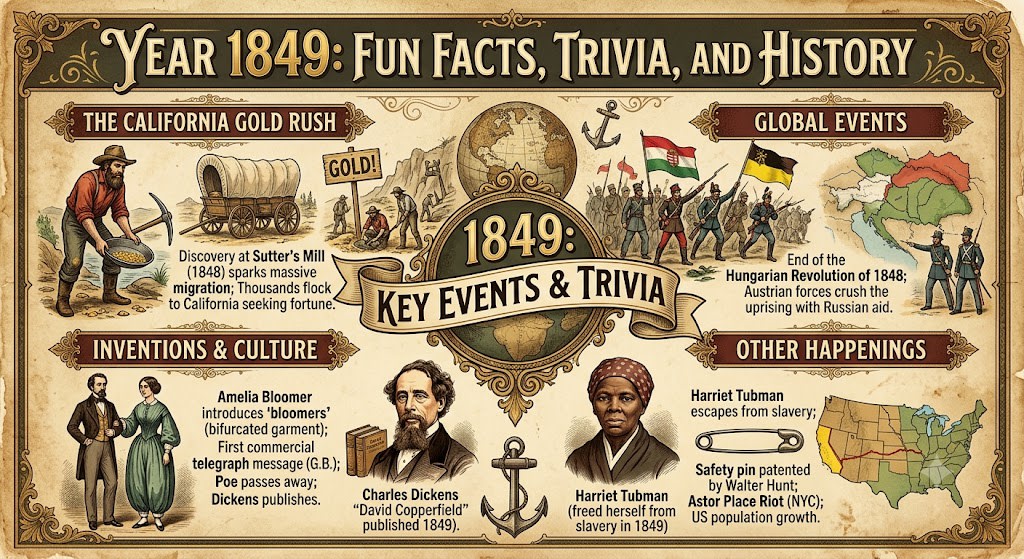
This quick read presents a mix of fun facts, trivia, and history events from the year 1849. Discover the year’s top news stories, most influential people, historic firsts, noteworthy inventions, famous birthdays and deaths, retail prices, entertainment trivia, and much more.
Take a journey through history in just minutes.
President of the United States: James K. Polk (Democrat-Tennessee)—Until March 4
President of the United States: Zachary Taylor (Whig-Kentucky)—Beginning on March 4
Vice President: George M. Dallas (Democrat-Pennsylvania)—Until March 4
Vice President: Millard Fillmore (Whig-New York)—Beginning on March 4
Chief Justice of the Supreme Court: Roger B. Taney (Maryland)
Speaker of the House of Representatives: Robert Charles Winthrop (Whig-Massachusetts)—Until March 4
Speaker of the House of Representatives: Howell Cobb (Democrat-Georgia)—Beginning on December 22
The 30th U.S. Congress was in session until March 4, when the 31st U.S. Congress convened.
Inflation rate: -2.53%
Consumer price index (CPI): 7.700
$100.00 in 1849 is equivalent in purchasing power to about $4,352.25 today. The U.S. dollar had “an average inflation rate of 2.15% per year” between 1849 and 2026, “producing a cumulative price increase of $4,252.25." In other words, a U.S. dollar today buys about 2.298% of what it could purchase back in 1849.
It’s also worth noting that the U.S. dollar has lost about 98% of its value since 1849.
American companies and brands founded in 1849 included Comerica (a financial services company); the Continental Baking Company (one of America’s first bakeries to produce “fortified” bread); Horne’s (a Pittsburgh-based department store chain); the Joseph Schlitz Brewing Company (a Milwaukee-based brewer); Pfizer (a pharmaceuticals company); Pope & Talbot, Inc. (a lumber and shipping company); Pratt & Lambert (an industrial paint brand); and the Vulcan Iron Works (a locomotive manufacturer).
American railroads established in 1849 were the Charles River Branch Railroad, the New York and New England Railroad, and the Pittsburgh, Cincinnati, Chicago, and St. Louis Railroad.
In 1849, there were 30 U.S. states. In order of admission to the Union, they were Delaware (1787), Pennsylvania (1787), New Jersey (1787), Georgia (1788), Connecticut (1788), Massachusetts (1788), Maryland (1788), South Carolina (1788), New Hampshire (1788), Virginia (1788), New York (1788), North Carolina (1789), Rhode Island (1790), Vermont (1791), Kentucky (1792), Tennessee (1796), Ohio (1803), Louisiana (1837), Indiana (1816), Mississippi (1817), Illinois (1818), Alabama (1819), Maine (1820), Missouri (1821), Arkansas (1836), Michigan (1837), Florida (1845), Texas (1845), Iowa (1846), and Wisconsin (1848).
On January 23, Jesse K. Park and Cornelius S. Watson received a U.S. patent for an envelope-making machine.
On January 23, at a graduation ceremony in Geneva, New York, Elizabeth Blackwell became the first woman in the United States to receive a medical degree.
On February 28, the newly built steamship SS California arrived in San Francisco, carrying “the first wave” of prospectors from the East Coast.
On March 3, Congress created the U.S. Home Department, later renamed the Department of the Interior.
On March 3, the Coinage Act “authorized” the $20.00 Double Eagle and the $1.00 Gold Liberty coin.
On March 7, Luther Burbank, an American horticulturist, was born in Lancaster, Massachusetts. He created many new varieties of fruits and vegetables, including the Burbank potato, 10 varieties of berries, and over 100 varieties of plums and prunes.
On April 10, Walter Hunt, a mechanic and inventor from New York, received a U.S. patent for a safety pin.
On May 3, the “engorged” Mississippi River “breached the levee at Pierre Sauvé’s plantation” in present-day River Ridge, Louisiana, “flooding over 200 city blocks in New Orleans and displacing around 12,000 residents.”
On May 10, the Astor Place Riot unfolded when “disputes between fans of Edwin Forrest, one of the most famous American actors in the 19th century, and William Charles Macready, a British actor who was performing at the Astor Palace Opera House, turned into a bloody riot. Over 10,000 people gathered outside the Opera House, throwing stones at both the building and the police force. In need of assistance, the state militia was called up. The militia shot into the crowd in an attempt to control the riot. By the end of the night, 25 were dead and more than 120 seriously injured.”
On May 29, future U.S. President Abraham Lincoln “purportedly” stated, "You can fool some of the people all of the time, and all of the people some of the time, but you can not fool all of the people all of the time."
On June 12, Lewis Haslett of Louisville, Kentucky, received a U.S. patent for a gas mask.
On September 17, abolitionist and social activist Harriet Tubman made her first attempt to escape slavery in Maryland.
On September 19, the first commercial laundry in the United States was established in Oakland, California.
On October 3, four days before his death, American author Edgar Allan Poe was found “delirious in a gutter” in Baltimore, Maryland.
On November 13, Peter Burnett became the first governor of California.
On November 15-16, the first poultry show in the United States took place in Boston, Massachusetts. An estimated 1,423 birds were exhibited by 219 participants.
On December 6, Harriet Tubman escaped from slavery in Maryland for the second and final time, taking her to Philadelphia.
On December 21, the first skating club in the United States was founded in Philadelphia.
On December 24 (Christmas Eve), San Francisco's first great fire ignited in Dennison's Exchange, a popular gambling hall on Kearny Street opposite Portsmouth Square. The blaze “destroyed over 50 buildings” and began “a devastating sequence” of six massive fires over the next 18 months.
In 1849, self-service restaurants (aka cafeterias) first appeared in San Francisco during the California gold rush.
American writer Edgar Allan Poe published the poems A Dream Within a Dream, Annabel Lee, Eldorado, and The Bells.
William Smith, a British lexicographer, published the Dictionary of Greek and Roman Biography and Mythology.
Popular baby names for boys in 1849 were John, William, James, Charles, George, and Thomas. Popular baby names for girls were Mary, Anna, Emma, Elizabeth, Margaret, and Minnie.
The most common surnames in the United States were Smith, Johnson, Brown, Williams, Jones, Davis, Clark, Taylor, Thompson, and Hall. (Just so you know, the most common last names were tied to English, Irish, and Scottish origins.)
In 1849, the average life expectancy at birth in the United States was about 41 years for a white male and around 43 years for a white female. During the 1800s, if an individual survived to age 10, their remaining life expectancy would jump considerably, and they could often expect to live into their 50s, 60s, or even 70s.
Famous people born in 1849 were Benjamin Holt (an entrepreneur), Ivan Pavlov (a biologist), and William Osler (a medical doctor who was one of the founders of the Johns Hopkins Hospital).
Notable people who died in 1849 included Edgar Allan Poe (an American writer), Frédéric Chopin (a Polish composer), and James K. Polk (a United States president).
In 1849 as well, the words “anorexic,” “armrest,” “avant-garde,” “bankroll,” “bean sprouts,” “between the lines,” “coloring book,” “curio,” “dead meat,” “death rate,” “dosage,” “getaway,” “index finger,” “Kentucky bluegrass,” “labor union,” “mechanical engineering,” “ornery,” “painkiller,” “Plymouth Rock,” “red light,” “room and board,” “rubber cement,” “shopping bag,” “slingshot,” “superpower,” “tequila,” “upholster,” and “zinc oxide” all appeared in print for the first time.
12 eggs: Around 12 cents
One bushel of potatoes: About 50 cents
One pound of butter: Around 20 cents
One ton of coal for home heating: About $1.00
Two pounds of ham: Around 25 cents
Two pounds of sugar: About 30 cents
Washboard: Around 37 cents
References:
https://en.wikipedia.org/wiki/Category:American_companies_established_in_1849
https://www.foodreference.com/html/html/food-timeline-1846.html
Disclaimer: In writing and editing this article, Gregory DeVictor has made every effort to ensure historical accuracy and not to mislead his audience. In addition, the contents of this article, including text, graphics, and captions, are for general informational purposes only.
© 2026 Gregory DeVictor
About the Creator
Gregory DeVictor
Gregory DeVictor is a trivia enthusiast who likes to write articles about American history and nostalgia. Each of his articles presents a mix of fun facts, trivia, and historic events about a specific calendar year, decade, or century.
Enjoyed the story? Support the Creator.
Subscribe for free to receive all their stories in your feed.
Comments