
Year 1847: Fun Facts, Trivia, and History
This quick read presents a mix of fun facts, trivia, and history events from the year 1847.

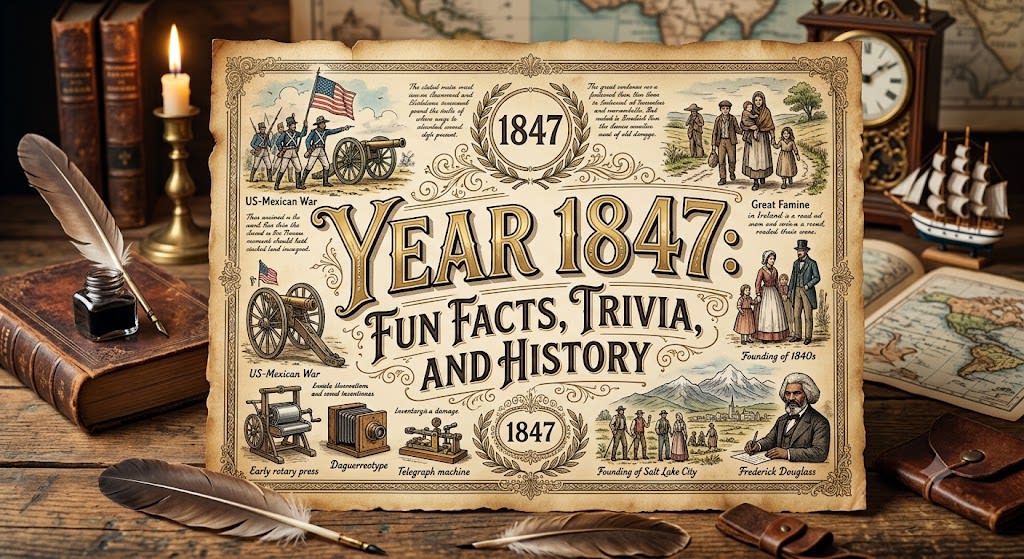
This quick read presents a mix of fun facts, trivia, and history events from the year 1847. Discover the year’s top news stories, most influential people, historic firsts, noteworthy inventions, famous birthdays and deaths, retail prices, entertainment trivia, and much more.
Take a journey through history in just minutes.
President of the United States: James K. Polk (Democrat-Tennessee)
Vice President: George M. Dallas (Democrat-Pennsylvania)
Chief Justice of the Supreme Court: Roger B. Taney (Maryland)
Speaker of the House of Representatives: John Wesley Davis (Democrat-Indiana)—Until March 4
Speaker of the House of Representatives: Robert Charles Winthrop (Whig-Massachusetts)—Beginning on December 6
The 29th U.S. Congress was in session until March 4, when the 30th U.S. Congress convened. The Senate had a Democratic majority, and the House had a Whig majority. It was the only U.S. Congress in which future U.S. President Abraham Lincoln served.
Inflation rate: 6.49%
Consumer price index (CPI): 8.200
$100.00 in 1847 is equivalent in purchasing power to about $4,086.87 today. The U.S. dollar had “an average inflation rate of 2.09% per year” between 1847 and 2026, “producing a cumulative price increase of $3,986.87." In other words, a U.S. dollar today buys about 2.447% of what it could purchase back in 1847.
It’s worth noting that the U.S. dollar has lost about 98% of its value since 1847.
American companies founded in 1847 included Cleveland-Cliffs (a Cleveland, Ohio-based steel manufacturer) and the Ocean Steam Navigation Company (a New York City-based shipping company).
American railroads established in 1847 were the Grand Junction Railroad, the New York and New England Railroad, and the New London Northern Railroad.
In 1847, there were 29 U.S. states. In order of admission to the Union, they were Delaware (1787), Pennsylvania (1787), New Jersey (1787), Georgia (1788), Connecticut (1788), Massachusetts (1788), Maryland (1788), South Carolina (1788), New Hampshire (1788), Virginia (1788), New York (1788), North Carolina (1789), Rhode Island (1790), Vermont (1791), Kentucky (1792), Tennessee (1796), Ohio (1803), Louisiana (1837), Indiana (1816), Mississippi (1817), Illinois (1818), Alabama (1819), Maine (1820), Missouri (1821), Arkansas (1836), Michigan (1837), Florida (1845), Texas (1845), and Iowa (1846).
In January, the novel Vanity Fair: Pen and Pencil Sketches of English Society began its serial publication in London’s Punch magazine, which included illustrations by the author, William Makepeace Thackeray.
On January 4, American inventor and industrialist Samuel Colt rescued his faltering gun company by securing a contract to supply the United States government with 1,000 of his .44 caliber revolvers.
On January 9, the first San Francisco-based newspaper, the California Star, began publishing.
On January 15, the magazine Skandinavia debuted in New York City, and became “the first Swedish-language magazine published in the United States.”
On January 16, John C. Frémont became the governor of the new California Territory.
On January 30, Lt. Washington A. Bartlett renamed the growing Mexican settlement of Yerba Buena to San Francisco.
On February 19, the first rescuers reached surviving members of the Donner Party, “a group of California-bound emigrants who were stranded by snow in the Sierra Nevada.” Nearly half of the original 87 members died, “and many of the living had resorted to cannibalism to stay alive.”
On March 1, Michigan became the first “English-speaking jurisdiction” in the world to abolish the death penalty, except for treason.
On March 3, Congress authorized the first U.S. postage stamps.
On May 7, the American Medical Association was founded in Philadelphia, Pennsylvania.
On June 10, the Chicago Tribune began publishing.
On June 18, American photographer Thomas Martin Easterly of St. Louis, Missouri, took “the earliest known photograph of lightning.”
On July 1, the first U.S. postage stamps went on sale in New York City.
On July 24, Richard March Hoe of New York City received a U.S. patent for a rotary-type printing press.
On July 24, after 17 months of travel, American religious leader Brigham Young “led 148 pioneers into the Great Salt Lake Valley, where he proclaimed, ‘This is the place,’ as they began to prepare for the influx of followers from The Church of Jesus Christ of Latter-day Saints [Mormons].”
On July 29, the Cumberland School of Law was founded in Lebanon, Tennessee, and became only one of 15 law schools in the United States.
On September 5, Jesse Woodson James, the famous American outlaw, was born in Clay County, Missouri.
On September 6, American writer Henry David Thoreau moved in with Ralph Waldo Emerson and his family in Concord, Massachusetts, “after living for two years in a shack he built himself on Walden Pond.”
On September 11, Stephen Foster's ever-popular song, Oh! Susanna, debuted at the Eagle Ice Cream Saloon in Pittsburgh, Pennsylvania.
On September 16, the United Shakespeare Company purchased William Shakespeare's house of birth in Stratford-upon-Avon in England for preservation.
On October 19, Smith, Elder & Co. of London published Charlotte Brontë's novel Jane Eyre in three volumes.
On December 3, abolitionist Frederick Douglass published the first issue of his newspaper, The North Star, in Rochester, New York.
On December 14, T. C. Newby of London published Emily Brontë's novel Wuthering Heights and Anne Brontë's novel Agnes Grey “in a three-volume set under the pen names of Ellis and Acton Bell, respectively.” (It’s worth noting that Wuthering Heights was Emily Brontë's only published novel, since she died a year later, at age 30.)
In 1847, Hanson Crockett Gregory, of Rockport, Maine, supposedly created the doughnut.
Sarah Rutledge published The Carolina Housewife, one of America’s first cookbooks.
German philosopher and social commentator Karl Marx published The Poverty of Philosophy.
Favorite baby names for boys in 1847 were Arthur, Benjamin, Eli, George, Henry, James, John, Joseph, Thomas, and William. Popular baby names for girls were Ada, Alice, Amelia, Charlotte, Clara, Cora, Elizabeth, Emma, Jane, and Lucy.
In 1847, the average life expectancy at birth in the United States was about 41 years for a white male and around 43 years for a white female. During the 1800s, if an individual survived to age 10, their remaining life expectancy would jump considerably, and they could often expect to live into their 50s, 60s, or even 70s.
Famous people born in 1847 were Alexander Graham Bell (the Scottish-born scientist and engineer who patented the first “practical” telephone), Bram Stoker (the Irish author who wrote the gothic horror masterpiece Dracula), and Joseph Pulitzer (a Hungarian-American journalist and newspaper publisher).
Notable people who died in 1847 included Charles Bent (the first civilian governor of the newly formed New Mexico Territory) and Felix Mendelssohn (a German composer, conductor, and pianist).
In 1847 as well, the words “aftershock,” “aquarium,” “bleary-eyed,” “bok choy,” “cherry tomato,” “cirrhosis,” “fire chief,” “French pastry,” “hen of the woods,” “irregardless,” “Judeo-Christian,” “judgment call,” “love seat,” “math,” “methyl alcohol,” “normalize,” “oil well,” “picket line,” “pony express,” “psychosis,” “public transit,” “referendum,” “rigor mortis,” “safety pin,” “self-healing,” “slowpoke,” “social work,” “take the cake,” “time and a half,” “vantage point,” “weeklong,” and “woodstove” all appeared in print for the first time.
12 eggs: Around 12 cents
One bushel of potatoes: About 50 cents
One pound of butter: Around 20 cents
One ton of coal for home heating: About $1.00
Two pounds of ham: Around 25 cents
Two pounds of sugar: About 30 cents
References:
https://en.wikipedia.org/wiki/Category:American_companies_established_in_1847
https://www.foodreference.com/html/html/food-timeline-1846.html
Disclaimer: In writing and editing this article, Gregory DeVictor has made every effort to ensure historical accuracy and not to mislead his audience. In addition, the contents of this article, including text, graphics, and captions, are for general informational purposes only.
© 2026 Gregory DeVictor
About the Creator
Gregory DeVictor
Gregory DeVictor is a trivia enthusiast who likes to write articles about American history and nostalgia. Each of his articles presents a mix of fun facts, trivia, and historic events about a specific calendar year, decade, or century.
Enjoyed the story? Support the Creator.
Subscribe for free to receive all their stories in your feed.
Comments