
Year 1789: Fun Facts, Trivia, and History
This quick read presents a mix of fun facts, trivia, and history events from the year 1789.

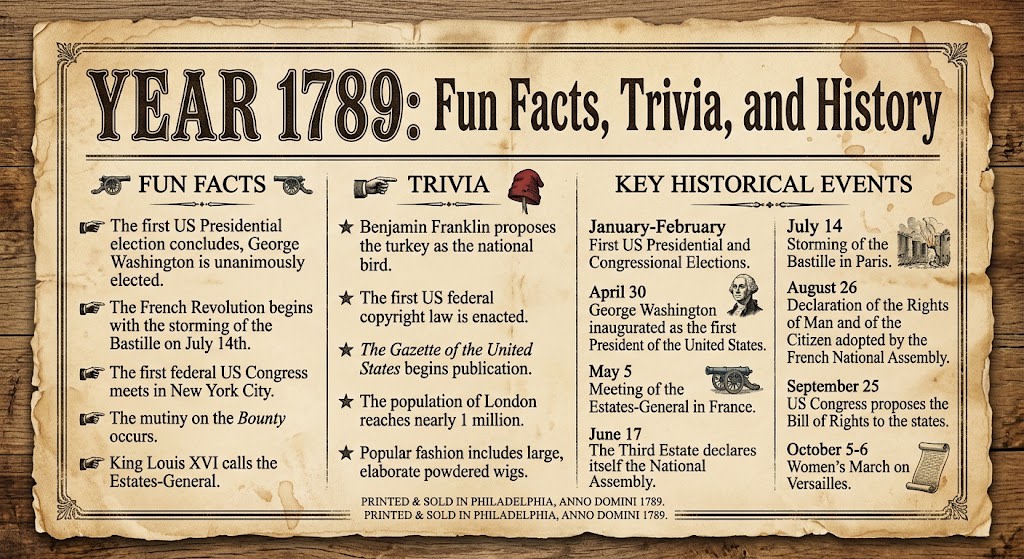
This quick read presents a mix of fun facts, trivia, and history events from the year 1789. Discover the year’s top news stories, most influential people, historic firsts, U.S. economic data, entertainment trivia, and much more.
Take a journey through history in just minutes.
President of the United States: George Washington (Independent-Virginia)—Beginning on April 30
Vice President: John Adams (Massachusetts)—Beginning on April 21
Chief Justice of the Supreme Court: John Jay (New York)—Beginning on October 19
Speaker of the House of Representatives: Frederick Muhlenberg (Pennsylvania)—Beginning on April 1
Inflation rate: -1.12%
Consumer price index (CPI): 8.800
$100.00 in 1789 is equivalent in purchasing power to about $3,794.52 today. The U.S. dollar had “an average inflation rate of 1.55% per year” between 1789 and 2026, “producing a cumulative price increase of 3,694.52%.” In other words, a U.S. dollar today buys about 2.635% of what it could purchase back in 1789.
It’s worth noting that the U.S. dollar has lost about 97% of its value since 1789.
In 1789, there were 12 U.S. states. In order of admission to the Union, they were Delaware (1787), Pennsylvania (1787), New Jersey (1787), Georgia (1788), Connecticut (1788), Massachusetts (1788), Maryland (1788), South Carolina (1788), New Hampshire (1788), Virginia (1788), New York (1788), and North Carolina (1789).
American companies and brands established in 1789 included the Francis Bacon Piano Company, a player piano manufacturer based in New York City.
Farmers accounted for about 90% of the U.S. labor force.
On January 21, Isaiah Thomas, an early American printer from Boston, Massachusetts, published William Hill Brown’s The Power of Sympathy, believed to be the first American novel.
On January 23, Georgetown, the first Roman Catholic college in the United States, was founded.
On February 4, George Washington, the commander of the Continental Army during the Revolutionary War, was “unanimously elected the first president of the United States by all 69 presidential electors who cast their votes. John Adams of Massachusetts, who received 34 votes, was elected vice president.”
On March 4, the first session of the U.S. Congress convened in New York City.
On April 1, at the first U.S. House of Representatives meeting in New York City, Pennsylvania Representative Frederick Augustus Conrad Muhlenberg was elected as the chamber’s first speaker.
On April 28, three weeks into a journey from Tahiti to the West Indies, the HMS Bounty was “seized in a mutiny led by Fletcher Christian, the master’s mate. Captain William Bligh and 18 of his loyal supporters were set adrift in a small, open boat, and the Bounty set course for Tubuai south of Tahiti.”
On April 30, George Washington was sworn in as the first U.S. president and delivered the first inaugural speech at Federal Hall in New York City.
On May 7, the first U.S. presidential inaugural ball, in President Washington’s honor, was held in New York City.
On June 13, Mrs. Alexander Hamilton served a new dessert to President Washington—ice cream.
On June 14, English Captain William Bligh and 18 others, “cast adrift from the HMS Bounty seven weeks before, reach[ed] Timor in the East Indies after traveling nearly 4,000 miles in a small, open boat.”
On July 27, Congress established the Department of Foreign Affairs, now known as the State Department.
On August 7, Congress created the Department of War and the United States Lighthouse Establishment.
On August 28, German-British astronomer William Hershel discovered Saturn’s moon Enceladus.
On September 2, the U.S. Treasury Department was founded.
On September 11, Alexander Hamilton became the first secretary of the U.S. Treasury Department.
On September 13, the Bank of New York loaned $200,000 to the U.S. government to pay the salaries of President Washington and the members of Congress.
On September 17, German-British astronomer William Hershel discovered Saturn’s moon Mimas.
On September 24, the U.S. Supreme Court was established.
On September 25, the first U.S. Congress approved 12 amendments to the U.S. Constitution and sent them to the states for ratification. The amendments, “known as the Bill of Rights, were designed to protect the basic rights of U.S. citizens, guaranteeing the freedom of speech, press, assembly, and exercise of religion; the right to fair legal procedure and to bear arms; and that powers not delegated to the federal government were reserved for the states and the people.”
On September 29, the U.S. Department of War established America’s first “regular” army, consisting of several hundred men.
On October 3, George Washington issued his “historic national Thanksgiving Proclamation,” “setting aside Thursday, November 26, 1789, as a day of public prayer and gratitude.”
On November 6, Pope Pius VI appointed John Carroll as America’s first Roman Catholic bishop. Bishop Carroll headed “the newly formed Diocese of Baltimore, which covered the entire country.”
On November 20, New Jersey became the first state to ratify the Bill of Rights.
On November 21, North Carolina became the 12th U.S. state.
On November 26, the first national Thanksgiving took place in the United States.
On December 11, the University of North Carolina, America’s oldest public university, was founded.
In 1789, the New Jersey legislature passed an act that would fine anyone 10 shillings for picking cranberries before October 10.
Thomas Jefferson, the third U.S. president, returned to the United States from a trip to Europe and brought the first macaroni machine to America.
Philadelphia was “actively preparing to become the nation's interim capital, a role it officially assumed in December 1790 while Washington, D.C. was being built.”
Key fiction books published in 1789 included Ann Radcliffe’s The Castles of Athlin and Dunbayne and William Hill Brown’s The Power of Sympathy.
Notable poetic works for the year were William Blake’s Songs of Innocence and William Lisle Bowles’ Sonnets.
Noteworthy dramatic works in 1789 included George Colman’s The Battle of Hexham, George Colman’s The Family Party, and Richard Cumberland’s The School for Widows.
In 1789, Isaiah Thomas of Boston, Massachusetts, began publishing The Massachusetts Magazine, a monthly publication that specialized in agriculture, architecture, biography, chemistry, deaths, history, marriages, mathematics, meteorological observations, morality, music, novels, philosophy, poetry, and much more.
Famous people born in 1789 were Ann Hasseltine Judson (American missionary), Georg Ohm (German physicist), and James Fenimore Cooper (American novelist).
Famous people who died in 1789 included Ethan Allen (American philosopher) and John Cleland (British novelist).
In 1789 as well, the words “Adam-and-Eve,” “alcoholic,” “bakeshop,” “blueprint,” “cardboard,” “choreography,” “cuckoo clock,” “date of birth,” “district attorney,” “double up,” “federal court,” “inverted comma,” “melodramatic,” “nitric oxide,” “Odd Fellow,” “pessimist,” “private enterprise,” “rutabaga,” “shipping clerk,” “sickening,” “star of Bethlehem,” “unemployment,” “water ice,” and “window shade” all appeared in print for the first time.
Beef: About $2.00 to $3.00 per 100 pounds
Chicken: Around 12 cents each
Coffee: About 25 cents to 33 cents per pound
Corn: Around 50 cents per bushel
Flour: About $5.00 per barrel
Oats: Around 33 cents per bushel
Salt Pork: About eight cents per pound
Turkey: Around 50 cents each
Wheat: About $1.00 to $1.25 per bushel
References:
https://en.wikipedia.org/wiki/Category:American_companies_established_in_1789
https://www.foodreference.com/html/html/food-timeline-1785-1789.html
https://en.wikipedia.org/wiki/List_of_U.S._states_by_date_of_admission_to_the_Union
Disclaimer: In writing and editing this article, Gregory DeVictor has made every effort to ensure historical accuracy and not to mislead his audience. In addition, the contents of this article, including text, graphics, and captions, are for general informational purposes only.
© 2026 Gregory DeVictor
About the Creator
Gregory DeVictor
Gregory DeVictor is a trivia enthusiast who likes to write articles about American history and nostalgia. Each of his articles presents a mix of fun facts, trivia, and historic events about a specific calendar year, decade, or century.
Enjoyed the story? Support the Creator.
Subscribe for free to receive all their stories in your feed.
Comments