
Year 1788: Fun Facts, Trivia, and History
This quick read presents a mix of fun facts, trivia, and history events from the year 1788.

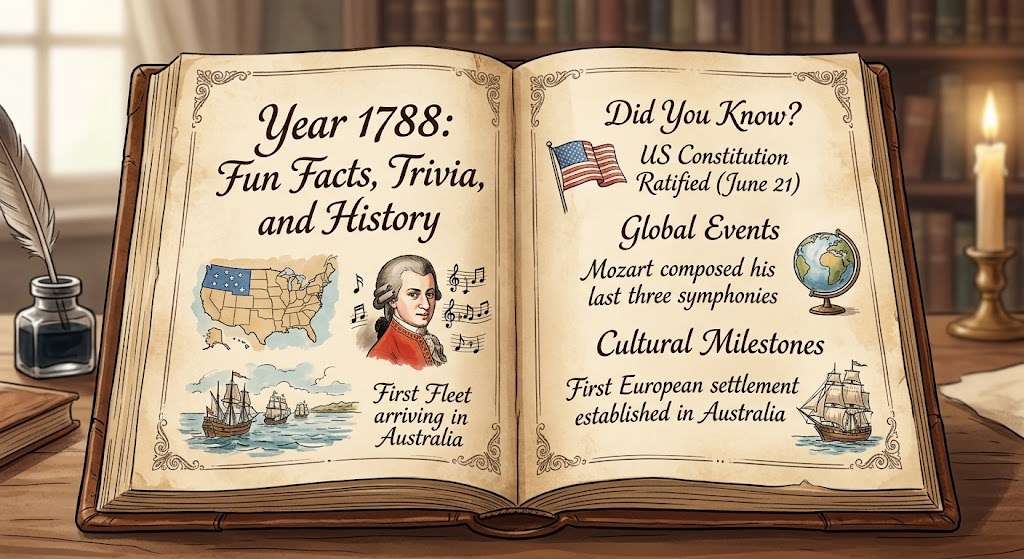
This quick read presents a mix of fun facts, trivia, and history events from the year 1788. Discover the year’s top news stories, most influential people, historic firsts, U.S. economic data, entertainment trivia, and much more.
Take a journey through history in just minutes.
In 1788, the United States Constitution, the Great New Orleans Fire, and The [London] Times were all center stage. Oatmeal porridge and cornmeal mush were American food staples, and John and Mary were two of the most popular baby names. In 1788 as well, salt pork cost about eight cents a pound, oats were around 33 cents a bushel, and coffee was 25 cents to 33 cents a pound.
Inflation rate: -4.30%
Consumer price index (CPI): 8.900
$100.00 in 1788 is equivalent in purchasing power to about $3,751.89 today. The U.S. dollar had “an average inflation rate of 1.53% per year” between 1788 and 2026, “producing a cumulative price increase of 3,651.89%.” In other words, a U.S. dollar today buys about 2.665% of what it could purchase back in 1788.
It’s worth noting that the U.S. dollar has lost about 97% of its value since 1788.
In 1788, there were 11 U.S. states. In order of admission to the Union, they were Delaware (1787), Pennsylvania (1787), New Jersey (1787), Georgia (1788), Connecticut (1788), Massachusetts (1788), Maryland (1788), South Carolina (1788), New Hampshire (1788), Virginia (1788), and New York (1788).
American companies established in 1788 included Gray’s General Store, located on Main Street in Adamsville, Rhode Island. It operated for nearly 225 years and is believed to be “the oldest continually operating general store in the United States.”
Farmers accounted for over 90% of the U.S. labor force.
On January 1, Quakers in Pennsylvania emancipated their enslaved people.
On January 1, the London newspaper, The Daily Universal Register, was renamed The Times.
On January 2, Georgia became the fourth state to ratify the U.S. Constitution.
On January 9, Connecticut became the fifth state to ratify the U.S. Constitution.
On January 26, Captain Arthur Phillip guided a fleet of 11 British ships carrying about 1,000 people “to the colony of New South Wales, effectively founding Australia.”
On February 6, Massachusetts became the sixth state to ratify the U.S. Constitution.
On March 21, which was also Good Friday, the Great New Orleans Fire of 1788 destroyed 856 structures in the city's French Quarter. The fire began at around 1:30 PM “at the home of Spanish Army Treasurer Don Vicente José Núñez (619 Chartres Street) from unattended taper candles.”
On April 7, Marietta, Ohio, was founded, which is believed to be the first settlement in Ohio.
On April 28, Maryland became the seventh state to ratify the U.S. Constitution.
On May 23, South Carolina became the eighth state to ratify the U.S. Constitution.
On June 21, New Hampshire became the ninth state to ratify the U.S. Constitution.
On June 25, Virginia became the 10th state to ratify the U.S. Constitution.
On July 4, the Grand Federal Procession took place in Philadelphia. The celebration lasted for three hours and stretched from Third and South Streets in the modern-day Queen Village neighborhood to Bush Hill in North Philadelphia, making it “the largest civic event in America at that time.” An estimated 5,000 marchers and 17,000 spectators participated.
On July 26, New York became the 11th state to ratify the U.S. Constitution.
On September 22, land speculators Mathias Denman and Colonel Robert Patterson and surveyor John Filson founded Cincinnati, Ohio.
On October 24, Sarah Josepha Hale was born in Newport, New Hampshire. She was an author (Ladies' Magazine and Godey's Lady's Book) and was also influential in having Thanksgiving declared a national holiday.
On December 23, the Maryland legislature voted to cede 10 square miles to establish the District of Columbia.
Key fiction books published in 1788 included Charlotte Turner Smith’s Emmeline and Mary Wollstonecraft’s Mary: A Fiction.
In 1788, Immanuel Kant’s Critique of Practical Reason was a groundbreaking non-fiction work.
Noteworthy dramatic works in 1788 included Frances Brooke’s Marian and John O'Keeffe’s Aladdin.
Famous people born in 1788 were Johann Peter Pixis (German pianist) and Lord Byron (British poet).
Famous and infamous people who died in 1788 included Charles Wesley (British religious leader) and William Brodie (British cabinetmaker and criminal who lived a double life).
In 1788 as well, the words “alleyway,” “ammonia,” “apple cart,” “aroma,” “baby talk,” “bullfight,” “democrat,” “hulled corn,” “hydrogen,” “immigrant,” “Jane Roe,” “legislative branch,” “mail carrier,” “mud pie,” “newsdealer,” “overeducated,” “oxygen,” “Philadelphia lawyer,” “policeman,” “prayer wheel,” “prospective,” “puff pastry,” “savoir faire,” “strong-minded,” “sulfate,” “sulfite,” “sulfuric,” “sulfuric acid,” “supersaturated,” “thumbscrew,” “waffle iron,” and “widowerhood” all appeared in print for the first time.
Beef: About $2.00 to $3.00 per 100 pounds
Chicken: Around 12 cents each
Coffee: About 25 cents to 33 cents per pound
Corn: Around 50 cents per bushel
Flour: About $5.00 per barrel
Oats: Around 33 cents per bushel
Salt Pork: About eight cents per pound
Turkey: Around 50 cents each
Wheat: About $1.00 to $1.25 per bushel
References:
https://en.wikipedia.org/wiki/Category:American_companies_established_in_1788
https://www.foodreference.com/html/html/food-timeline-1785-1789.html
https://en.wikipedia.org/wiki/List_of_U.S._states_by_date_of_admission_to_the_Union
Disclaimer: In writing and editing this article, Gregory DeVictor has made every effort to ensure historical accuracy and not to mislead his audience. In addition, the contents of this article, including text, graphics, and captions, are for general informational purposes only.
© 2026 Gregory DeVictor
About the Creator
Gregory DeVictor
Gregory DeVictor is a trivia enthusiast who likes to write articles about American history and nostalgia. Each of his articles presents a mix of fun facts, trivia, and historic events about a specific calendar year, decade, or century.
Enjoyed the story? Support the Creator.
Subscribe for free to receive all their stories in your feed.
Comments